
Case File: Why Mercedes-Benz Dropped Drive Pilot From the New S-Class and EQS — and What the L2++/L4 Pivot Means for Industrial Buyers
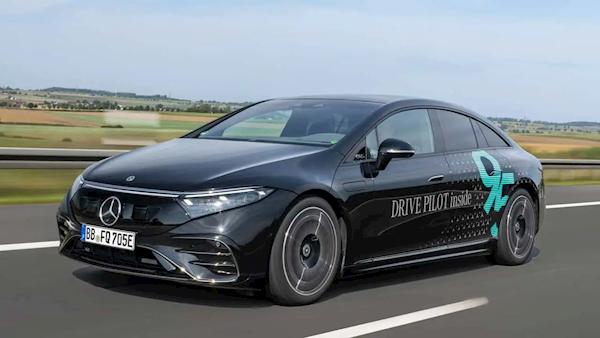
Mercedes-Benz removed Drive Pilot, the first production L3 system ever cleared for legal road use, from the new S-Class and from the updated EQS because a narrow operating envelope (top speed capped at 64 km/h in congested highway traffic), a fully redundant hardware bill and a manufacturer-side liability chain never generated enough customer usage to pay for itself. The replacement is L2++ MB.DRIVE ASSIST PRO, which hands responsibility back to the driver, while Level 4 work moves into a robotaxi programme with Momenta. This case file reads the decision as cost and engineering evidence.
Case timeline: how a world-first L3 approval ended as a cancelled option
Conclusion first: the system worked, and it was still withdrawn. Approval, not capability, was the starting point — in late 2021 the German Federal Motor Transport Authority cleared Drive Pilot as the world's first legally usable mass-production L3 system, and in 2023 the programme extended into the US states of Nevada and California.
With the system active, the driver may take hands and eyes off the road, watching video or playing games, and if a crash occurs Mercedes-Benz carries full responsibility. Underneath that headline experience sat a very tight operating design domain: a maximum speed of only 64 km/h, congested motorway sections only, clear daytime weather only, and only where high-definition map coverage exists. In practice the car was cleverest in stop-and-go creep and least useful once traffic started flowing.
Demand followed the operating envelope downward. Even so, the option list in Germany ran to EUR 5,000 to EUR 9,000, while the US model was a USD 2,500 annual subscription. Low usage plus low frequency is what broke the business case: the new S-Class launched in January this year no longer offers Drive Pilot, and the refreshed EQS drops it as well.
Why did the L3 economics break for Mercedes-Benz and for everyone else who tried it?
Three cost lines explain the retreat, and all three are manufacturing problems before they are software problems.
- Redundancy is a bill of materials, not a feature. Mercedes-Benz's own engineering documentation describes the redundant architecture behind Drive Pilot as resting on four core elements: braking, steering, power supply and part of the sensor set. Duplicating actuators and power domains to satisfy an unconditional fallback changes supplier scope, assembly variants and warranty modelling for every unit built.
- Regulation stopped being the bottleneck. UN Regulation No. 157, the international rulebook for Level 3 automated lane keeping, entered force in early 2021 with a 60 km/h ceiling and was amended in June 2022 to allow speeds up to 130 km/h under defined conditions. The rulebook moved; the commercial product did not follow, because proof of safety and liability attribution — not permission — remained the binding constraint. The same regulation also mandates driver monitoring and an automated data recorder, which is why accident attribution across OEM, supplier and driver is becoming a data-engineering task.
- The halo-customer base is too thin. The German-market comparison is instructive: BMW sold Personal Pilot L3 on the 7 Series for EUR 6,000 from 2024, and in February 2026 electrive reported that BMW, following Mercedes-Benz, plans to discontinue the system. Earlier, Honda's Legend was the first vehicle type-approved for Level 3 in Japan (approval in November 2020, lease-only launch on 5 March 2021 in a run of 100 units), and nippon.com records that sales ended in January 2022. Every first-generation L3 programme has run the same script: narrow access, low take-rate, early exit.
What replaces Drive Pilot, and what changes for the person in the driver's seat?
The successor is MB.DRIVE ASSIST PRO, an L2++ driver-assistance package rated for assist from start point to destination. It performs lane changes, negotiates intersections and reacts to traffic lights on both motorway and urban roads. The new S-Class carries up to 27 sensors for this system: 10 cameras, 5 millimeter-wave radars and 12 ultrasonic sensors, feeding a 254 TOPS compute platform.
The catch is contractual, not technical. Because the package remains L2 assistance, the driver must keep hands on the steering wheel and eyes on the road, and responsibility stays with the driver. Rollout reverses the usual order for this industry: the system reached the market in China first, before the US and Europe. German and US trade reporting adds that Stuttgart and Munich are targeted for the urban assist function by the end of 2026; treat those dates as company reporting, since the verified baseline here is the deployment sequence above.
| Dimension | Drive Pilot (L3) | MB.DRIVE ASSIST PRO (L2++) | S-Class L4 robotaxi track |
|---|---|---|---|
| Driver engagement | Hands-off, eyes-off when active | Hands on wheel, eyes on road | No safety driver in the target service |
| Operating envelope | Congested motorway, up to 64 km/h, daytime, mapped areas | Start-to-destination, motorway plus urban | Defined city service area, prototype stage |
| Liability while active | Mercedes-Benz bears it | Driver bears it | Operator and OEM framework, being tested |
| Customer economics | EUR 5,000 to EUR 9,000 option in Germany; USD 2,500 per year in the US | Priced as an assistance package for a mass customer base | Service revenue, not vehicle margin |
| Status | Withdrawn from new S-Class and updated EQS | In market, China first, then US and Europe | Public-road testing in Abu Dhabi |
Why skipping L3 for L4 is an industrial decision, not just a technology call
Mercedes-Benz is now trying to leapfrog the disputed middle level. The company is working with Momenta and running Level 4 Robotaxi public-road testing in Abu Dhabi with S-Class prototype vehicles — a deployment that pairs a vehicle manufacturer, a perception stack and a local mobility operator, which is how robotaxi programmes are being industrialised across the sector, as the parallel case of Waymo and Toyota moving robotaxi integration onto the assembly line illustrates.
Burzer, the company's chief technology officer, expects L4 vehicles to reach series production only after 2030, followed by step-by-step rollout. For planners, that timing is the point: capital released from customer-billed L3 hardware and liability reserves is being redirected into validated L4 architecture and fleet operation. Mercedes-Benz's own robotaxi programme page lists the first S-Class robotaxi test vehicles for Abu Dhabi roads during this year, which compresses the learning cycle into operating cities rather than into consumer vehicle lines. The same sensor-plus-software logic is being staged first on commercial vehicles, where duty cycles are measurable, as Daimler Truck's next-generation safety rollout shows.
On the supply side, the pivot does not shrink electronics content. Yole Group projects in its ADAS market analysis that the global market for ADAS sensors and electronic control units will grow to more than USD 66 billion by 2031, with value shifting from hardware units toward software. Our reading of that number: an L2++ car carrying 27 sensors and 254 TOPS of compute is a richer bill of materials than the premium L3 halo model was a few years ago, so component suppliers are re-routing volume rather than losing it.
Common misconceptions from this case
- "The technology failed." It performed: hands-off, eyes-off driving with OEM liability. What failed was the usage rate inside a 64 km/h, map-covered, congestion-only envelope.
- "Dropping L3 means downgrading the car." The replacement adds sensor count, compute and urban capability; what was removed is the liability transfer.
- "Mercedes-Benz has left autonomy." The company moved the same capability question into an L4 robotaxi programme with Momenta, tested on public roads in Abu Dhabi.
- "Regulation was the wall." UN R157 had already been amended to 130 km/h, so the wall sat in validation cost and responsibility assignment.
Action recommendations for plant, procurement and product teams
- Cost automation levels as contracts. Price the liability transfer explicitly: who owns the accident, who owns the data, and who funds the fallback — those answers decide whether redundancy becomes a BOM line item or an insurance reserve.
- Quote redundancy to suppliers, not adjectives. Specify duplicated steering, braking and power domains with part numbers and assembly variants; the Mercedes-Benz redundancy pattern (braking, steering, power supply, partial sensor duplication) is the reference architecture buyers should ask Tier-1s to price.
- Design one electrical/electronic spine for two duty cycles. The new S-Class shows that a production assistance car and an L4 testbed can share sensing and compute; running parallel architectures this way is what strains plants and supplier coordination.
- Buy the data chain early. Driver-monitoring and event-recording requirements under UN R157 make traceability a procurement item, since insurers and regulators will read the vehicle's own logs.
- Pilot autonomy as a service in dense operating cities first. Abu Dhabi's robotaxi model — defined area, known duty cycle, measurable utilisation — validates a platform more cheaply than asking retail customers to pay EUR 5,000 to EUR 9,000 for a feature they use rarely.
Frequently asked questions
Is Drive Pilot still available on Mercedes-Benz vehicles?
Not on the current generation: the new S-Class, launched in January this year, no longer offers Drive Pilot, and the updated EQS drops it too. The approval history stands — German Federal Motor Transport Authority clearance in late 2021, Nevada and California entry in 2023.
What does the new S-Class offer instead?
MB.DRIVE ASSIST PRO, an L2++ package with start-to-destination assist, lane changes, intersection handling and traffic-light response, supported by up to 27 sensors (10 cameras, 5 millimeter-wave radars, 12 ultrasonic sensors) and 254 TOPS of compute.
Can the driver legally look away under L2++?
No. L2++ remains assistance: hands on the wheel, eyes on the road, and responsibility stays with the driver, which is the core difference from the withdrawn L3 setup in which Mercedes-Benz accepted liability.
Why is L3 commercially hard even for engineers?
Because unconditional fallback demands duplicated actuators, power and sensing plus certification evidence, while the usable speed window stays small. Honda's 100-unit Legend and BMW's EUR 6,000 Personal Pilot L3 both ended, or are ending, for the same reason.
When will Mercedes-Benz sell an L4 vehicle?
CTO Burzer expects L4 models to reach production after 2030, with staged rollout; the near-term proof point is L4 Robotaxi public-road testing with Momenta in Abu Dhabi.
References
- UNECE, "UN Regulation extends automated driving up to 130 km/h under certain conditions" — https://unece.org/sustainable-development/press/un-regulation-extends-automated-driving-130-kmh-certain-conditions
- Mercedes-Benz Group, "Redundancy for safe conditionally automated driving" — https://group.mercedes-benz.com/technology/autonomous-driving/driving/redundancy-drive-pilot.html
- Mercedes-Benz Group, "Future robotaxi ecosystem" — https://group.mercedes-benz.com/technology/autonomous-driving/driving/robotaxi-ecosystem.html
- Yole Group, "From sensors to software: ADAS market accelerates toward USD 66 billion" — https://www.yolegroup.com/press-release/from-sensors-to-software-adas-market-accelerates-toward-66-billion/
- electrive, "Following Mercedes, BMW also abandons Level 3 automated driving" (February 2026) — https://www.electrive.com/2026-02-23/following-mercedes-bmw-also-abandons-level-3-automated-driving/
- nippon.com, "Toward a Self-Driving Future: Japan Green-Lights Level 4 Autonomous Vehicles" — https://www.nippon.com/en/in-depth/d00917/toward-a-self-driving-future-japan-green-lights-level-4-autonomous-vehicles.html
- WardsAuto, "Mercedes-Benz shifts autonomous driving tech in 2026 S-Class" — https://www.wardsauto.com/news/mercedes-benz-shifts-autonomous-driving-tech-in-2026-s-class/811431/