
From Crash Protection to Crash Prediction: Daimler's Next-Generation Truck Safety Rollout and What It Means for Fleet Operations
By Michael Torres | WorldIndustrialWeekly — For the people who own uptime, the definition of a good safety system has quietly changed. The question is no longer only how well a cab protects its occupant once steel has already met steel; it is how many collisions never happen at all. Every avoided impact is a truck that stays on its route, a trailer that stays in service, a driver who stays at work, and a legal and compensation file that never gets opened. That operational arithmetic, not just the engineering, is what makes the next-generation driver-assistance package Daimler Trucks presented recently for the European and North American markets a topic for plant managers, procurement leads and transport directors.
The company's approach combines radar, cameras and considerably more advanced software so that professional drivers identify hazards earlier, and so the vehicle itself can intervene automatically when a situation develops faster than a human can respond. For Europe, Daimler announced Active Cross Traffic Assist, Active Sideguard Assist 3 and an upgraded Active Drive Assist. These technologies will be applied to Mercedes-Benz Actros and Arocs trucks as well as Mercedes-Benz and Setra long-distance coaches, with market launch planned from April 2027.
On the other side of the Atlantic, Daimler Trucks North America is moving toward the same objective through a different product path: safety upgrades for the 2027 model year Freightliner Cascadia and Western Star X series, anchored on an enhanced version of the Detroit Assurance Suite, whose headline item is the upgraded Active Brake Assist 6, or ABA6.
Two regions, one design brief: act before the impact
Although the systems are named differently and their specific functions vary between Europe and North America, the overall goal is identical: stronger perception plus automatic intervention, so the professional driver can react before a hazard matures into a crash.
Case file: what happened at the Oregon proving ground
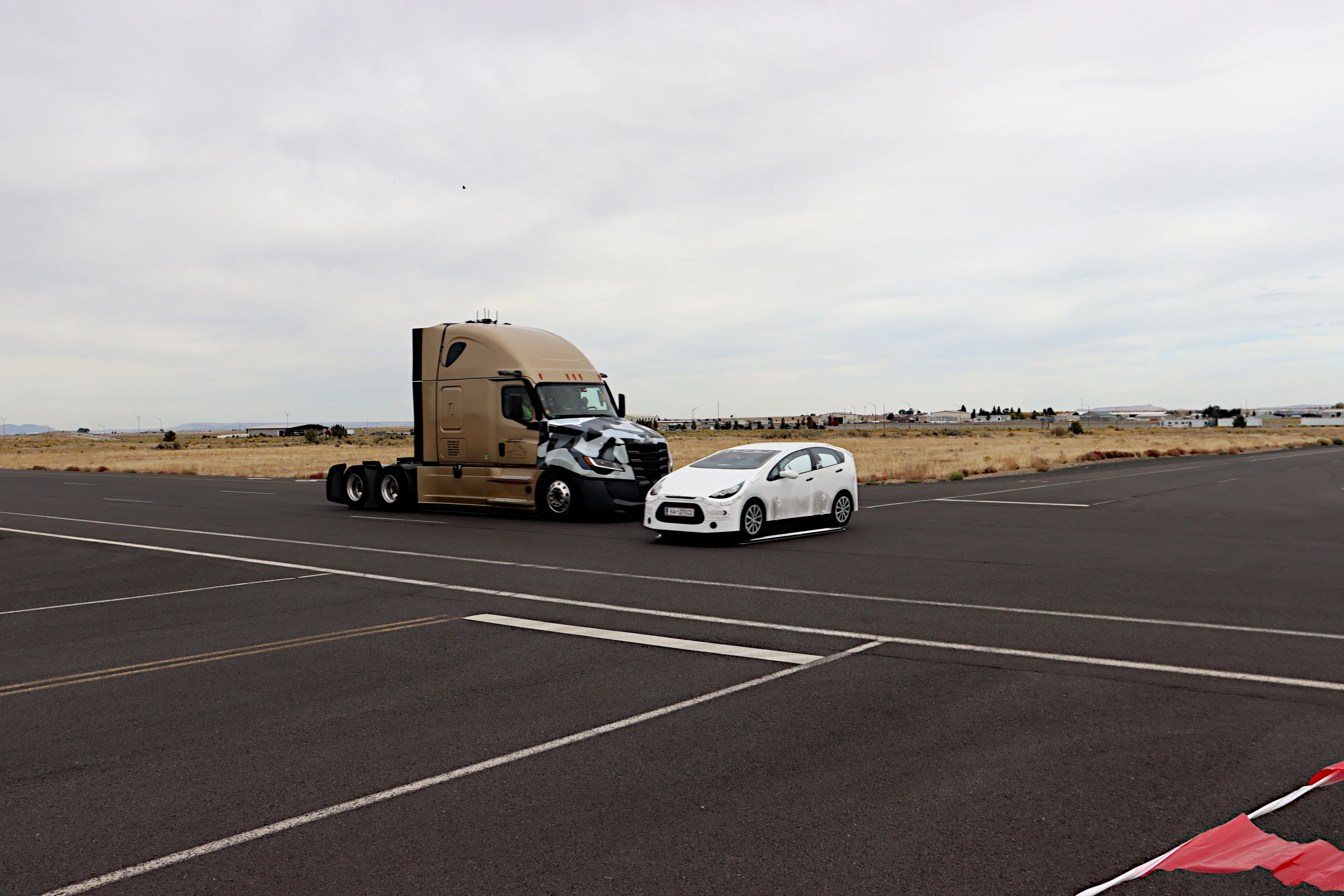
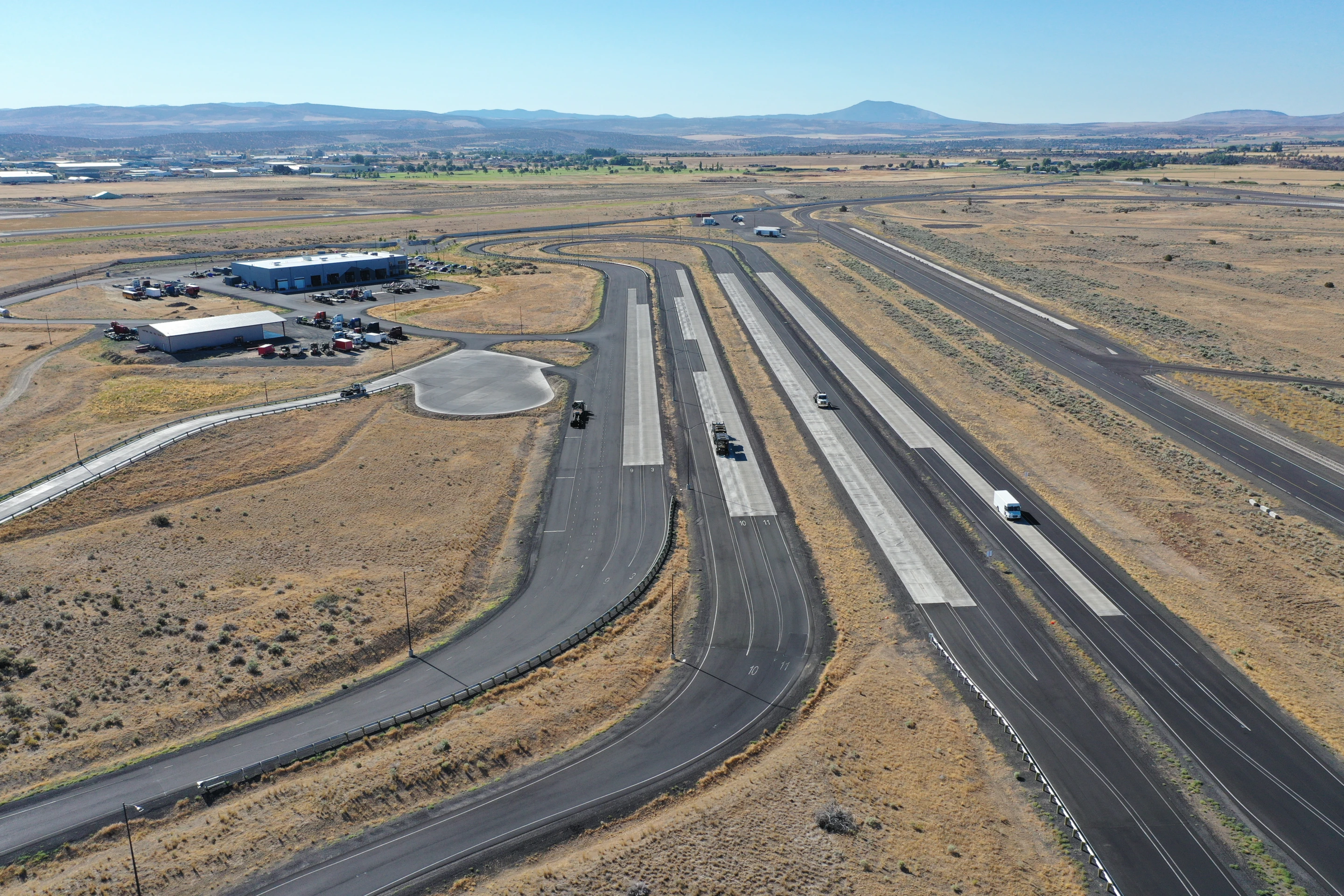
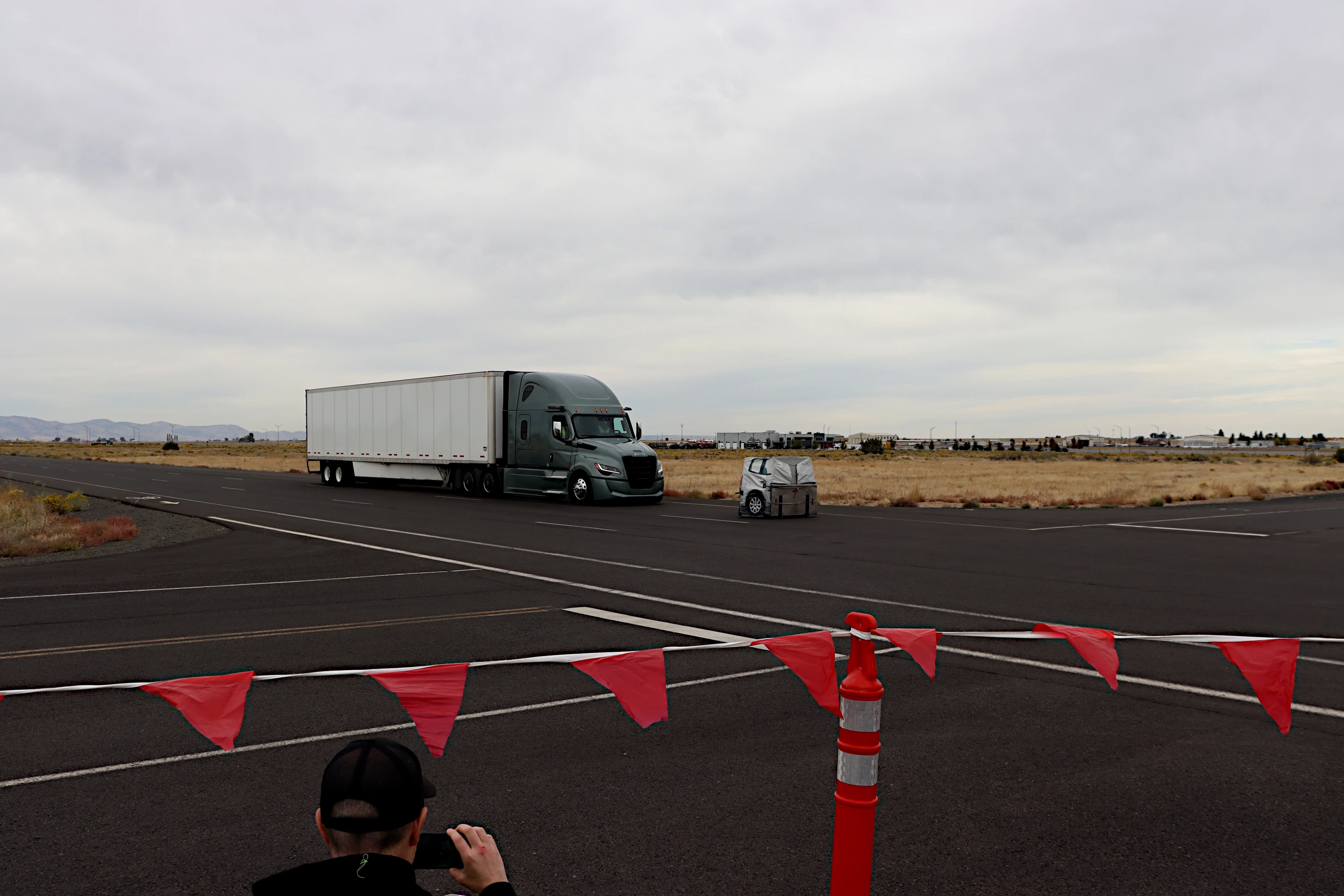
Media were invited to Daimler's test facility in Oregon, United States, to ride in a Cascadia fitted with the latest safety systems. During the demonstrations, several remote-controlled surrogate targets appeared abruptly ahead of the truck or drove into its path. The system identified the risk in time and either warned the driver or applied braking automatically, avoiding collisions and reducing the consequences of impacts.
For North America specifically, Daimler published the fifth-generation Freightliner Cascadia's new safety equipment in April 2026: ABA6, Cross Traffic Assist, and Active Sideguard Assist 2 with left-turn protection. Ordering for the relevant models is expected to open in the third quarter of 2026, with production beginning in January 2027.
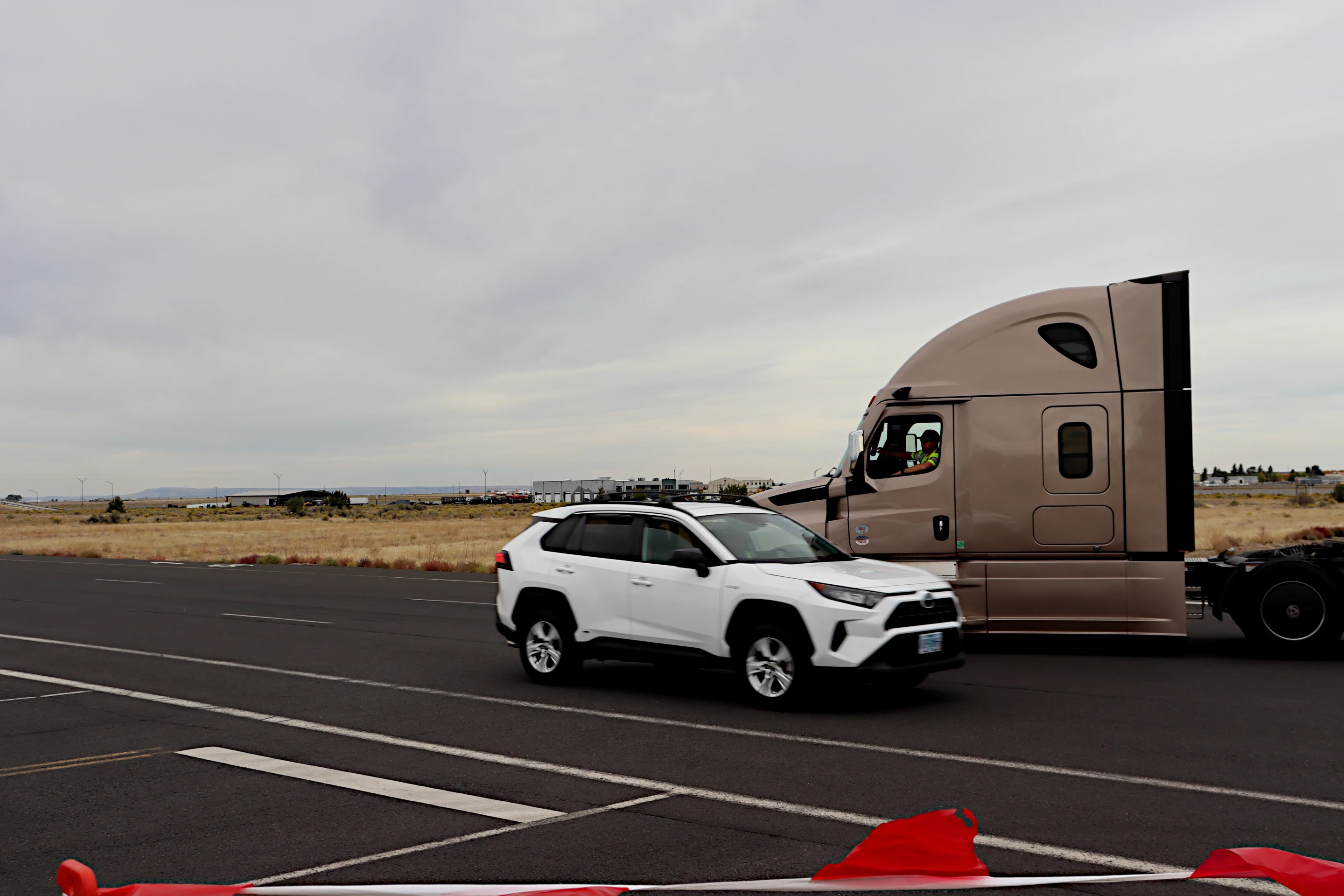
In one scenario, a simulated sedan crossed suddenly in front of the heavy truck. On the first attempt the vehicle avoided the collision entirely; on the second attempt there was minor contact, but the severity of the impact was greatly reduced. At the speeds used in the demonstration, a small car would very likely have suffered a catastrophic strike had no active intervention occurred. In another test, a surrogate vehicle turned left abruptly into the space ahead of the truck, and the system again prevented the accident.
Daimler disclosed the parameters behind those runs: the test vehicle was hauling a trailer loaded to about 30,000 lb (about 13,608 kg), and most demonstrations took place at 40 to 55 mph (about 64 to 89 km/h). The company stresses that these systems do not guarantee a heavy truck will come to a complete stop in every situation. Their core purpose is to warn as early as possible and, when a collision cannot be fully avoided, to cut impact energy and damage so that lives are saved.
Why the two regions are not mirror images
Heavy-truck operating environments in Europe and the United States differ markedly — vehicle weights, travel speeds, road conditions and regulatory requirements are not the same. The two regions therefore share a philosophy but not a parts list: Europe receives Active Sideguard Assist 3, while North America gets a Detroit Assurance solution customized to local needs.
| Dimension | Europe | North America | |
|---|---|---|---|
| Key additions | Active Cross Traffic Assist; Active Sideguard Assist 3; upgraded Active Drive Assist | Enhanced Detroit Assurance Suite with ABA6; Cross Traffic Assist; Active Sideguard Assist 2 with left-turn protection | |
| Applied vehicles | Mercedes-Benz Actros and Arocs trucks; Mercedes-Benz and Setra coaches | Fifth-generation Freightliner Cascadia; Western Star X series | |
| Timeline disclosed | Market launch planned from April 2027 | Announced April 2026; ordering in the third quarter of 2026; production from January 2027 | |
| Shared objective | Earlier hazard detection and automatic intervention so professional drivers respond before a hazard becomes a collision | ||
Inside the functions
Cross traffic assist: watching the road you have not looked at yet
The new cross traffic assist monitors vehicles crossing an intersection laterally. When the system judges that a potential collision risk exists, it issues visual and audible alerts; if the danger escalates, it can perform partial braking or even full automatic braking. Daimler says the function is aimed at the complex environment large commercial vehicles face at junctions, where a driver must track traffic from multiple directions, pedestrians and other road users simultaneously, while the vehicle's own size makes judgment considerably harder.
Sensor fusion and staged braking
Using sensor fusion, the system recognizes cars and motorcycles rapidly approaching across the vehicle's path. When a collision risk appears it issues a warning; when the situation becomes critical it triggers a graduated braking sequence that can end in automatic emergency braking.
Daimler's reasoning is blunt: driver warnings alone are not enough to prevent every accident. Even an experienced driver can misjudge a fast-approaching vehicle inside a very short time window. Automatic braking therefore functions as an additional safety layer, taking over part of the operation when human reaction speed falls short.
According to the company, the system does not merely identify cars; it has been specifically optimized for motorcycles approaching at high speed. The North American team is currently developing further improvements to recognition of bicycles and pedestrians.
Sideguard assist and the turning problem
Active Sideguard Assist 2 concentrates on turning scenarios. In addition to monitoring blind-spot risk on the vehicle's right side, it can identify oncoming traffic that may conflict with the truck's trajectory when the driver activates the left turn indicator, lowering the probability of turning accidents.
ABA6: a wider perimeter and harder targets
Beyond junctions and turning maneuvers, ABA6 lifts overall collision-mitigation capability. Its perception network is built from four short-range radars, one long-range radar and a multifunction camera, achieving monitoring across roughly 270 degrees and covering the area around a standard 53 ft (about 16.15 m) trailer.
The system recognizes moving and stationary vehicles, pedestrians and riders, and expands the scenarios in which automatic braking applies. Examples include a stationary vehicle hidden around a curve, vehicles parked across several lanes, or a broken-down vehicle left at an abnormal angle at an accident scene.
Those are precisely the situations most likely to produce severe accidents, Daimler points out: approaching a curve or an incident leaves a driver very little time, so higher-level target recognition becomes essential. ABA6 is intended to improve detection efficiency in these special cases and, when necessary, to warn and brake.
Assistance and driver monitoring
Active Lane Assist 2 helps keep a vehicle traveling in the center of its lane and corrects unintentional lane departures; its steering assist also provides extra support in crosswinds or during low-speed operation.
Another function drawing attention is Attentive Driver Protection. If the system determines that the driver has lost responsiveness, the vehicle can decelerate to a stop automatically while staying as close to the lane center as possible and activating the hazard warning lights, reducing the risk of loss of control.
Daimler nonetheless emphasizes that these technologies cannot replace driver rest, health management or reasonable operational scheduling. System performance remains subject to weather conditions, sensor state, vehicle configuration and driver attention.
In real test rides the lane-keeping experience resembled that of many modern passenger cars. The system cannot maintain 100 percent precise centering, but it noticeably eases the fatigue of controlling a heavy truck over long periods. It also continuously monitors whether the driver's hands are on the wheel and issues reminders when required.
Figures worth recording
- Trailer load in the demonstrations: about 30,000 lb (about 13,608 kg).
- Demonstration speeds: mostly 40 to 55 mph (about 64 to 89 km/h).
- ABA6 sensing hardware: four short-range radars, one long-range radar, plus a multifunction camera.
- Monitoring coverage: approximately 270 degrees, extending around a standard 53 ft (about 16.15 m) trailer.
- European rollout: Mercedes-Benz Actros and Arocs, plus Mercedes-Benz and Setra coaches, from April 2027.
- North American rollout: announced April 2026, ordering in the third quarter of 2026, production from January 2027.
Common misconceptions
- "Automatic braking means a loaded truck will always stop in time." Daimler explicitly states the systems do not guarantee a complete stop in every situation; the goal is earlier warning and reduced impact energy when avoidance is impossible.
- "The European and North American trucks run the same software." The two regions share a concept but not a copy: weight, speed, road and regulatory conditions differ, hence Active Sideguard Assist 3 in Europe versus a tailored Detroit Assurance package in North America.
- "A warning to the driver is sufficient." Even experienced drivers can misjudge rapidly closing vehicles within a very short interval, which is why graduated automatic braking is layered on top of alerts.
- "Assistance removes the need for driver rest and scheduling discipline." The vendor itself notes these systems cannot substitute for rest, health management and reasonable scheduling.
- "Sensors perform the same in all conditions." Weather, sensor state, vehicle configuration and driver attention all bound system performance.
- "Lane assist holds the truck perfectly centered." In the demonstration it reduced workload but did not achieve 100 percent precision.
Action recommendations for industrial and transport managers
- Align procurement calendars with the disclosed windows: the fifth-generation Freightliner Cascadia order period opening in the third quarter of 2026 and January 2027 production, against the April 2027 European market launch for Actros, Arocs and the coach lines.
- Rebuild driver training around the idea that warnings are one layer, not the whole defense; reinforce that automatic intervention exists to compensate for the limits of human reaction time.
- Revise vehicle specifications and tender checklists to state the required perception set — radar count and type, camera, coverage angle and the standard 53 ft (about 16.15 m) trailer coverage relevant to your operations.
- Add sensor condition to pre-trip and maintenance routines, since performance depends on sensor state, vehicle configuration and weather.
- Review urban and mixed-traffic routes with special attention to motorcycles, bicycles and pedestrians, and track the announced development work on bicycle and pedestrian recognition before committing to a fleet-wide expectation.
- Do not relax the fundamentals: keep safe following distance, control speed, check mirrors, and respect the large dimensions and wide turning radius of heavy vehicles.
- Keep rest, health management and scheduling policies unchanged as primary controls; treat assistance systems as supplements rather than replacements.
- Quantify the business case internally in terms of fewer collisions, less equipment damage, shorter transport interruptions and lower exposure to compensation claims.
FAQ
Is the objective of these systems to eliminate collisions entirely?
No. The stated aim is earlier hazard detection and, when a crash cannot be fully avoided, lower impact energy and damage, thereby reducing the consequences of serious accidents.
Do the European and North American vehicles use the same configuration?
No. Naming and functions differ because vehicle weight, speed, road conditions and regulations differ; Europe gets Active Sideguard Assist 3, while North America receives a locally customized Detroit Assurance solution.
Which target types can the upgraded cross-traffic function recognize?
Cars and motorcycles rapidly approaching and crossing the vehicle's path, with recognition optimized for fast-approaching motorcycles; work to strengthen bicycle and pedestrian detection is under development by the North American team.
What does ABA6 add over earlier collision mitigation?
A perception network of four short-range radars, one long-range radar and a multifunction camera giving roughly 270 degrees of coverage around the truck and a standard 53 ft (about 16.15 m) trailer, plus broader braking scenarios such as vehicles behind a curve or parked at abnormal angles.
Does lane keeping fully replace driver input?
No. The demonstration showed meaningful fatigue relief but not 100 percent centering, and the driver remains monitored for hands-on-wheel presence.
The operational takeaway
The heavy-truck sector is passing through a decisive stage: protection after an impact is giving way to perception, prediction and intervention before one. For buyers and operators, that transition changes what a specification sheet should ask for and what a training program should drill, without changing who is accountable on the road. Sensor limits, electronic boundaries and the fact that no technology can prevent every accident all remain true, which is why following distance, speed control, mirror checks and respect for vehicle dimensions stay on the checklist.
The most useful safety technology, in the manufacturer's own framing, is the kind a driver never consciously notices — the intervention that resolves a hazard while nobody is looking. Each such event that succeeds shortens vehicle downtime, protects drivers and other road users, and lifts the baseline of road safety across the whole transport network. Managers who treat the coming model-year changes as an operational program rather than a supplier feature list will be the ones who convert that capability into measurable results.
Editorial contact: news@industrialweekly.com — WorldIndustrialWeekly, Industrial Weekly.