
Planning a Continuous Polymer PBF Cell Around the Flight HT1002P-CAMS: Steps, Metrics and Traps
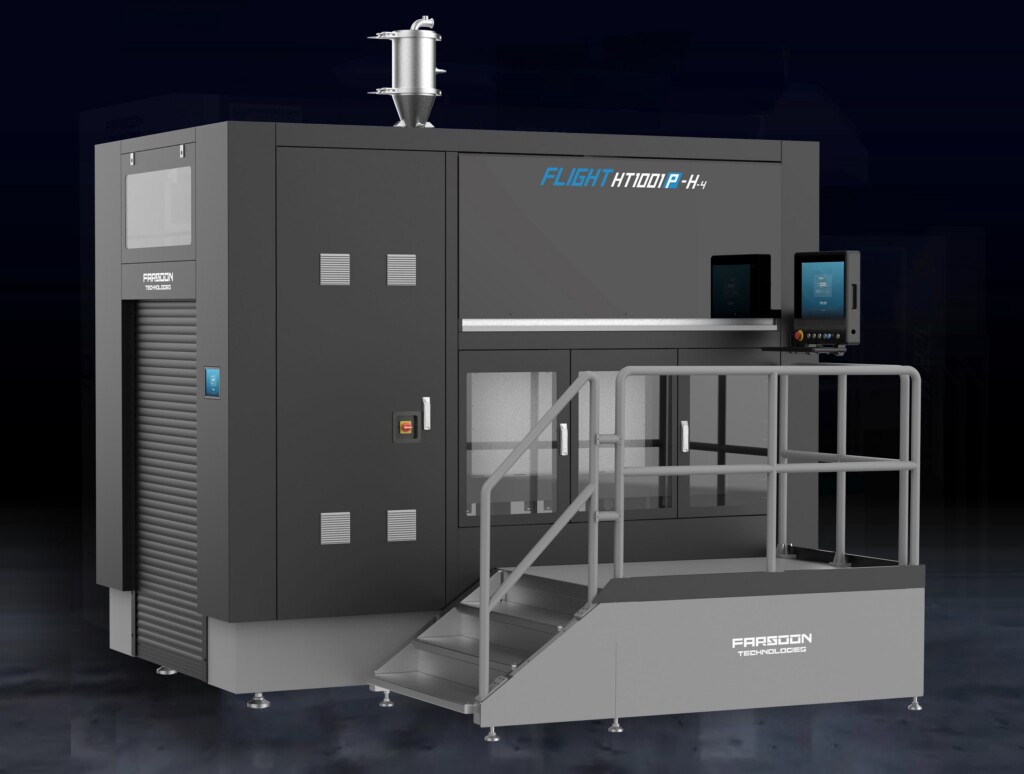
Polymer powder-bed production rarely stalls inside the chamber. It stalls in the queue in front of it: preheating, cooling, breakout and powder make-up. Vendor-side estimates from equipment builders put machine idle time between 30% and 50% of the clock on powder-bed platforms, because a finished build still needs hours of cooling and de-powdering before the next job starts. That idle window, not the beam, is what Farsoon Technologies is aiming at with the Flight HT1002P-CAMS, a 325-liter polymer powder bed fusion (PBF) machine that pairs four 300 W fiber lasers with a modular Continuous Additive Manufacturing Solution (CAMS) workflow. What follows is the planning order I would run before signing a purchase order.
What the HT1002P changes against the 1001 and 1001-H
Short answer: more geometry per build and less dead time between builds. The Flight HT1002P-CAMS is the newest evolution of the company's 1001 and 1001-H large-format platforms, and its specification sheet was shaped by feedback from users already running polymer additive manufacturing (AM) hardware in series production, aimed at process stability, material handling and equipment utilisation.
Three numbers define the envelope. The build volume of 1,000 × 500 × 650 mm gives 325 liters of space: the 1-meter axis carries elongated ducts, interior trim and long machine components as single pieces, while the 650 mm height leaves room for taller parts and denser nesting. On the beam side, the machine runs four 300 W fiber lasers with scanning speeds of up to 20 m/s, which is the core of Farsoon's Flight architecture — fiber laser sources instead of the carbon dioxide (CO₂) laser used on conventional selective laser sintering (SLS) systems. The chamber reaches a maximum of 220 °C, supported by multi-zone heating and infrared thermal monitoring.
Production Mode or Premium Mode: how to choose per part family
Decide by constraint, not by speed preference. If the binding constraint is output per week, run the overlapping field. If it is dimensional evidence for a qualification dossier, run one beam. The system provides two operating modes.
| Mode | Scanning approach | What it buys | Field trigger for choosing it |
|---|---|---|---|
| Production Mode | Overlapping multi-laser scanning fields | Higher build speed and output | Short leading time, nested batches, non-critical fixtures and ducting |
| Premium Mode | Single-laser scanning within a 335 × 550 mm working zone | Tighter process control and certification requirements | Parts entering a qualification path, tight tolerance faces, evidence for audit |
A practical habit on mixed cells: freeze one mode per part number, not per machine shift. Alternating modes build-to-build destroys comparability, and comparability is what makes per-part cost and first-pass yield credible in a business case.
Six steps to size the CAMS cell
- Baseline the non-print clock first. Log cartridge extraction, preheating, cooling, breakout, sieving and make-up ratios across 20 consecutive builds. Print time is only one line in that log; if cooling plus breakout exceeds the build window, the extra lasers buy nothing.
- Convert build time into station count. Preheating, building, cooling and breakout stations can be configured separately, and with exchangeable build cartridges, build preparation, cooling and part removal occur while printing continues. Planning arithmetic: number of support stations must at least cover the ratio of total non-print cycle to print cycle, rounded up. Treat that as a starting assumption, then refine it with your own logs.
- Pick the material-flow topology. The automated bidirectional conveyor loads and extracts build cartridges through electronic doors on both sides of the build station, so a through-feed layout is possible. Near-line option: multiple preheating and cooling units beside the printer. Cell option: connect units into centralised production cells using automated guided vehicles (AGV) or robotic arms. Decide now where the powder room sits, because that drives dust control, inerting and aisle width.
- Fix the powder loop and the sampling plan. Closed-loop powder supply and recycling is offered as an automation option, but the economics live in the refresh policy. Publish the make-up ratio, the number of reuse cycles allowed, and the mechanical tests taken at cycle 1, mid-life and end-of-life. Field research supports this: a 2024 study in the journal Additive Manufacturing ran polyamide 12 (PA12) at a 70:30 refresh ratio for seven build cycles with more than 200 hours of cumulative build and cooling exposure, and earlier review work describes typical used-powder shares of roughly 20% to 50% (ScienceDirect, MDPI Polymers).
- Validate the thermal envelope against the resin, not the datasheet. An updated multi-zone heating architecture and infrared thermal monitoring support temperature consistency across the large build area, and dynamic process adjustments plus cooling for optical assemblies are included. Material selection and operating temperatures should still be validated for the specific polymer grade and application: published sintering-window work shows PA12 behaviour changes sharply near 220 °C, where degradation accelerates (Virtual and Physical Prototyping, 2024).
- Instrument the cell before launch. Manufacturing execution system (MES) integration and remote monitoring are on the options list; without them there is no defensible record of utilisation or deviation. Automatic laser window changers matter only if your logs show optics downtime. Note the caveat in the release itself: available functions depend on the configured system and the customer's integration project.
Metrics worth putting on the cell board
| Metric | How to compute | Why it decides the case |
|---|---|---|
| Nested parts per build | Qualified parts ÷ builds shipped | The 1-meter axis and 650 mm height only pay off if nesting density rises |
| Non-print time share | Preheat + cool + breakout ÷ cell cycle | The single variable CAMS is designed to compress |
| Cell overall equipment effectiveness (OEE) | Printed hours ÷ available hours, at cell level | Printer-only OEE hides idle ovens and waiting carriages |
| Virgin make-up per shipped kilogram | New powder ÷ parts mass shipped | Material, not machine time, is often the largest recurring cost |
| First-pass yield | Parts passing inspection ÷ parts built | Separates throughput gains from rework gains |
| Cost per qualified part | All of the above, per part number | Actual output, material use and cost per qualified part depend on build loading, operating conditions and the validated workflow |
The multi-laser route to series production is not untested at Farsoon. In November 2025, Farsoon Europe and automotive supplier Brose commissioned an eight-laser FS721M-8-CAMS machine for automotive series production and showed a sample build at Formnext 2025 (Nov. 18-21), which is the metal-side precedent for continuous cartridge workflows (Metal AM Report, 16 November 2025). For the metal PBF comparison, including laser count and CAMS trade-offs, see our breakdown of eight-laser metal PBF with CAMS workflow.
Five traps in polymer PBF business cases
- Buying throughput and installing latency. More lasers shorten the print, which may already be the minority of the cycle. Size the support stations first.
- Reading a 220 °C ceiling as a material passport. Higher-melting grades, filled systems and high-temperature polymers need their own validation; the chamber maximum is a boundary condition, not a guarantee.
- Ignoring where the beams meet. Overlapping multi-laser scanning fields raise output, and thermal-deformation work on large, high-aspect-ratio parts built with multi-laser PBF reports added complexity in thermal management as laser count and part size grow (MDPI Journal of Experimental and Theoretical Applied Physics, 2026). Premium Mode's single-laser working zone is the mitigation the platform already ships with; use it for the parts that need evidence.
- Running a fixed refresh ratio without property data. Ageing is cumulative and heat-driven, so a constant ratio hides drift until a batch fails.
- Sizing the cell from the demo layout. The modular CAMS architecture adapts to different factory layouts and production requirements, which means the quotation you receive is one configuration among several. Confirm cartridge handling, conveyor length and door access against your building, not the brochure.
Rollout conditions: one printer, or a continuous cell?
- Demand is repeatable for a part family, so preheating and cooling stations stay fed. Batch-only work does not justify a conveyor.
- Someone owns qualification. Production Mode raises output, Premium Mode answers certification requirements; both need a documented owner.
- Powder logistics are staffed for two shifts, since the modular workflow is designed to reduce non-printing time only if stations are never waiting on people.
- Part consolidation is allowed by design and qualification requirements; the platform can raise the number of parts per build, which is where the 325-liter envelope earns its keep.
- Capex timing is checked against order-book data. If you are weighing this purchase against a moving demand picture, we separately unpacked what the October ISM print means for plant, procurement and capital spending decisions.
Frequently asked questions
What does the Flight HT1002P-CAMS actually print?
Long and nested polymer parts: a build envelope of 1,000 × 500 × 650 mm, that is 325 liters, with a 1-meter axis for automotive ducts, interior trim and machine components, and 650 mm of height for taller parts and denser nesting.
How many lasers, and how fast?
Four 300 W fiber lasers, scanning speeds of up to 20 m/s, and two modes: Production Mode with overlapping multi-laser fields, and Premium Mode with single-laser scanning inside a 335 × 550 mm working zone.
What does CAMS add over a standalone printer?
CAMS, the Continuous Additive Manufacturing Solution, is a modular workflow: an automated bidirectional conveyor moves build cartridges through electronic doors on both sides of the build station, while preheating, cooling and breakout run separately, so preparation and part removal happen while printing continues.
Can used powder go straight back into the machine?
Not blindly. Closed-loop powder supply and recycling keeps the loop tidy, but published PA12 work shows ageing accumulates with thermal exposure; set a tested refresh ratio and inspect properties across reuse cycles.
Is this enough for regulated series production?
The hardware addresses process stability, material handling and equipment utilisation, and Premium Mode targets certification requirements. Compliance still rests on your validated workflow, documented parameters and the MES or remote-monitoring configuration you buy.
References
- Farsoon Technologies product news, "Farsoon Unveils Flight HT1002P for series polymer production" — https://www.farsoon-gl.com/news/farsoon-unveils-flight-ht1002p-for-industrial-polymer-production/
- B. Sanders et al., Additive Manufacturing (2024), PA12 re-use at a 70:30 refresh ratio over seven build cycles — https://www.sciencedirect.com/science/article/pii/S2214860424000071
- B. Sanders et al., Polymers (MDPI, 2022), physical ageing and refresh-ratio ranges for used powder — https://www.mdpi.com/2073-4360/14/13/2682
- R. Vande Ryse et al., Virtual and Physical Prototyping (2024), PA12 stable sintering window and degradation — https://www.tandfonline.com/doi/full/10.1080/17452759.2023.2285414
- R. Raut & A. Basak, Journal of Experimental and Theoretical Applied Physics (MDPI, 2026), thermal deformation in multi-laser PBF — https://www.mdpi.com/2813-4648/4/1/6
- Metal AM Report (16 November 2025), Farsoon Europe and Brose on high-volume automotive production — https://www.metal-am.com/farsoon-and-brose-target-high-volume-automotive-production/
- Engineering.com, "Farsoon adds modular polymer PBF platform for production" — https://www.engineering.com/farsoon-adds-modular-polymer-PBF-platform-for-production/
Copyable framework, in one line each: measure the non-print clock → set station count from that clock → fix the topology (near-line or centralised cell) → publish the powder refresh policy → validate the thermal envelope per resin → instrument with MES and remote monitoring → then, and only then, judge the lasers. The machines in this class, starting with the Flight HT1002P-CAMS, are built around that order; a cell planned in any other order will show it in the utilisation numbers within a quarter.