
Farsoon FS722M Compared: Eight-Laser Metal PBF, CAMS Workflow and Production Trade-Offs
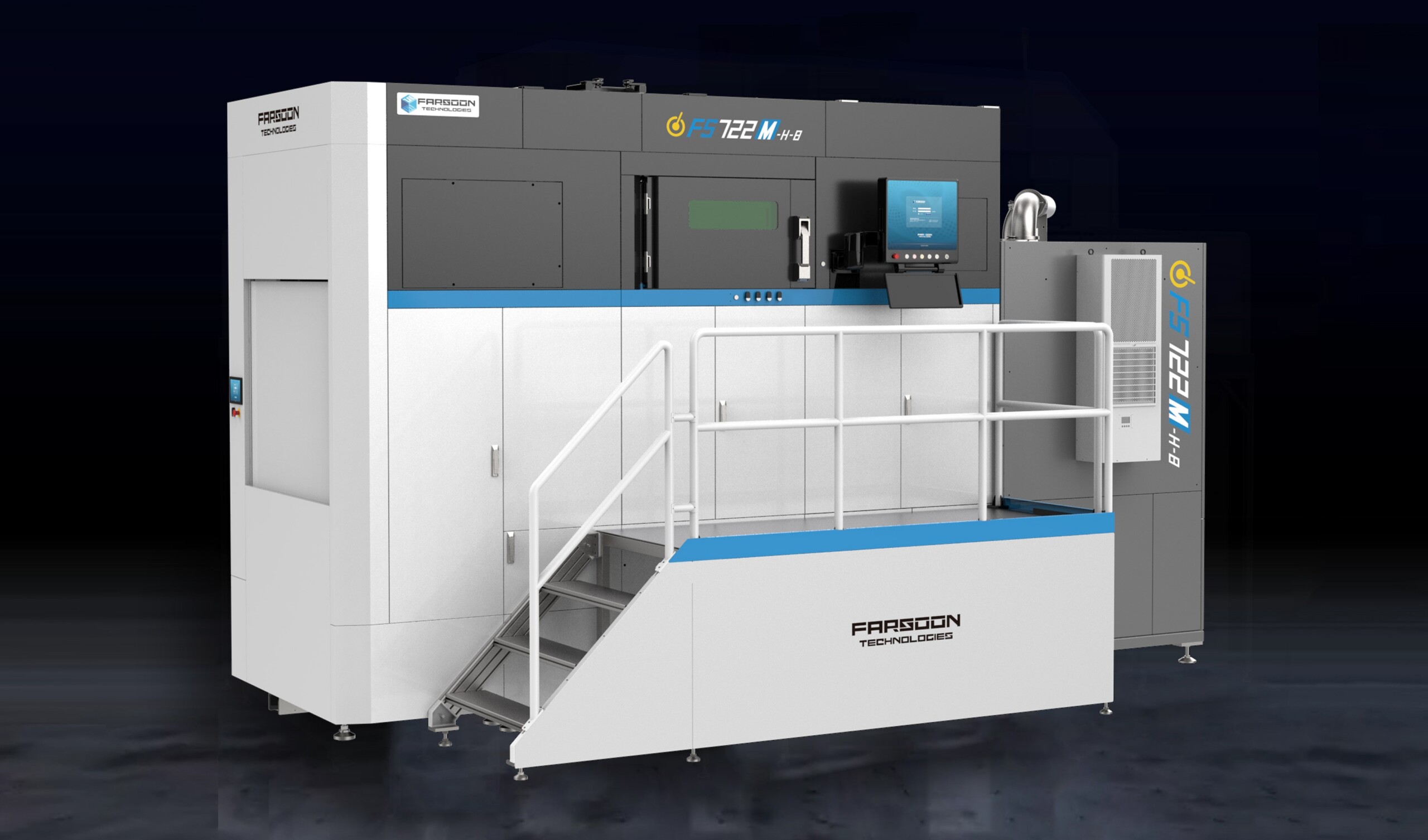
For teams comparing metal powder bed fusion systems for series production, the practical answer is that the machine should be judged by usable output, not laser count. The FS722M matters because its eight 1,000 W lasers, 720 × 420 × 650 mm envelope, up to 1,000 cm³/h build rate and CAMS cartridge handling convert large-format printing into a scheduling and throughput problem that can be engineered.
What changes does the FS722M bring versus the FS721M and FS721M-H line?
The short answer is: less reinvention, more production integration. The FS722M extends a known Farsoon Technologies architecture, so buyers should evaluate it as a workflow upgrade rather than a clean-sheet material-process breakthrough. It builds on the FS721M and FS721M-H platform while moving the large-format metal envelope toward greater vertical nesting flexibility. The 650 mm height is the clearest signal for shops that need taller fixtures, vertical stacks or elongated components.
A useful comparison point comes from earlier eight-laser coverage: the prior FS721M-8 was positioned for high-volume series work but with a lower vertical envelope. For current production planners, that history means FS722M should be judged on whether its layout converts available laser hours into fewer interruptions, not simply on how many lasers are installed.
How does eight-laser throughput compare with lower-laser platforms?
Throughput improves only when the build is dense enough to keep all lasers productive. The machine's headline figure is eight 1,000 W lasers with build rates up to 1,000 cm³/h, depending on material, process parameters and build conditions. In a comparative evaluation, that is a capacity ceiling, not a guaranteed shop-floor output.
A lower-laser machine may win if the part family is small, high-mix or low-volume, because fewer lasers simplify qualification and reduce idle capacity. A multi-laser platform becomes more attractive when one job can fill the 720 × 420 × 650 mm envelope with repeatable geometries, or when CAMS-style scheduling removes powder handling, part removal and cooling from the critical path. The decision therefore shifts from printer specifications to production planning.
Where does the build envelope create advantage, and where does it create risk?
The envelope favors parts that consume vertical space or long dimensions, not simply parts that are large in a marketing sense.
| Workload | Why FS722M can fit | Decision condition |
|---|---|---|
| Tall automotive housings or brackets | The rectangular build area supports elongated parts, while 650 mm height allows vertical nesting when geometrically justified. | Confirm that vertical stacking does not increase support removal, distortion or recoater risk. |
| Tooling inserts and machine components | Larger batch nesting can reduce machine idle time if post-processing is synchronized. | Validate thermal stability, dimensional repeatability and material supply across the full bed. |
| High-mix job shops | Large envelope can hold diverse orders in one build. | Useful only when scheduling can prevent small orders from consuming an entire cartridge cycle. |
| Small serial parts | Eight lasers can raise raw throughput, but labor and powder handling may dominate. | Measure cost per qualified part, not volume removed per hour. |
Risk also increases with envelope: gas flow, recoating consistency, powder reuse, calibration and thermal history become harder to control than on smaller systems. Those issues should be checked with witness builds, not brochure claims.
What does CAMS change in day-to-day scheduling?
The FS722M-CAMS configuration shifts the bottleneck from the laser to the workflow. The exchangeable cartridge concept separates building from part removal, powder sieving, loading and preheating outside the main build station, so the machine can start the next job when a prepared cartridge is ready. In practice, this turns the purchase into an automation project: conveyor placement, inerted breakout capacity, cartridge inventory and safety procedures determine whether utilization actually rises.
The concept is not isolated to one machine: Farsoon introduced CAMS as a continuous additive manufacturing solution architecture, using exchangeable cartridges and internal handling to keep laser-on time closer to planned. That lineage helps explain why the same platform logic can support both standalone builds and future line-based production.
How should buyers judge monitoring and quality evidence?
Process visibility matters most when it supports a clear acceptance decision: did this layer, this cartridge and this batch remain within the validated process window? Real-time parameter tracking and in-chamber layer imaging are useful because they create a traceable evidence chain for aerospace, automotive or regulated parts. But they are not an automatic quality guarantee.
Buyers should request a layered data package: parameter history, gas-flow alarms, recoater events, camera images, material certificates, powder aging logs and post-process results. If the supplier only reports machine uptime, the comparison is incomplete. In one 2024 series-production partnership statement, Oliver Li, Managing Director of Farsoon Europe GmbH, described the company’s objective as “pushing the boundaries of what additive manufacturing can achieve” for industrial adoption.
Which real-world cases should shape the comparison?
Case evidence should be treated as directional, not identical to every buyer’s product. Trade coverage of Toolcraft’s 2026 expansion shows an established metal AM service provider adopting an eight-laser FS722-class machine to increase capacity for industrial parts. The relevant lesson is not brand endorsement; it is that users with mature qualification programs are willing to move toward larger multi-laser platforms when throughput and part variety justify the process investment.
Another useful comparator is the large-format titanium motorcycle-component program announced around FS721M-H-8-CAMS, where the combination of build envelope, eight lasers and cartridge workflow was positioned for scalable production rather than prototype-only use. For FS722M, buyers should ask whether the same operational discipline—material control, build layout, post-processing and traceability—is available in their own region.
What are the common misconceptions in an evaluation?
- Assuming 1,000 cm³/h automatically becomes cost savings.
- Assuming the 650 mm build height is useful without vertical nesting.
- Overlooking that CAMS requires cartridge inventory, breakout stations and operator training.
- Treating closed-loop powder handling as a substitute for material qualification.
- Comparing machines before comparing part families, order volumes and post-process bottlenecks.
What action list does this comparison imply?
Start with a part-family audit. Rank candidates by annual volume, vertical dimension, post-process cost, surface-quality requirement and powder-material status. Then test three scenarios: single-cartridge baseline, CAMS-style continuous exchange and a smaller-laser fallback.
- Build a layout model for one 24-hour cycle, including powder handling, cooling and cartridge staging.
- Require witness builds from the target material lot, not generic coupons.
- Check whether beam-shaping options need separate process windows before quoting.
- Price labor, inert gas, filtration, safety compliance and post-processing—not only the machine.
- Make the acceptance metric cost per qualified part, not raw volume removed per hour.
WorldIndustrialWeekly’s practical conclusion is selective: FS722M is a strong candidate for factories that can feed it with repeatable, nested part families and that are ready to redesign handling outside the printer. It is less suitable for low-volume prototyping, fragmented jobs or shops without powder-safety and traceability infrastructure.
FAQ
Is FS722M always more productive than a single-laser metal printer?
No. It can be more productive when build layouts fill the 720 × 420 × 650 mm envelope and when the plant can keep cartridges moving. With scattered small orders, a smaller system may produce more usable parts per labor hour.
What does FS722M-CAMS add over a standard FS722M?
CAMS separates printing from part removal and cartridge preparation. FS722M-CAMS is aimed at users who want to reduce non-printing time, but it requires the supporting automation sequence, safety process and material-handling discipline to realize that benefit.
Should buyers prioritize eight lasers or the 650 mm height?
Neither alone. The eight 1,000 W lasers set a throughput ceiling; the 650 mm dimension sets nesting flexibility. The right question is whether the customer’s parts need both at the same time.