
IIoT Retrofit Playbook: Ubiqedge's KLEON and SAMASTH Stack Moves Deployments From nine to 18 months to one to eight weeks
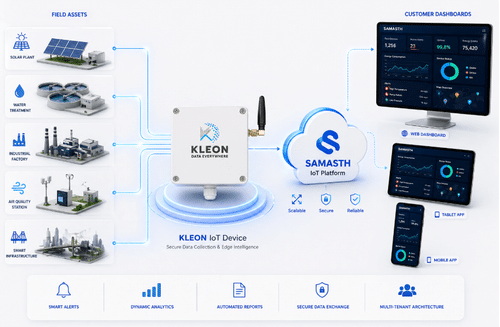 From edge hardware to cloud analytics: The KLEON and SAMASTH architecture.
How do you connect energy meters, pumps and controllers that speak different protocols without spending a year on integration? Put the field layer, the edge logic and the cloud layer on one stack that a single supplier owns end to end. Ubiqedge does this with KLEON hardware and SAMASTH software, and the company's own yardstick is the number to argue about: new applications delivered in one to eight weeks, against nine to 18 months for the conventional multi-vendor route, with more than 37,000 devices and assets deployed across India.
Start with the metric that hurts. Bain's 2022 survey of 500 industrial internet of things (IIoT) decision makers in Europe and the US found the count of organisations running proofs of concept had grown nearly 20% since 2018, yet in four of five companies fewer than 60% of pilots reached production scale. The gap is not dashboards. It is wiring, protocol lists, and the person who signs off a remote write command.
Why do retrofits stall before the first sensor is wired?
Conclusion first: projects stall on integration labour, not on analytics. Mixing gateways, sensors, communication hardware and software from several vendors means every new site rebuilds the same glue code, and glue code is where schedule and accountability leak.
The buyer-side data points the same way. In the Bain report, 39% of respondents named information technology (IT) and operational technology (OT) integration as their leading adoption barrier in 2022, overtaking cybersecurity, and the firm's analysts argue that scaling pilots is a problem hardware vendors and machine builders are better placed to solve than pure software teams. Ubiqedge's answer is structural: develop the connected hardware and the platform in-house, then configure them per application instead of re-sourcing them per project.
Carry this sentence into your next steering meeting: a brownfield retrofit is an addressing-and-authority problem before it is a data problem.
What does the field layer actually have to connect?
Whatever is already bolted to your machine, at register level. KLEON is Ubiqedge's modular IIoT hardware platform, designed to link assets such as energy meters, programmable logic controllers (PLCs), pumps, motors, controllers and environmental sensors. Rather than a fixed gateway layout, the same family is adapted to a deployment by changing the processor. Supported links are 4G, Wi-Fi, LoRa, Ethernet and the industrial serial families Modbus RTU, Modbus TCP/IP and RS485.
Here is where shop-floor reality trims the datasheet. Three constraints decide your bill of materials before any software is installed:
- Node count per serial segment. The RS485 electrical specification is built around 32 nodes per segment without repeaters, and the Modbus protocol caps logical addressing at 247 devices on one data link (see the Modbus protocol summary). A 60-meter motor control centre is three buses and three gateway ports, not one.
- Distance and baud rate are traded against each other. Roughly 1,200 metres of twisted pair is the accepted ceiling on a single segment at lower baud rates such as 9,600 or 19,200; push the bus to the limit and polling time, not bandwidth, becomes the bottleneck.
- Live-conductor sensing avoids the shutdown request. Split-core current transformer (CT) clamps fit around an energised conductor, so circuit-level energy data can be added to an existing panel without a planned outage, as documented in Ubidots' cellular energy monitoring guide. That single choice often moves a retrofit from the next shutdown window to this month.
| Link option | Where it earns its keep | What bites you |
|---|---|---|
| Ethernet | Existing plant LAN, control-room assets | Cable trays, IT change control, switch port fights |
| Wi-Fi | Warehouses, offices, retrofit without trenching | Interference, roaming, coverage audits |
| 4G | Dispersed sites: pumping stations, solar, rail-side | Airtime per device, signal at ground level or underground |
| LoRa (long range, low data rate) | Wide areas with sparse polling, borewells, metering | Duty-cycle limits, gateway siting, no low-latency control |
| Modbus RTU over RS485 | Meters, variable-speed drives, older controllers | 32 nodes per segment, slave-address conflicts, polling time |
| Modbus TCP/IP | Newer drives and gateways already on IP | Port exhaustion, network segregation rules |
Where should the logic run: edge or cloud?
Rule of thumb from the field: anything that protects an asset, a product or a person belongs in the last 100 milliseconds behind the panel. The architecture splits along that line. KLEON can store data locally, process information and execute control logic, while SAMASTH handles analytics, reporting, notifications and fleet management. Because of that split, functions such as pump scheduling keep running when internet connectivity is absent.
SAMASTH brings together data gathered by KLEON and other systems and offers dashboards, analytics, alerts, predictive analytics, reporting and remote device management. Two-way communication is provided, so connected devices can be controlled remotely and their firmware can be updated. That last clause is the one to interrogate: once write access exists, over-the-air (OTA) delivery becomes your biggest reliability exposure. Established practice is staged rollouts to a small device group with automatic rollback on failed boot, as set out in Mender's OTA update best-practice guide.
If your roadmap pushes inference to the panel rather than the data centre, the compute box inside the gateway is the next purchase decision; our write-up on AI inference systems at the edge shows how much headroom is now available in one box. Sites that need deterministic motion or process loops instead of analytics should read our notes on industrial real-time networking at the edge before choosing a gateway.
How does a first application reach service in one to eight weeks?
Ubiqedge states that developing both platforms internally gives it more control over customisation, and that its modular architecture can help bring new applications to market in one to eight weeks, compared with nine to 18 months using conventional methods that rely on off-the-shelf hardware or development from scratch. Treat that as a vendor claim and test it against your own list of prerequisites. The fast lane exists only when the asset already exposes its registers and the plant agrees in advance who owns a control command.
| Dimension | Conventional multi-vendor build | Shared stack (KLEON plus SAMASTH) |
|---|---|---|
| Lead time to first application | nine to 18 months | one to eight weeks |
| Hardware sourcing | Gateways, sensors, radios from several vendors | One modular family, processor chosen per deployment |
| Protocol coverage | Integrated project by project | 4G, Wi-Fi, LoRa, Ethernet, Modbus RTU, Modbus TCP/IP, RS485 as standard options |
| Control when the uplink fails | Usually lost, or rebuilt per site | Edge holds local storage, processing and control logic |
| Fleet changes | Manual or vendor-specific tools | Remote device management and firmware delivery from the platform |
The sequence that makes eight weeks credible:
- Build the asset register: nameplate data, protocol, available registers, physical port, power source.
- Freeze the point list before quoting anything: tags, sample rate, alarm thresholds, retention.
- Choose the variant per site, not per project: processor class up front, then the link option from the table above.
- Run the pilot on one asset family for 30 days and log the baseline: energy per unit produced, unplanned stops, mean time to repair.
- Write down control authority: which tags are read-only, who may issue remote writes, what fails safe.
- Close the loop with fleet hygiene: staged firmware rollout, spares on shelf, one address-and-naming standard.
Where is the stack running, and what does that say to a buyer?
The platforms are already used in solar monitoring, water management, air quality, railway infrastructure and ready-mix concrete applications, and Ubiqedge reports more than 37,000 devices and assets deployed across India. That mix matters more than the headline count: none of those five applications is a discrete production line.
Two additions outside the brief sharpen the picture. The company states it has digitised more than 23,000 borewells for groundwater monitoring, which is the deepest single-asset footprint it claims, per its published deployment notes. And Ubiqedge raised 10 crore rupees of seed funding led by Piper Serica, reported by Business Standard on 30 April 2026, money earmarked for scaling the hardware-and-software platform rather than for a single vertical.
Rather than treating each industrial application as a separate product, the company is building a common technology stack that can be configured for different requirements, with the stated ambition of making KLEON and SAMASTH an infrastructure platform where Ubiqedge and its channel partners build new IIoT applications. Read plainly: you are buying a base on which someone else's application may later sit, which cuts your integration cost and raises your dependency on that partner network.
Which five mistakes turn a retrofit into a repair job?
- Over-subscribing one serial bus. Designing 50 meters onto one RS485 port ignores the 32-node ceiling and lands you with polling timeouts and unexplained data gaps.
- Shipping pilot firmware to a fleet. No staged rollout and no rollback path converts one bad build into thousands of dead assets.
- Monitoring without authority. Dashboards alone never moved overall equipment effectiveness (OEE); the value appears when control logic runs from the same stack, offline included.
- Leaving the security target unstated. Name a security level per zone against the ISA/IEC 62443 series, which defines four levels from protection against casual or accidental error upward, per the ISA standard description.
- Scaling on one vendor's stock list. If the architecture cannot swap processors or radios per site, you have bought a product, not a platform, and the second application restarts the nine to 18 months clock.
When is a shared stack the right call?
Three conditions have to be true. First, you have a family of assets, not one machine: dispersed pumping, solar, metering or fleet equipment where the same protocol set repeats. Second, your internal integration capacity is thin, because the alternative is rebuilding glue code at every site. Third, you accept a platform supplier relationship, including its partner ecosystem, in exchange for a lead time measured as one to eight weeks.
Skip it when the requirement is a single line with one protocol and you already employ controls engineers who can own the integration: a bespoke gateway plus your existing historian will cost less over ten years.
The framework I hand to plant managers is five boxes, in this order: asset register (what speaks), point list (what you need), split line (what runs at the edge when the link is gone), authority matrix (who may write), and fleet rule (how firmware and spare parts are handled). Fill the five boxes before you compare vendors. Done that way, the KLEON and SAMASTH style of stack stops being a product decision and becomes a schedule decision, which is what it actually is.
FAQ: what buyers ask before signing
Do we have to replace the PLC to connect it?
No, provided it already exposes a supported interface. In the Ubiqedge architecture the connection layer is deliberately protocol-first: Modbus RTU over RS485 for serial devices, Modbus TCP/IP or Ethernet for devices already on the plant network, with 4G, Wi-Fi and LoRa carrying the data onward.
What happens when the internet drops?
Work that must continue runs at the edge. KLEON handles local storage, processing and control logic, so a duty such as pump scheduling keeps executing; SAMASTH resumes analytics, reporting, notifications and fleet management when the link returns.
Is one to eight weeks a delivery guarantee?
It is Ubiqedge's stated range for bringing a new application to market on its modular architecture, versus nine to 18 months for off-the-shelf or ground-up builds. Validate it on your own worst asset, not on a demo unit, and put the baseline log from a 30-day pilot in the acceptance criteria.
Who should own remote control and firmware delivery?
Operations owns the control authority, IT or OT security owns the update path, and the platform vendor owns the tooling. Write it into the contract: staged rollout, rollback on failed boot, and an agreed security level per zone.
Where is this already proven at scale?
Mostly in infrastructure rather than factories: solar monitoring, water management, air quality, railway infrastructure and ready-mix concrete, with more than 37,000 devices and assets deployed across India.
References
- Bain & Company, "To Scale the Industrial Internet of Things, Don't Forget Hardware", 2022 Technology Report: https://www.bain.com/insights/scale-industrial-internet-of-things-dont-forget-hardware-tech-report-2022/
- Modbus protocol and RS485 physical limits, overview: https://en.wikipedia.org/wiki/Modbus
- ISA/IEC 62443 series of standards, security levels: https://www.isa.org/standards-and-publications/isa-standards/isa-iec-62443-series-of-standards
- Ubidots, cellular energy monitoring and live-conductor CT installation: https://ubidots.com/blog/cellular-energy-monitoring/
- Mender, OTA update best practices for industrial IoT fleets: https://mender.io/resources/reports-and-guides/ota-updates-best-practices
- Business Standard, Ubiqedge seed funding report, 30 April 2026: https://www.business-standard.com/companies/start-ups/ubiqedge-raises-10-crore-to-scale-aiot-platform-for-infrastructure-126043001090_1.html
- Ubiqedge deployment disclosures: https://www.ubiqedge.com/