
Advantech MIC-743-AT AI Inference System Lands at Mouser Electronics, Inc.: Inside 2,070 TFLOPS of NVIDIA Jetson Thor Edge Compute
By Michael Torres, WorldIndustrialWeekly — Edge Computing & Industrial Automation Desk
Mouser Electronics, Inc. has started carrying the Advantech MIC-743-AT AI inference system, a factory-format box driven by NVIDIA Jetson Thor T4000/T5000 modules. The practical answer for plant and automation leaders: generative-class AI — multimodal inspection models, on-site copilots, agent-style workflow software — can now be specified, quoted, stocked and serviced the way a normal industrial controller is, instead of being a bespoke integration project. The published ceiling is 2,070 TFLOPS (FP4); the operative change is that this class of compute arrives through an ordinary distributor channel.
For the past three years the bottleneck in manufacturing AI was rarely the algorithm. It was placement. Vision-language models wanted data-center memory footprints; production lines wanted decisions in tens of milliseconds and hardware that survives a cabinet at 34°C. The MIC-743-AT sits precisely in that seam, which is why a stocking announcement deserves more than a component bulletin.
What actually changed when a Thor-class edge box reached a distributor shelf
Short version: the product moved from demonstration stage to procurement stage. Read as a timeline, the shift is unmistakable.
- 19 May 2025 — Advantech used COMPUTEX to show a full-stack integration of NVIDIA Jetson Thor hardware with its own edge platform, positioning the MIC-743 family for physical AI, vision-language models at the edge and humanoid-class robotics (advantech.com).
- 25 August 2025 — NVIDIA declared general availability of the Jetson AGX Thor developer kit and production modules, with the kit quoted at launch "starting at $3,499", and described the platform as "built ... for the millions of developers working on robotic systems that interact with and increasingly shape the physical world" (investor.nvidia.com).
- 26 August 2025 — the vendor press release for the MIC-743 cited up to 2,070 FP4 TFLOPs of AI performance aimed at VLM and LLM deployment outside the data center (advantech.com).
- November 2026 — the distributor newsroom entry that lists the system for order placement went live (eu.mouser.com), closing the loop between silicon launch and purchasable, traceable industrial hardware.
That last step matters more than buyers usually admit. Launch units reach OEM design teams eighteen months before channel stock reaches a maintenance storeroom. Availability through Mouser is the signal that boards can now be re-ordered, budgeted in a capex line, and supported over a multi-site rollout.
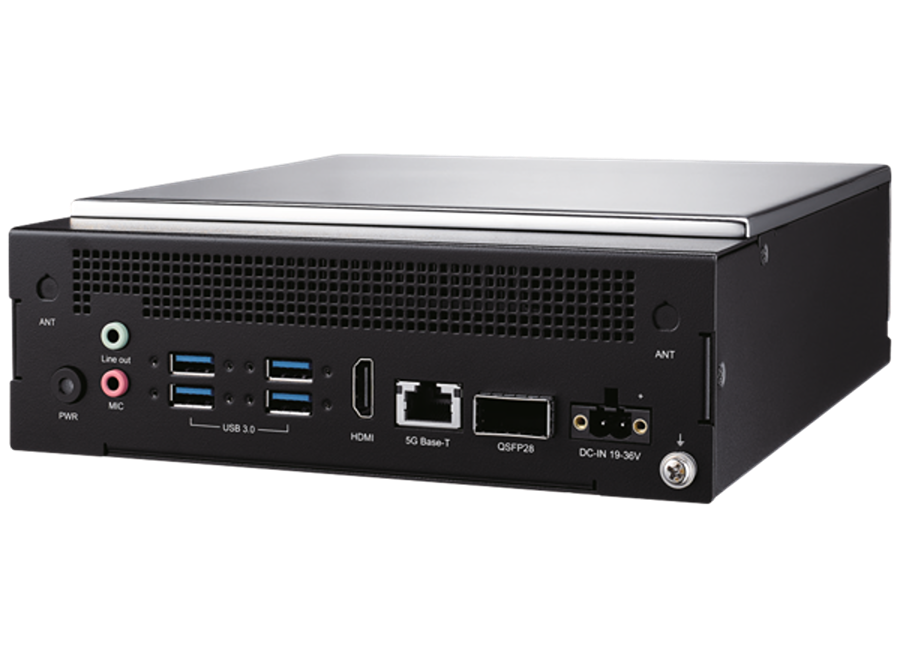 Advantech MIC-743-AT AI Inference System.
Is 2,070 TFLOPS more compute than a production line can absorb?
Conclusion: for most single-cell deployments it is surplus today — and that surplus is the point. The system is sized for what a line will run in 2027, not for what it runs now, and it lets one node consolidate several workloads that are currently spread across separate industrial PCs.
| Workload pattern | What it consumes | Fit today |
|---|---|---|
| Classical machine-vision defect detection (classification/segmentation) | Low compute, mostly I/O bound | Over-provisioned; still useful as a consolidation host |
| Vision-language inspection (open-set defects, "describe what is wrong") | Memory bandwidth and large weight sets | Strong fit — 128 GB of system memory is the enabling spec |
| Edge LLM for maintenance copilots, SOP retrieval, ticket triage | Sustained FP4 throughput and tokens/second per user | Viable at tens-of-billions parameter class, per vendor positioning and trade-press testing claims |
| Multi-camera video analytics with tracking | Tensor core occupancy plus decode | Strong fit with 2560 CUDA and 96 5th Gen Tensor cores |
| Robot or AMR "brain" with sensor fusion | End-to-end latency, not peak FLOPS | Fit, if thermal headroom is engineered rather than assumed |
The generational argument is straightforward. NVIDIA states that Thor delivers up to 7.5x the AI compute and about 3.5x the energy efficiency of Jetson AGX Orin, with module power configurable between 40 W and 130 W (developer.nvidia.com). Applied to a plant, that ratio says something operational: a node that used to require three Orin boxes to host a multimodal pipeline can now be one box, one power feed and one maintenance owner — while keeping the inference inside the firewall.
Inside the box: the specification lines that decide whether it fits
The published configuration reads like a small server, not like an embedded board. Both module tiers of NVIDIA Jetson Thor modules carry the same Blackwell-derived graphics architecture, and the peak figure quoted for the platform is 2,070 TFLOPS (FP4).
| Subsystem | Configuration | Operational consequence |
|---|---|---|
| CPU | 14-core Arm Neoverse V3AE 64-bit SMP architecture | Enough general-purpose headroom to run the plant software stack alongside inference, not beneath it |
| Accelerator | 2560 NVIDIA CUDA cores with 96 5th Gen Tensor cores, 1.57 GHz MAXN | Determines concurrent-model occupancy when several pipelines share one node |
| Memory | 128 GB LPDDR5X | Allows large multimodal weights to stay resident instead of streaming from storage |
| Storage | 1 TB pre-installed SSD | Enough for model versions plus a rolling buffer of local evidence; plan external capacity for retained images |
| Board-class throughput | Development-board configurations are rated up to 1,200 FP4 TFLOPS and support agentic AI deployment | Use the board figure when sizing pilot kits, the module ceiling when sizing production |
| Peripherals | HDMI, USB 3.2 Gen 2, M.2 AEkey (Wi-Fi), M.2 Bkey (LTE) | Cell-side HMI output plus wireless fallback where trenching fibre is blocked |
| Software | NVIDIA Jetpack 7.0 installed | Removes the first-two-weeks integration tax on a new hardware generation |
| Environment | 19V to 36V input; -10°C to 35°C with 0.7 m/s airflow | Directly determines cabinet design, not merely a datasheet footnote |
Two details outside the master specification sheet are worth flagging to mechanical teams. Advantech's own product material and Chinese trade coverage describe a compact chassis in the region of 195 x 200 x 71.5 mm at roughly 2.4 kg, with a polished stainless enclosure, and list high-speed networking options including 5GbE and a QSFP28 slot usable for four 25GbE links (iotmart.com; kongzhi.net). Treat those as design inputs to confirm against the current datasheet revision before a panel layout is frozen — the weight-to-footprint ratio is unusual for a machine carrying 128 GB of memory and implies a deliberately conduction-and-fan assisted thermal design.
Power, heat and network: the three constraints that quietly kill pilots
Conclusion: the specification's environmental envelope is the single most common source of field failure for this class of node, because it is stated as an absolute rather than a derated operating point.
- Thermal budget. The system is rated to operate from -10°C to 35°C with 0.7 m/s airflow. A sealed enclosure with no forced exchange routinely runs 8-12°C above ambient, so a summer floor at 38°C already breaches the stated window. Specify fan-forced cabinets, put the node away from heat-generating drives, and measure the air arriving at the inlet rather than the room temperature.
- Power topology. A 19V to 36V input is convenient — it matches common 24V control rail — but that rail is only as clean as the machine feeding it. Verify sag during motor starts and confirm the UPS or redundant-rail strategy, since an undervoltage reset during a shift destroys any local inference continuity argument.
- Network reach. HDMI and USB 3.2 Gen 2 serve commissioning; M.2 AEkey (Wi-Fi) and M.2 Bkey (LTE) serve resilience. Decide before installation whether the node is a data consumer or a data producer, because that determines whether the wireless link is a backup or the primary path for model artefacts.
The 40 W to 130 W configurable power envelope reported by NVIDIA for Thor modules turns this into an engineering trade-off rather than a fixed number: raise the cap for throughput, lower it for cabinet heat and energy targets. Teams that leave the default untouched usually under-exploit the platform.
Software: what NVIDIA Jetpack 7.0 changes for integrators
Conclusion: the pre-installed stack is the reason this is a product rather than a development project. NVIDIA Jetpack 7.0 covers drivers, CUDA runtime, tensor libraries and the container tooling that inference teams already use, so a model trained elsewhere lands on the line without a rewrite.
Two operational implications follow. First, the platform supports the current wave of agentic AI workloads — the vendor explicitly frames the board configurations, rated up to 1,200 FP4 TFLOPS, as supporting agentic AI deployment, which in a factory context means local tool-calling for maintenance assistants and coordinated multi-step inspection routines. Second, the version pin matters for lifecycle planning: teams should record which JetPack release each node runs, because a mixed fleet of runtime versions is the fastest route to an unreproducible defect-model comparison across two plants.
Our assessment, not a vendor claim: expect the practical constraint to be engineering time, not silicon. Model quantisation to FP4, latency budgets across camera-to-decision, and integration with MES or historian systems remain the slow parts of any deployment in this class.
Cost check: what a node in this class actually costs
Conclusion: the module economics, not the chassis, dominate the payback calculation.
- NVIDIA's launch release quoted the Jetson AGX Thor developer kit "starting at $3,499" on 25 August 2025 (investor.nvidia.com).
- NVIDIA's current Jetson pricing FAQ on developer.nvidia.com lists the developer kit at $5,499, the Jetson T5000 module at $4,999 and the Jetson T4000 module at $2,999 for 1,000-unit-plus volumes.
- Independent market research puts the edge AI hardware market at about $26.0 billion in 2025, rising to roughly $31.2 billion in 2026 (gminsights.com), while AI spending in manufacturing was estimated at $34.18 billion for 2025 (marketsandmarkets.com).
Read together, the two module tiers give buyers an unusually clean choice: a T4000-based design for high-volume camera nodes, and a T5000-based node where a single machine must host a large multimodal model. That tiering is why the same chassis family is offered on both module variants.
Where the distribution channel fits: traceability, support and the real risk
Conclusion: buying from an authorised source is a technical control, not a paperwork preference. Mouser is a global authorised distributor and states that customers receive 100% certified, genuine products that are fully traceable from each manufacturer partner; its Technical Resource Center provides design-support material intended to speed development.
For AI hardware this is not a marketing line. Counterfeit or grey-market memory and power stages are a known failure mode in industrial channels, and a mis-sourced DIMM or DC-DC stage in an inference node produces faults that look like model problems. Traceability protects the diagnosis path.
Where the master release carried distributor marketing rather than buyer guidance, this edition keeps only what is verifiable: authorised sourcing, traceable parts, and access to reference documentation.
Four misconceptions that stall shop-floor AI rollouts
- "Peak TFLOPS equals my throughput." Sustained performance depends on power cap, temperature, model precision and how many pipelines share the node. The published 2,070 TFLOPS figure is a ceiling, not a service level.
- "Edge replaces the cloud." In practice the winning pattern is hybrid: local inference for closed-loop decisions, site or central aggregation for retraining, drift analysis and fleet model management.
- "One big model beats several small ones." On a line, a tuned task model usually wins on latency and auditability; the value of Thor-class memory is that both can now coexist.
- "Thermal specs are for the installer to worry about later." The -10°C to 35°C envelope with 0.7 m/s airflow is the constraint most likely to be violated in retrofit cabinets, and it should be signed off before the purchase order.
Action plan: a 90-day path from evaluation to line-level deployment
- Days 1-15 — define the decision, not the model. Pick one closed-loop use case with a measurable latency and false-positive target. Record ambient temperature at the intended mounting point across a full shift cycle.
- Days 16-40 — bench the board tier first. Use a development configuration rated up to 1,200 FP4 TFLOPS to prove the pipeline on NVIDIA Jetpack 7.0; keep the environment variables (power cap, airflow) identical to the planned installation.
- Days 41-60 — instrument the node. Log inlet temperature, power-rail voltage during machine starts, tokens or frames per second, and time-to-decision. This dataset is the evidence base for scaling.
- Days 61-75 — fix the lifecycle policy. Assign model-version ownership, pin the runtime version per fleet, and define how a bad model gets rolled back within one shift.
- Days 76-90 — buy through the authorised channel. Specify the module tier against measured load, source traceable units, and register spares for the sites that will run unattended.
FAQ: what engineering and purchasing teams ask first
What is the Advantech MIC-743-AT in one sentence?
An industrial edge AI node — the Advantech MIC-743-AT AI Inference System — that pairs NVIDIA Jetson Thor modules with a 14-core Arm Neoverse V3AE 64-bit processor, 128 GB of memory and a 1 TB SSD so large multimodal models can run on the plant network instead of a data center.
How much AI compute does it deliver?
Up to 2,070 TFLOPS (FP4) at module level, according to the platform specification, with development-board configurations rated at up to 1,200 FP4 TFLOPS.
Can it really run a language model locally?
The 128 GB LPDDR5X subsystem is what makes it credible: memory capacity, not just FLOPS, is the limiting factor for large models. Vendor and trade-press material describe tens-of-billions parameter multimodal and language workloads as the target class; validate against your own quantised model before committing a line.
Why does the operating temperature range matter so much?
Because it is written without derating headroom: -10°C to 35°C at 0.7 m/s airflow. Most retrofit cabinets exceed 35°C at the inlet in summer, so thermal design is a gating condition, not a later detail.
Where is it available and how do buyers verify authenticity?
Through the authorised distributor channel, including Mouser Electronics, Inc., which states its products are 100% certified and fully traceable from manufacturer partners, with design material available through its Technical Resource Center.
Reference sources
- NVIDIA, "NVIDIA Blackwell-Powered Jetson Thor Now Available, Accelerating the Age of General Robotics" (25 August 2025) — https://investor.nvidia.com/news/press-release-details/2025/NVIDIA-Blackwell-Powered-Jetson-Thor-Now-Available-Accelerating-the-Age-of-General-Robotics/default.aspx
- NVIDIA Developer, "Introducing NVIDIA Jetson Thor, the Ultimate Platform for Physical AI" and the Jetson product/pricing FAQ — https://developer.nvidia.com/blog/introducing-nvidia-jetson-thor-the-ultimate-platform-for-physical-ai/
- Advantech, "Advantech Unveils MIC-743: Delivering Powerful Performance for VLM and LLM Applications at the Edge" (26 August 2025) and the COMPUTEX 2025 full-stack Jetson Thor demonstration note (19 May 2025) — https://www.advantech.com/en-us/resources/news/advantech-unveils-mic-743-delivering-powerful-performance-for-vlm-and-llm-applications-at-the-edge
- Advantech MIC-Jetson Thor edge AI server product page — https://www.iotmart.com/ko-kr/en/Deals-and-Offers/MIC-Jetson-Thor; MIC-743-AT product overview — https://www.kongzhi.net/news/details_212747.html
- Mouser Electronics newsroom entry for the Advantech MIC-743-AT listing (November 2026) — https://eu.mouser.com/newsroom/publicrelations-advantech-mic-743-2026final/
- Edge AI hardware market sizing — https://www.gminsights.com/industry-analysis/edge-ai-hardware-market; AI in manufacturing market sizing — https://www.marketsandmarkets.com/Market-Reports/artificial-intelligence-manufacturing-market-72679105.html
Editorial note: performance figures, environmental ratings and interface lists above follow the product announcement; independent market data and platform-level comparisons are attributed inline. Where a claim cannot be verified against a primary source it is labelled as assessment rather than fact.