
From Months to Days: Reading the Numbers Behind TI's Agentic AI Push in CCStudio
Texas Instruments has pushed the agentic AI layer inside CCStudio far enough that it now puts software migration time at days instead of months, with one workflow covering source-project analysis, peripheral configuration, API updates, build-error iteration and debugging. For anyone cost-modeling firmware work, the reading is narrow: the elapsed-time win lands where porting is repetitive and device-specific, while verification effort moves rather than disappears.
The announcement arrived inside the week that electronica 2026 ran at Messe München, 10-13 November 2026, where TI is demonstrating end-to-end application development from system configuration to debugging at its booth in Hall C4. Amichai Ron, senior VP for embedded processing and DLP products at Texas Instruments, calls embedded software development an incredibly manual and time-consuming process. In the firmware groups I audit, that description is the least controversial sentence in the release - and the migration clock is the metric I would re-measure before signing anything. Design engineers have had generative AI assistants for the past two years, yet porting backlogs usually survived the pilot because the model could not see the datasheet, the pin map or the SDK version in front of it.
What actually changed in CCStudio
Conclusion first: the change is context access, not a smarter chat window. Device-specific knowledge - software development kits (SDKs), pin configurations and peripheral data - is injected into the workflow through Model Context Protocol (MCP) servers, and the CCStudio IDE exposes its core capabilities (compiler, flasher, debugger) to industry-standard AI agents.
- Whole loop, one tool: agents generate code, configure peripherals, build the application, flash it to the device and debug it, with developers working in plain language inside CCStudio IDE or CCStudio for VS Code instead of switching tools or rebuilding context.
- Migration split into subagents: specialised subagents analyse the source project, configure peripherals, update code and API calls, then iterate through build errors to resolution while preserving the existing software investment.
- Coverage today: general-purpose and real-time microcontrollers (MCUs), wireless connectivity devices and radar system-on-chips (SoCs). The architecture is modular - task-specific skills, MCP server integrations and context injection - so support can extend to new devices, updated SDKs and edge AI workflows.
- Accuracy mechanism: with device data supplied through MCP, the models reduce hallucinations and produce implementation-ready outputs rather than plausible code.
One detail worth logging: MCP is not TI property. Anthropic published it as an open standard on 25 November 2024, OpenAI adopted it in March 2025 and Google DeepMind followed. Whatever a buyer gains or loses in portability depends on whether device knowledge stays reachable through an open protocol.
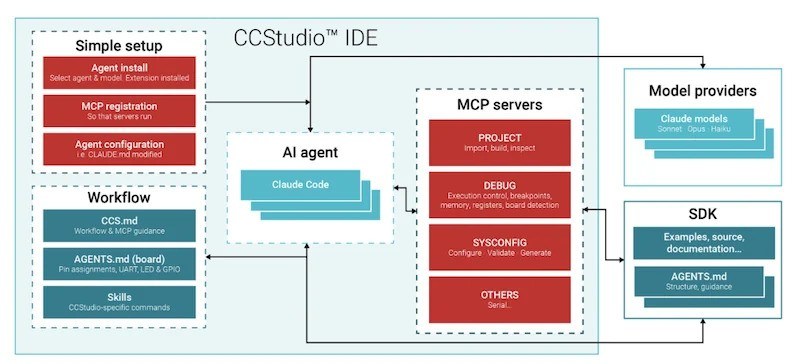
CCStudio strengthens agentic AI capabilities to streamline embedded software development across MCUs. Source: Texas Instruments
Why "months to days" is a cost question, not a productivity story
Two published numbers frame the money. First, PwC's Strategy& digital auto analysis models software climbing from 34% to 42% of per-model electrical/electronic (E/E) development cost between 2021 and 2030, while hardware falls from 38% to 27% and test-and-validation grows from 28% to 31%. The scarce line item is already code, and the second-largest is proving the code.
Second, in its 2025 annual report, Texas Instruments states that customers invest their own R&D to develop software that operates on its products, and that this investment lengthens customer commitments. The Embedded Processing segment generated $2.70 billion of revenue in 2025, with third-quarter revenue of $709 million, up 9% year over year.
My analysis, not TI's: a device migration is a switching-cost event dressed up as an engineering task. In most rebuilds I have timed, the sunk porting estimate - not the peripheral set - is what keeps a motor drive or a sensor node on an eight-year-old part. When the chipmaker itself absorbs that estimate, two things happen at once. Design-ins become cheaper to win, and the argument for staying also weakens, because a pin-compatible alternative now needs the same automated pass. Procurement leverage rises; engineering should keep the porting baseline anyway.
Which half of the claim is measured?
Conclusion first: the speed figure is vendor-reported, and independent evidence on AI coding help is mixed enough to warrant a controlled internal trial. In a randomised trial published 10 July 2025, METR found that 16 experienced open-source developers took 19% longer with early-2025 AI tools on their own mature repositories, even though they had predicted a 24% speed-up. Google Cloud's DORA 2025 report, drawn from roughly 5,000 technology professionals, found 90% of developers using AI in daily core work while 30% reported little or no trust in AI-generated code.
The difference between those findings and TI's pitch is the missing variable: general assistants work on codebases they cannot inspect, whereas an agent wired to SDKs, register maps and the debugger can at least fail against real facts. EE World Online, reporting on the launch, notes that TI puts simpler migrations at hours rather than days. Risk flag: no independent measurement of defect rates in agent-migrated firmware has been published, so read "months to days" as a scope statement about repetitive porting, not as a validated quality result.
How does it sit beside the rest of the microcontroller platform race?
Texas Instruments is not the only chipmaker treating the toolchain as the product; STMicroelectronics is turning STM32 into a unified platform that spans cloud AI and physical AI workloads across factory, vehicle and robot applications. The competitive signal for buyers is that development-time promises, not unit prices, are becoming the differentiator at the design-in stage.
| Decision input | What is published today | What the buyer must supply |
|---|---|---|
| Migration elapsed time | Months to days; hours for simpler projects (vendor claim) | Engineer-hour baseline from the last three porting projects |
| Correctness of generated code | Device-context injection reduces hallucinations | Static analysis, unit tests and a named review owner per module |
| Verification effort | Not quantified publicly | Re-run hardware-in-the-loop benches and the safety evidence pack |
| Tooling cost | CCStudio is a free download from TI.com | Model or agent usage fees and the compute bill per seat |
| Exit position | Knowledge reaches agents through open MCP servers | Contract terms on code ownership, provenance and audit logs |
Where traceability is mandatory, the shortcut loses value fast - the same conclusion our earlier analysis reaches on whether AI can actually cut engineering time: an agent output that floats free of requirements and change records still has to be reconstructed by hand.
Five misconceptions that inflate the savings in a business case
- "Fewer engineer-weeks automatically means lower cost." Only if the freed hours are removed from the critical path. In the teams I have measured they are absorbed by review, re-flash cycles and test queueing.
- "The agent replaces the migration plan." It replaces the mechanical pass. Pin-map decisions, power budget, timing margins and certification scope stay human.
- "Days means the same day." The published figure is a range from a vendor; your build farm, your legacy API surface and your toolchain validation rules set the real number.
- "Accuracy improves because the model is bigger." Accuracy here comes from supplied device context. Stale SDK documentation in the server produces confidently wrong code.
- "Only the firmware team is affected." Test benches, configuration management and the supplier quality agreement all change on the same day.
What to do before the first agent-assisted sprint
- Pick one bounded port. A single application, one device family, no safety-relevant control path. Motor-control firmware with a stable peripheral set is the usual candidate.
- Freeze a baseline. Record engineer-hours, build iterations, defect count and time to first working flash for the last two manual migrations.
- Put a gate in front of merge. Static analysis, unit coverage threshold and hardware-in-the-loop sign-off stay mandatory regardless of who or what wrote the code.
- Log provenance. Keep the prompt, the agent version, the SDK revision and the diff. That record is what turns an experiment into auditable evidence.
- Measure at 90 days, then decide on the second team. Scale only where the porting backlog was the constraint, not where requirements churn was.
FAQ: the first questions engineering and procurement ask
Does TI's agentic AI only work inside its own tools?
No. The agentic framework exposes CCStudio capabilities to industry-standard agents, and developers can run the workflow in CCStudio IDE or CCStudio for VS Code, keeping VS Code as the editor surface where the team prefers it.
Which devices are covered right now?
CCStudio's agentic AI capabilities are available across Texas Instruments general-purpose and real-time MCUs, wireless connectivity devices and radar SoCs, with a modular design intended to add new devices and updated SDKs over time.
Can the "months to days" number be used in a budget?
Use it as a hypothesis with a stop rule. It is a vendor-reported range covering repetitive migration tasks, and independent trials such as the METR study show that measured productivity effects can run opposite to expectation until review and verification are redesigned.
What is the honest bottleneck after adoption?
Validation throughput. If code appears in days but the test bench queue is unchanged, the project finish date barely moves - which matches the cost structure in which test-and-validation holds roughly a third of E/E development spend.
The repeatable frame: baseline, gate, measure, scale
Strip the launch language away and the transferable method is short. Measure one migration task end to end before you touch tooling; set a verification gate that generated code cannot skip; compare elapsed time and escaped defects at 90 days; then scale only to teams whose constraint was porting labour. That is the same four-step frame we apply to any line-level change: the win is rarely in the machine, and never in the press release - it is in whether the number you measured before matches the number you measure after.
References
- Texas Instruments, "TI redefines embedded development with agentic AI in its CCStudio ecosystem" (11 November 2026)
- EE World Online, "Agentic AI takes on embedded code migration"
- Texas Instruments 2025 annual report - Embedded Processing segment disclosure
- METR, "Measuring the Impact of Early-2025 AI on Experienced Open-Source Developer Productivity" (10 July 2025)
- Google Cloud DORA Report 2025, State of AI-Assisted Software Development (23 September 2025)
- PwC Strategy&, software-defined vehicle cost analysis
- Anthropic, introducing the Model Context Protocol (25 November 2024)
- electronica 2026, Messe München, 10-13 November 2026