
Why STMicroelectronics Is Turning STM32 Into a Unified Platform for Cloud AI and Physical AI
STMicroelectronics is turning STM32 from a component catalogue into a shared embedded foundation for cloud AI and physical AI, with STM32A, STM32G5, STM32H7P, redesigned edge AI tools, and STM32Cube for agentic AI. For industrial buyers, the bet is that software reuse across automotive, factory equipment, and robotics matters more than isolated MCU performance.
That shift is not only a technology refresh. The platform direction was presented around the online STM32 Summit 2026 keynote on November 3, which framed physical AI as systems that sense, decide and act in the real world. For operators and engineering managers, the practical question is whether one MCU, tooling, and ecosystem can survive repeated product cycles without new codebases and new supplier risk.
Why is STM32 becoming a platform, not just an MCU?
The short answer is that device selection is becoming a platform decision. “There are two rapidly growing markets today, cloud AI and physical AI, and it is our duty at ST to make sure that the STM32 platform will be the king of the microcontroller market in cloud AI and physical AI,” said Remi El-Ouazzane, president, microcontrollers, digital ICs, and RF products group at STMicroelectronics, answering a query posed by EE Times at ST’s global press briefing.
El-Ouazzane argued that the real engineering problem is now portability. “Across many applications, the challenge for customers and developers is shifting from selecting a single device to finding ways to reuse software, tools, architectures, and engineering expertise across multiple products and evolving requirements,” he said. “In other words, the value is shifting from the individual MCU to the broader platform surrounding it.”
According to Maria Erez, executive VP of STMicroelectronics’ embedded processing subgroup, the unified STM32 platform is designed to let customers reuse existing software, development expertise, and manufacturing investments across product generations and application domains. New additions include the STM32A automotive and high-safety MCU portfolio, a new STM32G5 mixed-signal MCU series, a high-performance STM32H7P with a neural processing unit (NPU), redesigned edge AI development tools, and STM32Cube for agentic AI.
How does the unified platform map to industrial, automotive, and robotics work?
According to El-Ouazzane, convergence is taking place across automotive, industrial, and other domains in areas such as AI, security, safety, connectivity, sensing, and control, creating opportunities to reuse common technologies and expertise. The company views this convergence as extending to systems that can perceive, make decisions, and act autonomously in the physical world, including industrial equipment, automotive systems, and robots. Although these applications share requirements for connectivity, real-time control, safety, security, and software lifecycle management, their specific certification requirements may differ.
Source: STMicroelectronics
What does the Arm partnership add to the embedded platform strategy?
Through its longstanding partnership with Arm, STMicroelectronics said it will help define the future Cortex-M processor roadmap, aiming to set up a common foundation for embedded systems. The partnership also gives ST early access to Arm cores, allowing it to optimize its platform for the processor roadmap.
STM32 has helped drive Cortex-M adoption, Erez said. STMicroelectronics said more than 100 billion devices use Arm Cortex-M cores. The company is working with more than 100 ecosystem companies through Arm’s Total Design program for physical AI, announced in September. Arm’s public program material describes Arm Total Design for Physical AI as a purpose-built ecosystem to build, validate, and scale physical AI solutions.
Arm said the program brings ecosystem partners together to accelerate development in the market, with STMicroelectronics and Cadence as key partners. “Now, we want the entire industry to adopt it,” said a company spokesperson during the Q&A session, referring to the Cortex-M roadmap.
“The next major frontier for computing is bringing intelligence into the machines that move, manufacture, and operate in the physical world,” said Drew Henry, executive VP, physical AI at Arm.
How should engineers evaluate STM32A for automotive and high-safety systems?
Extending the STM32 platform into automotive and high-safety systems, the STM32A family has its first three devices sampling to customers, with broader availability planned by STMicroelectronics in 2027. Targeting entry-level automotive local control nodes and safety systems is the STM32A4. Mid-range safety-critical applications in industrial automation, robotics, and energy systems, as well as automotive applications, are addressed by the STM32A5. Safety-critical, multi-domain control where real-time control, low latency, Ethernet, and deterministic communication are essential is the focus of the STM32A9.
“This is about continuity,” Erez said. “STM32A is not a separate story. It is an extension of the STM32 platform strategy, which we plan to continue and expand.”
Both STM32 and STM32A will be supported by the STM32Cube ecosystem. Process technologies and intellectual property (IP) such as Cortex-M cores, timers, clock sources, analog components, and power management can be reused across domains, although safety certification requirements still differ by market. Industrial and automotive products must meet different functional safety standards and qualification requirements, with automotive applications commonly assessed under ISO 26262 and its Automotive Safety Integrity Levels (ASILs).
Future STM32 products will be built on its 40-nm flash technology and 18-nm fully depleted silicon-on-insulator (FD-SOI) technology with embedded phase-change memory, supplemented by TSMC’s embedded non-volatile memory (eNVM) technologies, the company said. Erez said that nearly 2 million unique developers use the STM32 ecosystem, and the number of active users has grown by around 20% over the past three years.
Customers choosing its Stellar automotive MCUs or STM32A have different application requirements, the company said. ST also sees more automotive companies moving into humanoid robotics, citing commonalities in functional safety and architecture, and expects this trend to continue in the coming quarters and years.
Why is STM32G5 important for digital power, motor control, and data centers?
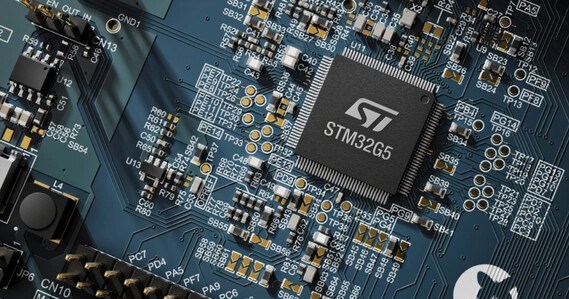
Now in production, the STM32G5 series of mixed-signal MCUs uses an Arm Cortex-M33 core running at 280 MHz. ST said the series delivers twice the compute performance of the STM32G4 series. The company targets the series for data centers, robotics, photovoltaic installations, wind turbines, industrial drives, and commercial drones.
“This new generation of microcontrollers addresses the challenge to meet the growing energy needs of AI data centers efficiently, realize more sophisticated humanoid robots, and power more complex motor-control systems,” said Patrick Aidoune, general manager, general purpose and automotive microcontrollers division at STMicroelectronics.
According to ST, GPU clusters are driving rack power toward 1 MW, and the largest data centers could demand more than 2 GW of peak power by 2030. The company said the STM32G5 is the first MCU with the company’s enhanced 12-channel high-resolution timer. Equipment makers can use it to reconfigure power supply units dynamically as server workloads change, and the timer also lets the MCU handle the higher switching frequencies of power supplies built with silicon carbide (SiC) and gallium nitride (GaN).
The company also said that robotics company Ruiyan Intelligent is using the STM32G5 in its next-generation robotic hands. “In humanoid robotics, dexterity depends on combining strength, precision, sensing, and real-time control in an extremely compact space,” said Paul Tian, CEO of Ruiyan Intelligent.
According to the company, the series includes a programmable logic array, PLAy, which lets developers implement custom hardware functions on chip. Security features include Arm TrustZone, an immutable root of trust for secure boot and firmware updates, and support for ST’s post-quantum cryptography (PQC) libraries. The device targets Platform Security Architecture (PSA) Level 3 certification. With 64 Kbytes to 512 Kbytes of on-chip flash and packages from QFN32 to LQFP128, STM32G5 devices start at $1.034 for orders of 10,000 pieces. ST plans to add dual-core products to the series in 2027.
The broader market context helps explain why this matters. IoT Analytics estimates the global microcontroller market is nearing $30 billion by 2030, with industrial and edge AI forming a $7 billion opportunity.
What changes in edge AI when STM32H7P meets STM32Cube for agentic AI?
Combining a Cortex-M7 core with ST’s proprietary NPU for AI processing, the STM32H7P will enter volume production in early 2027. Aidoune said one alpha customer working on solar inverters moved from managing arc-fault circuit breakers across four panels to 20 panels using a single MCU.
ST began rolling out new and redesigned edge AI tools at the end of October, including Model Zoo for finding models, Model Factory for customizing and optimizing models, Dataset Factory for organizing datasets, and tools for basic model testing on ST boards. The company said it offers more than 400 pre-validated models and has supported more than 260,000 active projects with its AI tools over the past 12 months. ST said deploying AI models on MCUs depends far more on development tools than on computing power.
Through a model context protocol (MCP) server, STM32Cube for agentic AI gives AI agents access to STM32 knowledge, resources, and toolkits, while providing validated reference code and STM32 code generation and review tools. Aidoune said the tool complements STM32 Sidekick, ST’s AI-based technical support tool. “STM32 Sidekick helps answer developers’ technical questions, while STM32Cube for agentic AI integrates into the coding workflow itself,” he said.
El-Ouazzane kept the agenda open. “Today’s announcement of STM32Cube for agentic AI is a step in the right direction, but there is more we can do,” he said. ST needs to strengthen its MCU portfolio with single-core and multicore devices, different security levels, and different types of accelerators, peripherals, and memory, he added.
What risks and common misconceptions should plant managers watch?
Asked by EE Times China whether the industry is heading toward a computing power race, ST said its ecosystem will be its biggest differentiator. The company expects multicore architectures to become a trend within the cost constraints of the microcontroller category. Physical AI is defined by the company as a subset of edge AI: physical AI systems perceive, decide, and act in the physical world, with actual movement through components such as joints and actuators. It said this is where the convergence between automotive and industrial applications is strongest.
| Common assumption | What the platform data suggests | Operational implication |
|---|---|---|
| More AI acceleration means easier deployment | ST said deploying AI models on MCUs depends far more on development tools than on computing power. | Treat Model Zoo, Model Factory, Dataset Factory, and STM32 Sidekick as procurement items, not optional software. |
| Reuse erases certification work | Industrial and automotive products must meet different functional safety standards, while STM32A targets ISO 26262 and STM32G5 targets PSA Level 3. | Map safety artifacts by market before assuming a common codebase. |
| Agentic AI can act unsupervised in production | STM32Cube for agentic AI supplies validated reference code and review tools, but ST also calls for stronger MCU security levels and portfolio depth. | Keep human sign-off in firmware release gates and use immutable root-of-trust features. |
“The industry needs less fragmentation and a stronger focus on helping MCU technologies converge around a common foundation, while maximizing software reuse,” El-Ouazzane said.
What should managers do next?
- Audit existing STM32 code bases by function rather than part number, so teams can test whether timers, connectivity, analog, and power-management IP can move across product generations.
- Start with a bounded digital-power or motor-control pilot using STM32G5, because the device is already in production and the 12-channel timer aligns with high-frequency SiC and GaN power designs.
- For safety-critical programs, separate automotive and industrial qualification tracks early, even when the Cortex-M, IP, and STM32Cube layer are shared.
- For edge-AI programs, compare the STM32H7P NPU path with the current STM32Cube workflow after STM32Cube for agentic AI moves through its 2027 production window.
- Track cost and supply assumptions using published device prices and volume thresholds, such as the $1.034 starting point for STM32G5 orders of 10,000 pieces, instead of treating platform features as cost-free.
FAQ: What STM32 platform changes mean for industrial buyers
Is this mainly a chip launch?
No. STM32A, STM32G5, and STM32H7P extend the portfolio, but ST’s framing is broader: the platform includes software reuse, development tools, ecosystem support, and Arm-based processor continuity across industrial, automotive, and robotics work.
Does convergence mean a car chip can simply become an industrial controller?
Not automatically. ST says technologies can converge, but certification requirements still differ. Automotive uses ISO 26262 and ASILs, while STM32G5 targets PSA Level 3, so teams must keep safety and qualification work separated.
Why are tools emphasized more than raw compute?
ST says deploying AI models on MCUs depends far more on development tools than on computing power, citing more than 400 pre-validated models and more than 260,000 active projects over the past 12 months.
When are the new products available?
STM32G5 is now in production. STM32A has its first three devices sampling, with broader availability planned in 2027. STM32H7P is scheduled for volume production in early 2027.