
Which Thermoplastic Joining Method Wins? A Comparison for Enclosure Teams | WorldIndustrialWeekly General
Set a hot-air station to 320 °C and a scrap PLA print becomes a usable enclosure tab in one pass — the fastest repair most benches can manage. So which thermoplastic joining method should you choose? Match the method to three variables: resin pair, wall thickness and production volume. Adhesive fails on low-surface-energy plastics; a hot-air iron suits prototypes; extrusion welding restores thick tanks; ultrasonic and laser take over at production scale.
Electronics sit inside injection-molded, 3D-printed and rotationally molded shells, yet most engineers specify the enclosure and never learn to join it. Metal gets the attention — TIG stories, custom sheet-metal chassis, aluminum heat sinks. That gap costs time: learn to weld thermoplastics and you prototype faster, repair lab gear, modify stock boxes and rescue field equipment without glues that peel.
Why does glue fail on the plastics a weld joins easily?
Conclusion first: a weld creates molecular continuity, while an adhesive only borrows surface contact. Thermoplastics such as ABS, PETG, HDPE and polycarbonate soften, melting and re-solidifying reversibly, which makes them weldable. Thermosets — epoxies, cross-linked resins and Bakelite — char and degrade on reheating, so welding is off the table.
Real welding needs more than heat: the polymer must pass its glass transition (Tg) or melting point (Tm) so long chains diffuse across the joint and re-entangle as they cool. That molecular handshake, not surface adhesion, supplies the strength. Adhesives struggle because HDPE, PP and PTFE sit near 31 mN/m of surface energy, below the 30–50 mN/m surface tension of most structural glues, so wetting fails and the bond peels like tape. Industry adhesive data puts HDPE at roughly 31–33 mN/m and PP at 29–32 mN/m, which is why surface treatment is mandatory before bonding.
The compatibility rule is absolute: ABS cannot be welded to polypropylene. Without matched solubility parameters the interface resists entanglement and the joint stays weak or never forms.
Which bench tool should you reach for?
Conclusion: use heat sources built for polymers, not solder. A Weller soldering iron will ruin its tip and char the plastic fast — it is designed for tin-lead alloys. A dedicated plastic welding iron carries a flat, spade-shaped brass tip that spreads heat evenly, so the polymer softens and fuses without burning.
| Tool | Heat delivery | Best for | Failure mode |
|---|---|---|---|
| Soldering iron (e.g., Weller) | Tip conduction, high local heat | Metal solder joints | Chars polymer, destroys tip |
| Plastic welding iron | Flat brass spade, even spread | Thin enclosure seams | Slow on thick walls |
| Hot-air station | Narrow nozzle, controlled gas | Prototyping, rework, filler rod | Overheat if unregulated |
| Extrusion welder | Hot gas plus auger-fed molten rod | Thick tanks, field repair | Overkill for thin parts |
Hot-air rework stations — the same units used for SMD desoldering — work as precision hot-gas welders at 300–350 °C with a narrow 3–5 mm nozzle. A useful shortcut: rolls of 1.75 mm and 2.85 mm PLA, ABS or PETG filament kept for the 3D printer make high-purity filler rods. With that setup an electronics bench becomes a capable welding station for 3D-printed polymer parts, the same class now produced on continuous powder-bed-fusion cells.
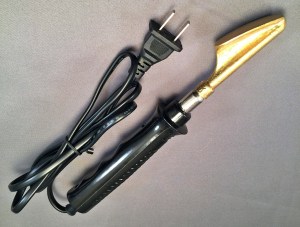
Figure 1 A hot-iron plastic welding tool fuses plastic parts with a heated triangular brass tip. Source: Weldi Plast
When does a crack need an extrusion welder instead of a hot-air pencil?
Conclusion: whenever the wall exceeds 1/4″. Cracks in rotomolded HDPE or polypropylene tanks are structural, not cosmetic: hydrostatic pressure (P=ρgh) and hoop stress make a small fracture run under load. A hot-air pencil cannot deliver enough thermal mass at that thickness. A handheld extrusion welder feeds filler rod through a heated barrel and auger, pumping molten plastic into a pre-heated joint.
Field repair follows a strict sequence:
- Crack arrest: drill 3-mm relief holes at the crack tips to remove stress concentrations.
- V-grooving: gouge a 60°–90° channel along the fault line to create a weld pocket.
- Scraping oxidation: remove the UV-degraded outer skin, since welding onto oxidized polymer yields brittle joints.
Done correctly, extrusion welding restores structural integrity to tanks that would otherwise be scrapped — a repair-versus-replace call that matters when new-tank lead times run long.
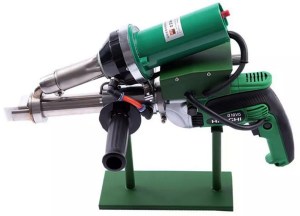
Figure 2 A handheld extrusion welder extrudes molten plastic rod while preheating the substrate to form structural seams in heavy plastic sheets. Source: Author
How do ultrasonic, laser and friction welding compare at scale?
Conclusion: these methods trade setup cost for cycle time and repeatability. Ultrasonic welding runs at 20–40 kHz, converting high-frequency electrical signals into mechanical vibration through piezoelectric transducers. Acoustic horns melt molded energy directors inside the joint in milliseconds — ideal for precision assembly.
Laser and infrared welding take another route: transmission welding places a laser-transparent top layer (clear polycarbonate) over a laser-absorbent bottom layer (carbon-black filled PC) and fuses the parts internally with no surface flash. Absorber loading is a real process limit: increasing carbon-black concentration raises peak weld temperature and can cross the degradation threshold, according to process modelling in Frontiers in Materials. Spin and vibration welding use friction itself as the heat source until the interface softens and bonds.
Throughput is the deciding factor at volume. ScienceDirect's engineering overview puts typical ultrasonic cycles at a fraction of a second to a few seconds, which explains the process's grip on high-rate enclosure assembly. TWI's welding-techniques guidance describes the same mechanism — high-frequency mechanical energy softening or melting thermoplastic at the joint line — as a production joining route, not a bench trick.
| Method | Energy source | Typical cycle | Best fit | Tradeoff |
|---|---|---|---|---|
| Ultrasonic | 20–40 kHz vibration | Milliseconds to seconds | Small rigid housings | Needs molded energy directors |
| Laser transmission | Focused laser, absorber layer | Seconds | Clean, flash-free seals | Material pairing constraints |
| Spin / vibration | Friction at interface | Seconds | Large circular parts | Geometry limited |
Which joint geometry goes with which method?
Conclusion: joint design is the selection rule, not an afterthought. Energy directors suit ultrasonic welding of small enclosures because a triangular point concentrates acoustic energy and melts instantly. Shear joints excel in hermetic seals for waterproof sensors and modules, forming a continuous interference-fit melt along vertical walls — critical for battery-limited sensor nodes that must stay sealed for years.
For manual hot-air or extrusion repair of tanks, single or double V-grooves maximize surface area and drive heat deep through thick walls. Match geometry to method first; strength and durability follow.
What do most shops get wrong?
Conclusion: the failures are process-control failures, not material failures. Precise temperature control — PID-regulated irons or hot-air stations with thermocouple feedback — prevents overshoot and keeps the polymer in the right rheological state without scorching.
- Filler mismatch: 3D-printer filament is a handy hack, but commercial rods are resin- and color-matched to the base polymer, preserving strength and appearance.
- Surface-prep shortcuts: scraping oxidation is not enough; oils, dust and mold-release agents need abrasion or a solvent such as isopropyl alcohol to guarantee chain entanglement.
- No verification: peel and tensile pulls, or ultrasonic inspection, confirm joint integrity before release.
- Safety gaps: hot-gas welding emits fumes, so fume extraction and PPE are non-negotiable.
Design for repair too: choose joint geometries that permit re-welding instead of permanently locking assemblies. Across every option the common thread is controllable heat at a compatible interface; the differences are throughput, geometry and operator skill. A bench station is enough to test the rules below.
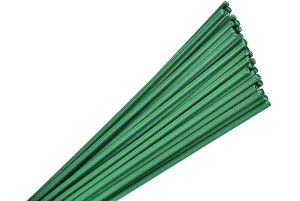
Figure 3 Green polypropylene (PP) plastic welding rods supply filler material to form strong, heat-fused bonds during thermal enclosure repair and prototyping. Source: Author
A replicable framework for choosing a joining method
- Identify both resins and confirm they are the same family — ABS to ABS, not ABS to PP.
- Measure wall thickness; above 1/4″ plan for extrusion welding and V-grooves.
- Fix the volume: prototypes and field repairs favor hot-air and irons; repeat assembly favors ultrasonic, laser or friction.
- Pick the joint geometry — energy directors, shear joints or V-grooves — before tooling.
- Verify with a peel or tensile test, then document temperature and surface-prep settings for repeatability.
Frequently asked questions
Can ABS be welded to polypropylene?
No. Without matched solubility parameters the interface resists entanglement; use a matched resin or a mechanical fastener instead.
Is a soldering iron good enough for plastic seams?
No — a Weller or similar iron is built for tin-lead alloys and will char polymer and ruin the tip. Use a flat brass plastic iron or a controlled hot-air station at 300–350 °C.
Why does my glue joint peel off HDPE?
HDPE sits near 31 mN/m of surface energy, below most structural adhesives' wetting range. Weld it, or treat the surface before bonding.
How fast is ultrasonic welding versus hot-air?
Typical ultrasonic cycles run from a fraction of a second to a few seconds; manual hot-air seams take far longer and depend on operator skill.
When should I stop repairing and replace the tank?
If the crack tips cannot be arrested with 3-mm relief holes, or the walls cannot hold a 60°–90° groove, replacement is safer than a structural weld.
References
- TWI — Welding Techniques for Thermoplastics: twi-global.com
- ScienceDirect Topics — Ultrasonic Welding overview and cycle-time range: sciencedirect.com
- Incure — Why Adhesives Fail on Low-Surface-Energy Plastics: incurelab.com
- Frontiers in Materials — carbon black in laser transmission welding: frontiersin.org