
WorldIndustrialWeekly General: How GE Vernova's 6 GW Barmer–South Kalamb HVDC Corridor Compares With HVAC Grid Alternatives
For bulk renewable evacuation from Barmer to South Kalamb, GE Vernova's 6 GW HVDC corridor is a better match than HVAC because it carries 6,000 MW over long distance with lower reactive constraints, converter-grade control via eLumina, and an end-to-end delivery model. HVAC remains useful for shorter, meshed collection, but the Barmer–South Kalamb case favors HVDC's capacity density and stable bulk transfer.
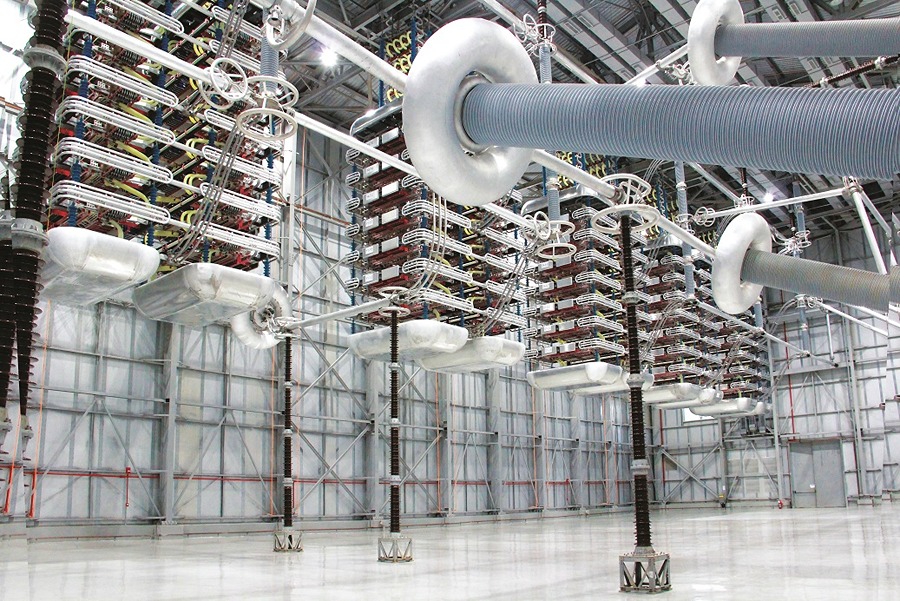
What PGCIL is buying, and why the delivery model matters
GE Vernova's award from PowerGrid Corporation of India Limited covers the complete design of a ±800 kV, 6,000 MW (2×3000 MW) bipolar link between Barmer II and South Kalamb, according to GE Vernova's project announcement. The scope extends to new converter stations, major equipment supply, site erection, testing, and commissioning. The booking took place in the fourth quarter of 2026.
This end-to-end structure is the first comparison point: a supplier is not merely selling valves or controls, but integrating them into a schedule that must coordinate civil works, converter sites, grid interface studies, and commissioning windows. GE Vernova's newsroom describes the scheme as “The Barmer–South Kalamb HVDC corridor is a strategic project for PGCIL,” a framing that fits the utility's need to move power from renewable-rich Barmer, Rajasthan, to load centers while keeping India's transmission expansion credible for industrial offtakers.
One earlier governance step sharpens the risk lens. As reported in September 2026, PowerGrid Corporation of India Limited acquired the Barmer HVDC Power Transmission Limited special-purpose vehicle through the TBCB route; financial coverage from ICICI Direct put the consideration at ₹18.98 crore. For project managers, that detail matters because a headline contract is only useful once the owning vehicle, land, permits, converter stations, and test resources are aligned. Read with the $9 billion grid bet coverage, the Barmer corridor becomes a case study in how financing pressure and execution readiness can move large electrification timelines.
HVDC versus HVAC: the trade-offs that decide a renewable corridor
For an industrial audience, the useful question is not whether HVDC is “advanced,” but whether its cost and control profile matches the job. HVAC is usually more economical for dense, shorter-distance networks where substations are already interconnected and power can be distributed in smaller blocks. HVDC is favored when bulk energy must cross long distances with fewer conductor losses and without the reactive-power limits that constrain very high-capacity AC links.
The 800 kV system rating is the headline voltage class, while ±800 kV describes the bipolar polarity arrangement used in the corridor.
| Decision factor | HVAC grid path | HVDC corridor | Industrial implication |
|---|---|---|---|
| Power block size | Often split across circuits and substations | A single bipolar design can move 6,000 MW, with 2×3000 MW poles | Easier to align with large renewable parks |
| Distance and losses | Reactive power and line charging constrain very long bulk transfer | DC lines reduce those constraints and can be competitive over long spans | Lower congestion risk for remote generation |
| Control surface | Depends on nearby synchronous machines, FACTS, and AC network strength | Converter controls such as eLumina can manage power flow dynamically | More predictable for scheduled transfers |
| Execution burden | More AC stations can be modular and widely sourced | Converter stations, erection, testing, and commissioning require tight integration | Need stronger program management |
The table is not vendor advocacy. It shows why the Barmer II–South Kalamb case is best read as a technology-fit decision: the route must evacuate renewable energy from Rajasthan into a national grid path, so the corridor's value is judged by transfer reliability, not just headline MW.
LCC versus VSC: why the converter choice is not just engineering detail
The project uses an advanced LCC (Line Commutated Converter) valve and the eLumina control system, with valves manufactured at the Pallavaram factory in India. Comparative engineering literature, including a 2026 ScienceDirect review of HVDC and renewable transmission, notes that LCC designs are often favored for high-power, long-distance bulk transfer, while VSC designs are useful when a network needs flexible active and reactive power support or operates around weaker renewable nodes.
That distinction matters for managers and procurement teams because the converter type affects spare-part planning, control-system integration, testing protocols, outage risk, and the quality of local service support. For Barmer, the LCC selection suggests a priority on moving 6,000 MW as a coherent block. It does not eliminate the need for AC system studies at both ends, and it does not mean the project automatically removes curtailment.
Common misconceptions and practical risks
- Myth: a 6 GW corridor creates 6 GW of generation. The transmission corridor provides transfer capacity. Renewable development in Barmer must still be built, financed, connected, and scheduled.
- Myth: HVDC makes grid stability automatic. The corridor can improve large-scale transfer, but stability depends on converter control, network strength, protection settings, and operating discipline.
- Myth: award date equals commercial operation. The booking took place in the fourth quarter of 2026, while the full scope covers erection, testing, and commissioning. Those are sequential gates with separate supply and site risks.
- Myth: local manufacturing removes execution risk. Producing valves at the Pallavaram factory in India strengthens supply resilience, but converter stations still require civil work, interfaces, and integration with the wider AC network.
Action checklist for managers, planners, and procurement teams
- Treat the corridor as an execution program, not a purchase order: verify converter-station milestones, equipment lead times, and commissioning windows before relying on renewable evacuation capacity.
- Compare delivery models: bundled engineering, supply, erection, testing, and commissioning can reduce interface risk, but only if the contractor carries credible project controls and field service depth.
- Score the technology against the duty cycle: if the job is bulk long-distance evacuation from Barmer, HVDC is the rational frame; if the job is local distribution or weak-grid flexible control, HVAC or VSC may deserve separate evaluation.
- Track governance and financing signals: the SPV and contract timeline tell industrial users when the project is moving from paper to energized assets.
- Use the corridor as a template for risk review: map curtailment exposure, outage assumptions, vendor dependency, and local grid constraints before making procurement or investment decisions.
Frequently asked questions
Why is the Barmer–South Kalamb link described as an energy highway?
Because the 800 kV corridor is designed to move large power blocks from a renewable-rich region to a load center. It reduces dependence on multiple congested AC paths and gives operators a more predictable transfer channel.
What does 2×3000 MW bipolar mean?
It means the scheme is built as two converter paths, each rated 3,000 MW, to reach the total 6,000 MW design target. The bipolar arrangement is a core reason the project can be described as a 6 GW corridor.
Does the GE Vernova award guarantee lower electricity prices for industry?
No. It improves the physical possibility of evacuating renewable power from Rajasthan into the wider grid. Price effects still depend on generation mix, tariffs, dispatch, congestion, and policy.
Which comparison matters most: GE Vernova versus another supplier, or HVDC versus HVAC?
For general industrial readers, the technology-fit comparison is more useful. Supplier selection matters, but the decisive question is whether long-distance HVDC can serve the corridor better than AC alternatives for the same power transfer.
What should readers watch after the fourth quarter of 2026 booking?
Watch converter-station progress, supply-chain lead times for major equipment, grid studies, and commissioning milestones. Those are the gates that convert a 6 GW design into an operating asset.
References
- GE Vernova press release on the Barmer–South Kalamb HVDC project
- ScienceDirect: HVDC Systems and renewable energy in a comparative analysis
- Business Standard: Power Grid acquires Barmer HVDC Power Transmission Limited under TBCB route
- ICICI Direct: POWERGRID acquires Barmer HVDC SPV for ₹18.98 crore