
WorldIndustrialWeekly General: Case Replay — Pricing Spectral Crop-Disease Detection by the Band, Not the Box
Ask a grower what a spectral disease sensor must do, and the answer is not "capture 200 bands" — it is "tell me this week which field needs a pass, at a price I can recover." A soybean trial at North Dakota State University produced that kind of early signal: Twelve days after planting, hyperspectral imaging separated sudden-death syndrome from healthy plants before any visible symptom appeared.
The signal came from Xin "Rex" Sun's team at the Peltier Institute for Advancement in Agricultural Technology. They said the separation was visible several days to approximately a week before the eye could see it. The work has yet to be validated under field conditions, which makes it a promising research output rather than a purchasing specification.
The economics are the harder half of the case. Research-grade hyperspectral cameras can cost tens or hundreds of thousands of dollars, demand specialized expertise and produce very large volumes of data. Without a clear financial return, few growers can justify that spend — and that gap is exactly what the cheaper-sensor route tries to close.
What the soybean case actually showed
The conclusion is narrow: the spectral difference exists before symptoms, but the field proof does not. In the greenhouse, plants hit by sudden-death syndrome could be separated from healthy ones Twelve days after planting using hyperspectral imaging, while the plants still looked alike to a person.
"That's the beauty of using hyperspectral imaging technology," Sun said. "It's all about selecting the bands."
His hypothetical is concrete: if two or three wavelengths reliably separate soybeans hit by sudden-death syndrome from healthy ones, a multispectral camera built around those wavelengths can take the place of the far costlier research instrument. The lab's own multispectral units hold four to 10 bands.
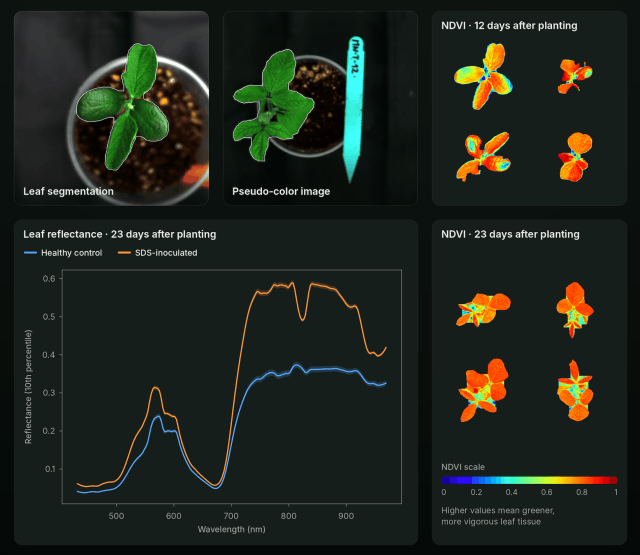
Soybean sudden-death syndrome detection using hyperspectral imaging technology (Source: Rex Sun and Febina Mathew | North Dakota State University)
Why the band count, not the camera box, sets the price
Ordinary cameras record reflected light in three broad bands: red, green and blue. Hyperspectral imaging splits light into many narrower bands, exposing shifts in a plant's physiological or chemical state that may not yet show in appearance.
Sun's laboratory recently took delivery of a short-wave infrared (SWIR) camera covering approximately 1,000 to 2,500 nm, with more than 200 spectral bands. For research that breadth is useful, because nobody can know in advance which wavelengths carry the signal. A grower managing one specific disease may need only a small share of it.
The cost ladder follows the band count. Research-grade hyperspectral systems carry six-figure prices, while the multispectral cameras in Sun's lab sit at hundreds or thousands of dollars. Market pricing guides put entry-level agricultural hyperspectral units at roughly $8,000 to $18,000 in 2025, down from more than $30,000 in 2019 — cheaper than a decade ago, still far above a per-acre scouting budget.
Data volume is the other half of the cost. Extensive hyperspectral measurements can generate hundreds of gigabytes or more, which calls for substantial processing resources. "If we can find three or four bands out of the hyperspectral imaging, those small processors can process them," Sun said. "Then it can be fast enough in the field to give you a good result."
That is why the band, not the camera, is the unit of account in this case.
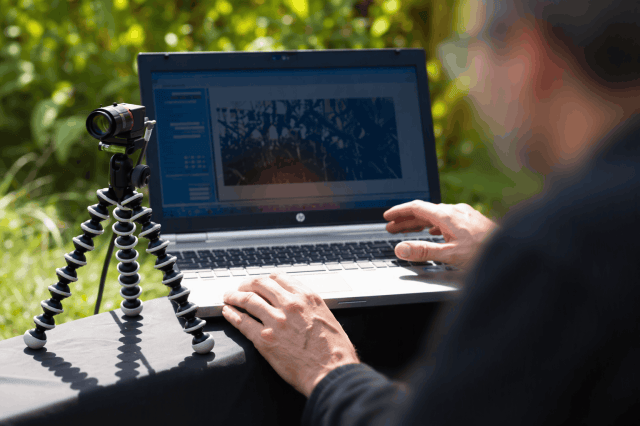
A snapshot multispectral camera used in the field (Source: imec)
How imec is putting the filters on silicon
At imec, the Belgian semiconductor research organization, the goal is to make application-specific spectral sensors commercially practical. Carolina Blanch, a senior researcher working on hyperspectral imaging applications, agreed that most uses do not call for the full spectrum.

Imec's Carolina Blanch
"We typically start with high-resolution spectral cameras that capture around 100 bands, then identify which ones are most relevant," she said. "For most applications, 10 or fewer bands are sufficient."
Designing a separate sensor for every crop disease is not necessarily economical, so imec also develops standardized sensors with nine, 16, or 25 spectral bands that serve several applications at once and spread manufacturing costs across larger markets.
Klaas Tack, technical lead of hyperspectral imaging at imec, explained the manufacturing route. Traditional hyperspectral cameras often depend on separate optical components to divide incoming light into wavelengths; imec's alternative integrates spectral filters directly with image detectors during semiconductor fabrication.
"We developed a process in our fab where we integrate the filters with the detector," Tack said. "Because we're doing this at wafer level, we're manufacturing many detectors at the same time."
That trims components, size, weight and alignment requirements, and it makes compact snapshot sensors possible — sensors that capture spatial and spectral information in a single exposure, avoiding some of the motion artifacts of scanning cameras. That matters when sensors ride on moving tractors or drones, or when wind stirs leaves during image acquisition.
Manufacturing volume is the remaining economic hurdle. Tack points to Spectricity, an imec spinoff targeting smartphone applications with low-cost snapshot multispectral sensors. Those devices are not built for agricultural disease detection, but they demonstrate the volume economics: "When the volume is high enough, you can dramatically reduce the cost," Tack said.
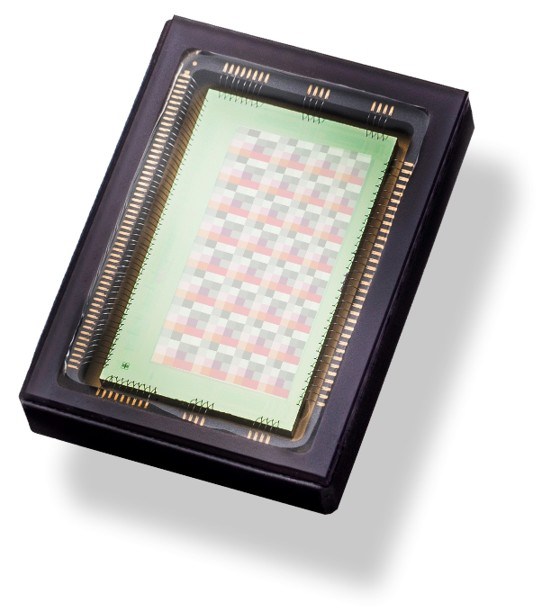
A snapshot multispectral detector with 25 bands organized in 5 × 5 patterns of pixels. Because of the small size of the pixels, the picture shows an artistic impression of this layout. (Source: imec)
Where the sensor works — and where it does not
Not every application gains equally. Some diseases and stresses can be picked up in visible and near-infrared wavelengths; others are better served by SWIR measurements, which can reveal additional information about plant chemistry and water-related stress.
SWIR detectors remain more expensive than conventional CMOS sensors, and Tack said integrating spectral filters with them is more complicated. Further manufacturing advances may be needed before comparable cost reductions can be achieved.
Sun's team has a related warning: disease and other stresses can produce similar spectral shifts, particularly before symptoms become visible, and changing sunlight, soil conditions and other environmental factors also affect measurements. That is why the team has been gathering agricultural imagery under varied conditions instead of trusting a single greenhouse result.
- Misconception one: more bands always mean a better diagnosis. The trial's logic runs the other way — find the few bands that separate the disease, then build the camera around them.
- Misconception two: a greenhouse signal transfers directly to the field. Sun's team has not yet established a sufficiently validated set of wavelengths for field diagnosis of soybean sudden-death syndrome.
- Misconception three: any spectral camera can be dropped onto any machine. Alignment, vibration and changing light all move the measurement.

Imec's Klaas Tack
How to run the payback test before you buy
The decision rule is not "which camera has the most bands" but "which few bands, on which machine, pay back inside the window the farm can tolerate." Historical yield losses from sudden-death syndrome generally range from 1 to 25 percent, so the size of the prize depends on how often and how early the disease shows up in a given field.
Blanch's framing helps: start from the 100-band research camera, keep the 10 or fewer bands that matter, then decide whether a standardized nine, 16, or 25-band sensor covers the job. Tack believes the visible and near-infrared technology is already available to application developers. "I think today we can provide them with the technology that is required," he said.
Sun expects significant progress over the next five or six years, and he is blunt about the buying test: "If you're a farmer, you need to think twice," he said of investing in an expensive hyperspectral system. "If I spend that much money, I want to know how soon I get my money back."
A practical checklist for a farm or an ag-tech team evaluating this route:
- Define the single disease or stress to be detected; do not buy a general-purpose research camera.
- Require field data across at least two seasons and multiple soil and light conditions before trusting a wavelength set.
- Price the decision, not the sensor: cost per scouted acre and per avoided or targeted spray.
- Start with a standardized nine, 16, or 25-band sensor and confirm it covers the disease before customizing.
- Mount the sensor on the machine that already does the pass, and set a payback horizon before purchase.
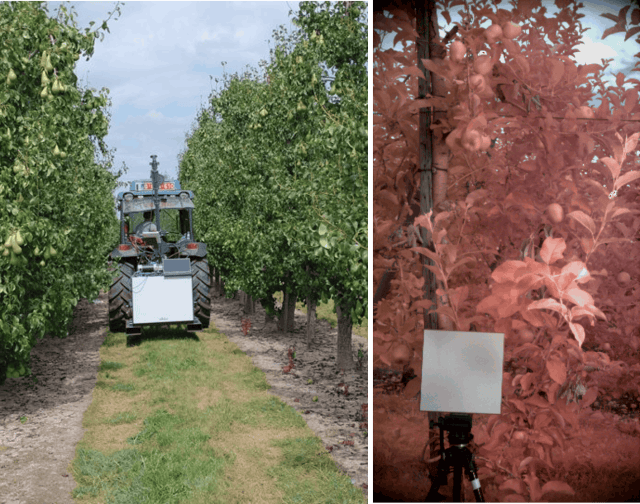
In-field demonstration of a multispectral camera used to detect fire blight in orchards (Source: imec)
FAQ
How early can spectral imaging detect soybean sudden-death syndrome?
In the greenhouse trial at North Dakota State University, the separation was visible Twelve days after planting, several days to approximately a week before symptoms could be seen. Field validation is still pending.
How many spectral bands do you actually need?
For most applications, 10 or fewer bands are sufficient, according to imec. For one specific disease, Sun's hypothetical case uses two or three wavelengths, captured by a camera holding four to 10 bands.
What does a field-ready multispectral camera cost?
Cameras with four to 10 bands run hundreds or thousands of dollars. Research-grade hyperspectral systems cost tens or hundreds of thousands of dollars, with some at six-figure sums.
Can this be deployed on farms today?
Not as a validated product. Sun expects significant progress over five or six years and stresses that field validation remains essential.
Which diseases are better served by SWIR?
SWIR measurements can reveal additional information about plant chemistry and water-related stress, but SWIR detectors are more expensive and harder to integrate, so they are not the first choice for every crop.
参考来源
- imec hyperspectral imaging: https://www.imechyperspectral.com/en
- Crop Protection Network, An Overview of Sudden Death Syndrome: https://cropprotectionnetwork.org/publications/an-overview-of-sudden-death-syndrome
- Kansas State University eUpdate, Sudden Death Syndrome in Soybeans: https://www.agronomy.k-state.edu/eupdates/2026/issue-1118-august-27/sudden-death-syndrome-in-soybeans.html
- imec wafer-level spectral filter process, Phys.org: https://phys.org/news/2015-02-imec-snapshot-hyperspectral-image-sensors.html