
Oz, Ted or a Large Tractor: A Field-Level Comparison of What Unsupervised Farm Work Really Requires
Read the specs first: Oz weighs about 150 kg, travels below 2 km/h, and covers roughly half a hectare a day on vegetable blocks of 1–20 hectares. That small robot runs unsupervised because its risk envelope is narrow. A large tractor working U.S. Midwest corn and soybean acres carries more mass, more speed and a much heavier safety burden. Verdict: unsupervised farm work is approved machine by machine and parcel by parcel — never sold model by model.
I review autonomy quotations the way I review a line retrofit: what changed on the machine, what changed in the work, and who is standing there when it stops. Two statements frame the whole comparison. Salah Issa, associate professor in the Department of Agricultural and Biological Engineering at University of Illinois Urbana–Champaign, works on agricultural safety and is the person most often asked whether a big machine can run alone. Matthias Carrière, Naïo's managing director, sells machines that already do. Both spoke to EE Times, and their answers diverge exactly where a buyer's spreadsheet is thinnest.
Where does the word autonomy actually start?
It starts with supervision, not with navigation. Carrière's definition is deliberately narrow: "When we talk about autonomy, we mean work without supervision," he told EE Times. Nobody watching, nobody holding a remote, nobody walking behind to confirm the route. Everything else — guidance accuracy, implement choice, task list — is secondary to that single claim.
For row-crop growers, the payoff sits somewhere else. Issa's research is shaped by the scale of Midwest grain, and he does not promise a labor substitution there. "It's more of the same operation, either doing it with a better life balance or over more acres to expand operations," he told EE Times. In his read of U.S. Midwest corn and soybean production, autonomy buys schedule control and coverage, not a smaller crew.
Fruit and vegetable operations open a different door, because the work being automated is manual work that is hard to staff. Issa points to produce-carrying robots that walk alongside workers and to autonomous sprayers moving through orchards, where the task and the workflow decide when people and machines meet.
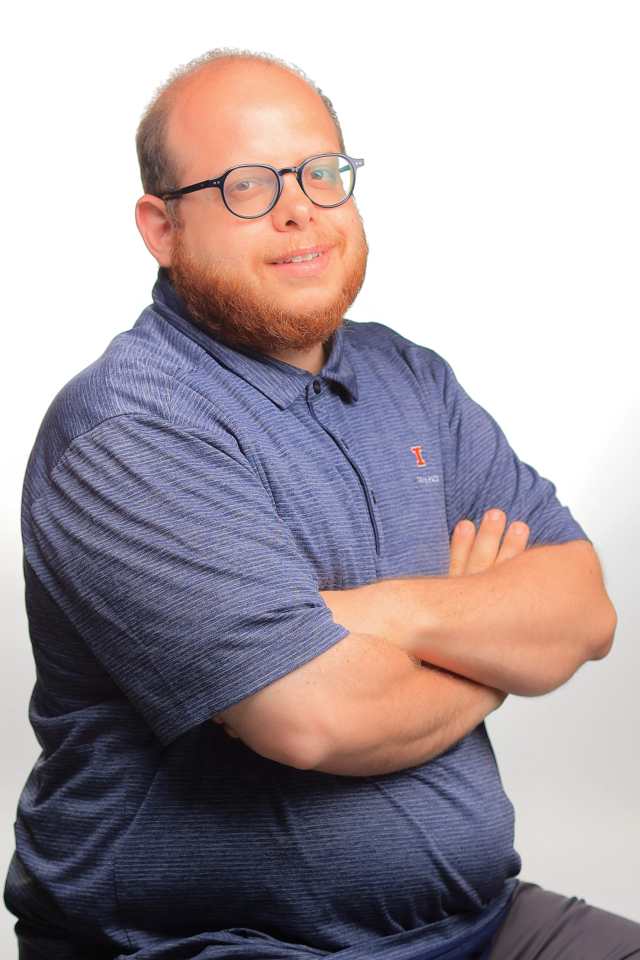 University of Illinois Urbana–Champaign’s Salah Issa
Oz, Ted or a large tractor: what actually differs?
The French company at the centre of this comparison is Naïo, whose two platforms cover opposite ends of low-speed autonomy: Oz, a small robot for vegetable growers and other specialist crops, and Ted, a robot that straddles vineyard rows, primarily for mechanical weeding. The American counter-example is the heavy machine Issa studies: a high-horsepower tractor on open grain land, where an encounter with a person is a different class of event.
| Comparison dimension | Oz (specialty vegetables) | Ted (vineyard) | Large autonomous tractor (row crops) |
|---|---|---|---|
| Typical buyer | Vegetable farmers and seed producers, usually 1–20 hectares | Wine growers working between rows | Grain operations scaling acreage or crew hours |
| Mass and speed | about 150 kg, below 2 km/h | Heavier straddle frame, still low speed | Multiple tonnes at several times the speed |
| Throughput reference | roughly half a hectare a day | Row-by-row mechanical weeding | Fieldwork windows measured in hours, not days |
| Primary safeguard | Mechanical contact bumper | Contact and boundary protection; vegetation can trip it | Perception-based stopping with long stand-off distance |
| Boundary control | Parcel assessed before release; barriers or virtual limits | Row geometry plus mapped limits | Open parcels, public edges, road transfers between fields |
| Who is accountable | Manufacturer signs a per-parcel supervision decision | Same parcel logic, higher interruption rate | Mostly unresolved; machine-specific guidance still developing |
| Where the case is strongest | Manual weeding, sowing, harvest transport | Herbicide-free weed control | Long days, tight planting and harvest windows |
The right-hand column is my analysis, not a published specification: no standard fixes a universal stop distance for a tonnage-class machine, and that gap is the subject of the next section. The middle column is where a procurement conversation gets honest. On Ted, vegetation growing beside a vine can trigger the mechanical safeguards, and someone must investigate and clear the obstruction before unattended work resumes.
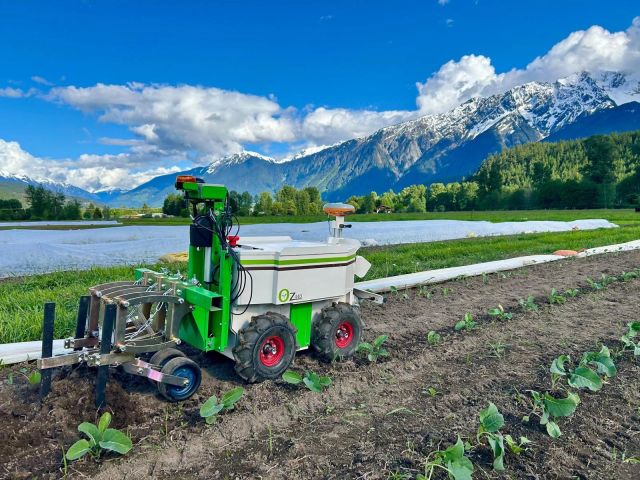 Oz in British Columbia, Canada
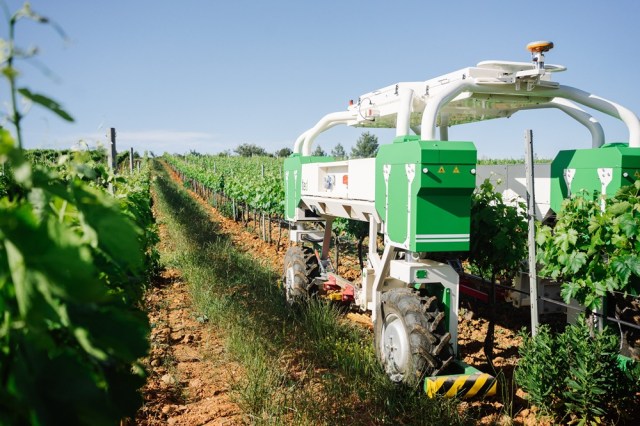 Ted
How is person detection verified — and is the test object good enough?
Short answer: the industry's stand-in is crude, and researchers know it. To assess obstacle detection, Issa describes a two-cylinder test object used to represent a person. Other groups have checked how that training transfers. "They studied machines trained using the cylinders as stand-ins," he said. "They found that when the machine operates with real humans, the level of accuracy drops."
Environment does the rest of the damage. "Vision systems get dusty. You're dealing with vibrations, which impact the effectiveness and the longevity of sensors," Issa said, which is why he favours combining sensor types rather than trusting one technology. If you have ever qualified a bracket against cab-level shaking, the vibration half of that sentence is familiar; component teams normally do that work with noise, vibration and harshness methods such as ISO 20270 blocked-force testing, and a lab result is a floor, not a field guarantee.
On paper, ISO 18497 is the reference frame. Issa said it provides a broad framework, but that more detailed standards are needed for particular machines, and the latest version points manufacturers toward additional obstacle-detection guidance while leaving questions such as how far from a person a machine should stop to be answered by application-specific guidelines. Buyers should read that precisely. A California Labor and Industries research briefing on automation in agriculture lists the standard as a multi-part series: the original 2018 document on design principles, then Part 1 on machine design principles and vocabulary, Part 2 on obstacle protection, Part 3 on autonomous operating zones, and Part 4 on verification methods and validation principles (dir.ca.gov). The practical consequence: ask a vendor which part and which clause a claim rests on, not whether the machine is "ISO 18497 compliant".
Two scope limits are worth flagging before a machine crosses a public road. The autonomous-operating-zone part of the standard excludes work on public roads, including braking and steering requirements, and excludes forestry; road movement then falls back on machine-specific documents such as the ANSI/ASABE brake standards for farm equipment and the lighting-and-marking practice for highway travel (asabe.org). Issa's safety assessment also extends to setup, cleaning, maintenance and other stages where workers remain involved.
Why does Naïo not simply add better sensors?
Because its risk model starts from mass and speed, not from perception. Oz uses GPS with real-time kinematic (RTK, a correction method that narrows positional error to centimetres) for guidance, plus a sensitive contact bumper. "A very light bump is enough, and it stops on contact," Carrière said, attributing that choice to Naïo's assessment of the robot's mass, speed, and intended operating conditions. He is equally blunt about the perception stack: "Our robots don't use AI," Carrière said. "We prioritize affordability and straightforward operation."
That is a defensible trade for a small, slow machine with a defined application. It is not a general answer. Contact-based protection necessarily acts after contact occurs, so suitability depends on the complete risk assessment, including movement and task; low speed alone does not establish that every possible encounter is harmless.
The architectural point Naïo does insist on transfers to any site. Carrière described a separate boundary-safety loop, with mapping distinct from that used to guide everyday work. "You must always isolate the loops," he said: route-following and enforcement of an approved operating boundary are different functions. Any factory engineer recognising that argument is looking at the same problem in the plant — deterministic fieldbus and time-sensitive edge links, such as EtherCAT (Ethernet for Control Automation Technology) and Time-Sensitive Networking (TSN), exist to keep control and safety traffic predictable when perception data floods the same wire.
What happens when protection keeps interrupting the job?
Repeated interruptions create a difficult engineering problem: protection that gets in the way can encourage users to defeat it. Issa recalled a demonstration where a manufacturer covered sensors with duct tape so a machine could operate with people nearby, and worries that frustrated farmers facing frequent nuisance stops adopt the same workaround. A safety mechanism can perform its intended function while prompting behaviour that undermines it. Warnings age the same way: users grow accustomed to them and stop noticing, and asking a person to intervene whenever the machine is uncertain has practical limits if the requests become burdensome.
The behavioural loop is the part most business cases ignore. "We're now assuming the machines will respond to our interactions," Issa said. "Then we change the way we interact based on how we assume the machine does."
Naïo engineers against foreseeable misuse: the robots will not start if required safety devices have been disabled, and even supervised operation is designed to make circumvention difficult, requiring the operator to interact with the remote control every six minutes to confirm that someone remains near the machine. A farmer who deliberately rigs around such safeguards, Carrière said, crosses an important line: the manufacturer designed for misuse, but the user intentionally defeated the safety system.
Which operation pays back first?
Look at your labour line before you look at a demo. USDA's Economic Research Service reports that, from the 2022 Census of Agriculture data, wages and salaries plus contract labour costs represented just 12 percent of production expenses for all farms, but 42 percent for greenhouse and nursery operations and 40 percent for fruit and tree nut operations (ers.usda.gov). That spread explains why the two conversations sound different. In grain, paid labour is a small slice, so the return is schedule and coverage. In greenhouse, nursery, orchard and vegetable work, manual hours are the biggest controllable cost, and a machine that removes walking, carrying and waiting shows up in the same quarter.
Run the arithmetic on a small platform. At roughly half a hectare a day, a 20-hectare block is about 40 working days of weeding — more if the machine shares the day with sowing, planting and harvest transport, which Oz also supports alongside its original weeding role. Whether those days are free depends on who clears the false stops and who re-maps a field after rain, which is why my payback template counts supervision minutes as a cost line, not an overhead.
Four misconceptions that break autonomy business cases
- Autonomy is a feature on a spec sheet. It is a per-parcel supervision decision. Naïo assesses individual parcels before approving unsupervised operation; physical barriers can simplify containment, virtual boundaries are used elsewhere, and shared access routes or nearby activity complicate the assessment.
- Slow equals safe. Contact protection reacts after contact, and suitability comes from the full risk assessment.
- More sensors equal more safety. Dust, vibration and the drop in accuracy when real humans replace test cylinders all argue for redundant sensor types plus a stated verification method.
- Technology maturity predicts fit. Farm structure does. "You can have all the AI and all the technology in the world," Carrière said. "If the structure of a farm is not compatible with using a machine, and the farm is not ready to make structural changes, it won't work."
Who signs for unsupervised work, and how does the fleet scale?
Responsibility is documented, not implied. "It's Naïo's management that signs a document saying that, on this parcel, the robot can operate alone; on that parcel, it cannot—it must be supervised. That is how we assume responsibility," Carrière said. The approval relies partly on information supplied by the farmer, including whether an adjoining route is public or private, and users must respect the operating conditions. Naïo stands behind its assessment and safety systems rather than assuming every possible liability.
Then there is the learning problem. Issa argues that learning from near-misses is essential while deployment remains limited, because waiting for serious accidents provides feedback too late; unexpected encounters, confusing behaviour and situations that make users uncomfortable reveal weaknesses earlier. Ask any supplier for the near-miss reporting channel and what changed in the last firmware release because of it.
Supply and service reality also belongs in a comparison. Naïo closed a US$33 million (€32 million) funding round announced in late 2022 to industrialise production (naio-technologies.com); trade reporting in November 2025 described a turnaround plan targeting roughly 100 robots produced annually and about €11 million in revenue, with operational balance by 2028 (agnavigator.com). At the time of its 2020 Series A, industry coverage counted close to 150 machines in the field (agfundernews.com). Read as analysis rather than vendor promise: small fleets mean long lead times, thin parts stock and one technician covering several regions, so a multi-machine rollout should be scored on service coverage before capability.
One regulatory date matters for 2027 deliveries. Regulation (EU) 2023/1230 on machinery safety applies from 20 January 2027, replacing the older Machinery Directive and adding obligations relevant to machinery with autonomous behaviour and to digital instructions (eur-lex.europa.eu). If you are quoting a European-built robot for delivery next year, ask which conformity file you will receive.
FAQ: what buyers ask me before signing
Can the machine run with nobody on site?
Only where the manufacturer has approved that specific parcel under defined conditions. Carrière's rule — "When we talk about autonomy, we mean work without supervision" — is exactly the claim that gets tested by boundaries, bystanders, animals and changing outdoor conditions.
Is a small robot automatically the safer purchase?
It is the safer starting point, because mass and speed set the consequences of an encounter. Stopping distance and protective measures required for a small robot moving slowly between vegetable rows differ from those for a large tractor, and the standard leaves the exact stand-off distance to application-specific guidance.
What evidence should I demand on detection?
The test object (a two-cylinder stand-in or real human subjects), the sensor stack, the verification method and the ISO 18497 part being cited. Issa's position is redundant sensing, because single technologies degrade with dust and vibration.
What if the machine stops constantly?
Do not defeat the safeguards. Measure nuisance-stop minutes per field day, put them in the business case, and take the data back to the vendor. Naïo blocks start-up when safety devices are disabled and requires remote-control re-engagement every six minutes in supervised mode precisely because bypass behaviour is expected.
Do field conditions or technology decide first?
Conditions. The blocking quote in this whole comparison is Carrière's: "If the structure of a farm is not compatible with using a machine, and the farm is not ready to make structural changes, it won't work."
The repeatable framework I would run on any parcel
- Map the encounters. List every person, animal and bystander route the machine can meet, including adjoining public and private access. Task and workflow determine where people meet equipment.
- Fix the envelope. Write down mass, speed, implement and area as a risk set, then choose the safeguard from that set — contact bumper, stand-off stopping, or both.
- Isolate the loops. Guidance mapping separate from boundary enforcement, with a stated response when conditions change.
- Score the interruptions. Time every stop for one season, including clearing vegetation caught by mechanical protection, and price the labour it takes.
- Get the supervision decision in writing. Per parcel, signed by the manufacturer, with a near-miss log you own and review before scaling to the next block.
The machines are not converging; the two philosophies are still visible in the specifications. One supplier keeps the perception stack simple and the safety logic auditable, and says so — "We're not going to add innovation for innovation's sake," Carrière said — while the researchers behind the standard want the verification detail written down machine class by machine class. Working alone requires safeguards suited to the application, and evidence that they remain effective when people put the machine to work. That is the test I would apply on your own field, parcel by parcel, before the first unattended shift.
Reference sources
- USDA Economic Research Service, Farm Labor topic page — 2022 Census of Agriculture labour cost shares: ers.usda.gov/topics/farm-economy/farm-labor/
- Aby, G.R. and Issa, S.F., "Safety of Automated Agricultural Machineries: A Systematic Literature Review", Safety 2023, 9(1):13 — mdpi.com/2313-576X/9/1/13
- California Department of Industrial Relations research briefing, overview of safety standards and practices for agricultural automation (ISO 18497 part structure) — dir.ca.gov
- ISO catalogue, agricultural machines and equipment in general (ISO 18497:2018 and related work) — iso.org/ics/65.060.01.html
- ASABE published national standards, including farm-equipment braking and lighting/marking — asabe.org
- Naïo Technologies newsroom, US$33 million (€32 million) funding announcement — naio-technologies.com/en/news
- AgNavigator, "How Naïo Technologies plots its comeback", 11 November 2025 — agnavigator.com
- EUR-Lex summary of machinery safety requirements, Regulation (EU) 2023/1230 application from 20 January 2027 — eur-lex.europa.eu
- Interview quotations from Salah Issa and Matthias Carrière as published by EE Times