
DK-NFLNK vs. Copper Harness vs. Chip-on-Cell: A Buyer's Decision Map for Pack Monitoring
Short answer: delete the harness only where the harness is the problem. On Dukosi’s own numbers, a contactless link removes connector escapes, high-voltage coupling and assembly labor, while the usable-energy prize — 6% to 12% — is released by the measurement stack behind it, not by the radio itself. Sampling is open; the decision now sits with pack engineers.
BUDAPEST, Hungary — At the Pretzl Connect 2026 press event, Dukosi, headquartered in Edinburgh, confirmed that commercial sampling has started for DK-NFLNK, a contactless intra-battery communication solution intended to remove wiring harnesses and raise battery safety.
I read that as three separate projects wearing one press release: a parts change, an assembly change and a data change. Only the first is decided by the chip supplier, and the second is the one your line will actually feel.
What is being sampled, and what it replaces
Instead of copper cabling, voltage and temperature data are transmitted wirelessly over one bus antenna using near-field radio-frequency (RF). The transport is C-SynQ, a protocol that runs those signals along a single conductor so they stay inside the enclosure and keep noise immunity without requiring line of sight. The link is synchronous, which is what makes it compatible with the wider Dukosi Cell Monitoring System, known as DKCMS.
Dukosi’s product material describes the deliverable as a set: a DK8503 node chip per module, a DK8203 system hub and a vendor API, with the node attaching to the analog front ends (AFE) already sitting on the module through a serial interface. That single sentence defines the addressable buyer: teams running multi-channel AFE architectures who cannot re-tool the module, not clean-sheet cell designers.
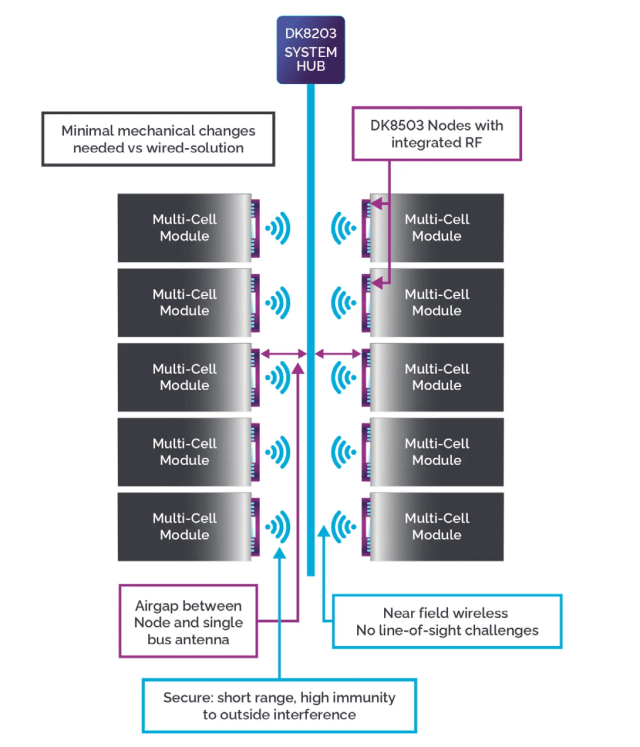 DK-NFLNK System Diagram (Source: Dukosi)
Why 10 parts per million is a line problem, not a datasheet problem
Joseph Notaro, president of Dukosi in Budapest, states: “Connector failure rates in a conventional wiring harness are around 10 parts per million,” followed by “In the automotive and industrial arenas where you’re looking at parts-per-billion-level reliability, that failure rate is simply too high and an unacceptable risk of failure.”
The second cost is invisible on the bill of materials. Wired networks create galvanic coupling between high-voltage circuits and low-voltage controls, while adding labor and weight. Trade coverage of pack automation keeps naming the harness as the station that is still assembled by hand wherever labor is cheap, which is exactly why it keeps showing up on deletion lists (EMobility Engineering).
Notaro frames the fix as subtraction: “With contactless technology, we decouple the high-voltage circuits and get rid of the physical connectors, which makes the system safer, higher quality, and more reliable over its entire operating life,”
 Joseph Notaro (Source: Dukosi)
Three interconnect paths compared
Contactless monitoring does not compete with a hand-built wire in isolation; it competes with the whole cell collection system (CCS) family. In current practice the signal layer is either a discrete harness with thermistor leads or a flexible printed circuit (FPC) laminated to the busbar plate — typically 0.1 to 0.3 mm thin, lighter and harder to mis-build, but still terminated with connectors and still etched at a price (Bonnen Battery). Read the row that matters to you.
| Decision factor | Wire-harness CCS | FPC-based CCS | Contactless DK-NFLNK | Full chip-on-cell (DKCMS) |
|---|---|---|---|---|
| Failure points | Connector failure rates are around 10 parts per million | Fewer discrete terminations, connectors remain | Removes physical connectors from the signal path | Removes physical connectors; node sits on the cell |
| High-voltage / low-voltage coupling | Risks galvanic coupling between high-voltage circuits and low-voltage controls | Same coupling exposure, shorter conductors | Decouples high-voltage circuits | Decouples high-voltage circuits |
| Installation and mass | Adds labor and weight | Lower insertion labor, higher board cost | Eliminates wiring harnesses | Eliminates wiring harnesses and module-level boards |
| What you must change | Nothing | CCS supplier and tooling | AFE interface code, hub, end-of-line (EOL) test coverage | Cell, module design and qualification from scratch |
| Realistic fit | Qualified legacy packs | High-volume packs chasing space | Retrofit-friendly step on existing AFE modules | New platforms and second-life-heavy markets |
What synchronous sensing is worth in energy, not in slides
Notaro said: “Smarter battery management starts with better data, and better data starts at the individual cell,” adding: “When you’re deciding available power or charge limits, you want every cell being measured at the same time under the same conditions. That’s the technical equivalent of taking a high-speed photo of every cell at the same time.”
He continued: “The weakest cell dictates the state of charge and the overall performance of the pack. If you don’t measure the cells in synchronization, then measurement errors creep in, and you’re forced to add in design margins, which in turn limit performance.”
Chemistry makes that margin more expensive, not less. Lithium iron phosphate (LFP) is notorious for a flat open-circuit curve: one test-instrument vendor characterizes the plateau as spanning roughly 27% to 94% state of charge with about 0.07 V of movement (IEST Instrument). Across that window, voltage alone cannot separate a small measurement error from a large capacity shortfall, so designers buy certainty with reserved energy. If chemistry selection is still open on your program, that trade is analyzed separately in our sodium, solid-state or lithium-ion decision matrix.
DKCMS — built around the DK8102 Cell Monitor chip and DK8202 System Hub — targets the system measurement errors that traditionally degrade usable battery capacity rather than the cell itself. Notaro said: “By providing consistent cell-level data, operators can reduce safety buffers and increase usable energy by 6% to 12%,” and “You are not altering cell chemistry or adding weight; you are simply extracting energy previously locked away by measurement margins.”
At project scale, for utility-scale energy storage, that efficiency gain produces a direct financial impact: in a 200-MW installation, additional revenue of $8 million can be generated from the extra capacity, or capex can be reduced by $2 million by needing fewer cells. My caution, not the vendor’s: those two figures are the same kilowatt-hours expressed once as revenue and once as avoided silicon. Test whichever one matches your contract — tariff and availability for the revenue case, cell price for the capex case — before either number enters an investment memorandum.
How much warning time does a thermal event actually leave?
For Li-ion battery safety, the goal is preventing thermal runaway. A short circuit in a single cell can start an exothermic reaction that spreads to neighboring cells. Older pack designs used only two or three temperature sensors across the whole module and therefore did not monitor individual cells.
Notaro said: “In the traditional layouts with very sparse temperature sensing, the heat from a failing cell can take 10 to 15 minutes to get to an external sensor,” and “With sensing capability on every cell, temperature excursions are detected almost immediately, well before the heat has a chance to propagate to the adjacent cells.”
That is where software earns its seat: with cell-level monitoring, algorithms can run outlier detection, comparing thermal profiles across cells and flagging minor deviations before they become problems. The payback is only real if the acquisition is timing-aligned, which is also what makes proving it a synchronized multi-channel capture job on the bench before it is a pack problem in the field.
Notaro is blunt about the shortcut: “Some manufacturers try to cut costs by getting rid of the sensors and just assuming the cells are all the same,” adding: “Every chemical manufacturing process has variation. You can’t have a battery pack that’s that uniform and then ignore the cell-level monitoring without increasing your operating risk.”
One counterweight worth pricing in: under ISO 26262, the automotive functional-safety standard and its automotive safety integrity level (ASIL) classes, voltage and temperature acquisition sit inside the safety mechanism chain, so changing the physical layer drags diagnostic coverage and EOL validation back onto the schedule (peer-reviewed BMS functional-safety methodology, Energies, 2021).
What the battery passport asks of your bill of materials
The Regulation (EU) 2023/1542 of the European Parliament and of the Council requires that “From 18 February 2027 each LMT battery, each industrial battery with a capacity greater than 2 kWh, and each electric vehicle battery placed on the market or put into service shall have an electronic record (‘battery passport’).” The European Commission’s digital product passport page carries the same start date for the covered categories.
My reading, flagged as analysis: the rule is a data-access duty, not a sensor mandate. A passport populated with pack-level estimates is legally possible and commercially thin, because the downstream reader — insurer, second-life buyer, recycler — cannot price a cell it cannot see.
Dukosi’s monitoring technology may also support collection of operational data relevant to the EU Battery Passport. From Feb. 18, 2027, batteries covered by the EU Batteries Regulation will require an electronic record containing information about identification, composition, performance, and health. The DKCMS chips include onboard non-volatile memory and a unique silicon identifier attached to each cell.
Notaro said: “Every cell has its own digital passport on chip, which records the maximum temperature it’s ever seen, its voltage history, and total charge cycles,” adding: “When the battery has finished its life in the car, the recyclers and integrators simply read the chip to determine the health of the cell, which allows them to sort it efficiently for either grid use or recycling.”
Which customer profile fits which path
During the briefing, EE Times asked whether battery manufacturers in China approach monitoring and safety differently from companies in other regions, particularly whether their strategies are mainly cost-driven.
Notaro replied that China has two distinct tiers of customers: one that prioritizes safety and total system value, and another strictly focused on short-term component costs. He stressed that this split is not unique to China, because carmakers worldwide divide between safety-conscious and cost-driven mindsets, and added that the massive volume of EVs in China gives domestic manufacturers extensive operational data, accelerating their ability to refine battery quality over time.
Treat that as a purchasing variable, not a map. The same cell maker often serves both tiers, so the practical question is which tier signs your contract: with a total-value buyer, contactless monitoring is a specification conversation; with a component-price buyer, it is a cost conversation you will lose on bill-of-materials alone.
Where the stack is already earning mileage
Chip-on-cell is the direction of travel, but Dukosi said DK-NFLNK is an upgrade path for manufacturers still using traditional module design: the system connects the node chip to the analog front ends through a serial interface, enabling wireless capability without changing the module hardware structure.
Notaro concluded: “DK-NFLNK and our full cell monitoring system are built on the same C-SynQ communication platform, giving battery manufacturers a real migration path,” and “The engineers can upgrade their architecture today and move to full chip-on-cell monitoring in future product cycles.”
Dukosi’s monitoring technologies are now in commercial testing across several sectors. Nordic Marine Power received DNV maritime approval for its PowerStack system using Dukosi monitoring, and Yichuan Intelligent Technology incorporated the system into marine vessels in China. Marine duty is the honest reference class here: modest volumes, heavy certification, and downtime priced in charter rates — the conditions where a parts-per-million defect rate is worth paying silicon to remove.
Four misconceptions to write out of the business case
- “Contactless” means the module is electrically floating. It is not — the bus antenna is still a physical conductor, and the power path, busbars and isolation design stay on your side of the drawing.
- More channels automatically mean more energy. Timing alignment plus outlier logic is what converts measurement into released margin; a dense but asynchronous channel count only buys data volume.
- Sparse sensing is a China story. Notaro’s two-tier split runs through every regional market, and certification regimes, not geography, decide which tier dominates.
- The passport is an IT deliverable. If the fields required after 18 February 2027 are not generated at the cell during cycling, no portal downstream can manufacture them.
A five-check framework before you specify any of these
- Count the interfaces. Total the crimps, mating faces and terminations per pack, then pull twelve months of EOL rejects and field returns against that count. If harness-related escapes are not top three, the safety argument carries the case and the cost argument will not.
- Price your plateau. Measure how much reserved energy your current state-of-charge error costs per kilowatt-hour-year on your tariff. That figure, not the headline percentage band, is the payback line.
- Check the interface, not the radio. Confirm your AFE exposes a serial path a node chip can attach to without module re-tooling, and identify what changes in your EOL sequence — that is where retrofit projects slip.
- Fix the warning budget. Decide what detection latency your safety concept requires, then verify that per-cell acquisition plus outlier logic meets it under your fastest credible abuse case.
- Lock the data duty early. Name the owner of passport fields, chip identifiers and lifetime history before the design freeze; retrofitted traceability is the most expensive version of this project.
FAQ
Is DK-NFLNK in production or still at sampling?
Commercial sampling was opened at Pretzl Connect 2026; the wider monitoring family is described as being in commercial testing across several sectors, with marine deployments already certified.
Do I have to redesign the module to remove the harness?
No, that is the specific claim of the DK-NFLNK bridge: the node chip attaches to existing analog front ends over a serial interface, so the module hardware structure is retained. Full chip-on-cell monitoring is the redesign path.
How much extra energy justifies the extra silicon?
Dukosi’s stated band is 6% to 12% usable energy from reduced safety buffers, equal to $8 million of additional revenue or $2 million of avoided capex in a 200-MW installation. Convert it with your own tariff or cell price before adopting it.
Is near-field communication inside a metal pack reliable?
Dukosi argues the C-SynQ signals stay within the enclosure along a single bus antenna, which gives noise immunity without line of sight. Independent field data over a full warranty period is still thin, so ask for failure-mode analysis rather than a demonstration.
What should storage buyers do before 2027?
Decide whether you will specify cell-level records in supply contracts. From 18 February 2027 the passport obligation applies to the covered categories, and integrators that wait will be buying data as well as cells.
Sources referenced
- Dukosi, DK-NFLNK product page: https://www.dukosi.com/dukosi-dk-nflnk
- European Commission, Digital Product Passport — Batteries: https://single-market-economy.ec.europa.eu/single-market/digital-product-passport/batteries_en
- EMobility Engineering, “Automated battery manufacturing”: https://www.emobility-engineering.com/automated-battery-manufacturing/
- IEST Instrument, LiFePO4 state-of-charge estimation across the flat plateau: https://iestbattery.com/case/a-method-for-estimating-the-lifepo4-soc/
- Marcos et al., “Functional Safety BMS Design Methodology for Automotive Lithium-Ion Batteries”, Energies (2021): https://www.mdpi.com/1996-1073/14/21/6942
- Bonnen Battery, “What Are CCS and FPC in an EV Battery Pack?”: https://www.bonnenbatteries.com/what-are-ccs-and-fpc-in-an-ev-battery-pack/
- Chargedevs Newswire on DK-NFLNK sampling: https://chargedevs.com/newswire/dukosi-opens-sampling-of-dk-nflnk-a-contactless-link-between-battery-afes-and-the-bms/
As battery production scales globally, the industry is moving beyond pack manufacturing toward long-term reliability and data. The line decision is narrower and more useful: pick the interconnect path your escape rate, your chemistry plateau and your data duty can actually justify — then change one variable at a time.