
Bench, Modular, or 1U Rack: Where the Keysight XR3 14-bit Oscilloscope Pays Off
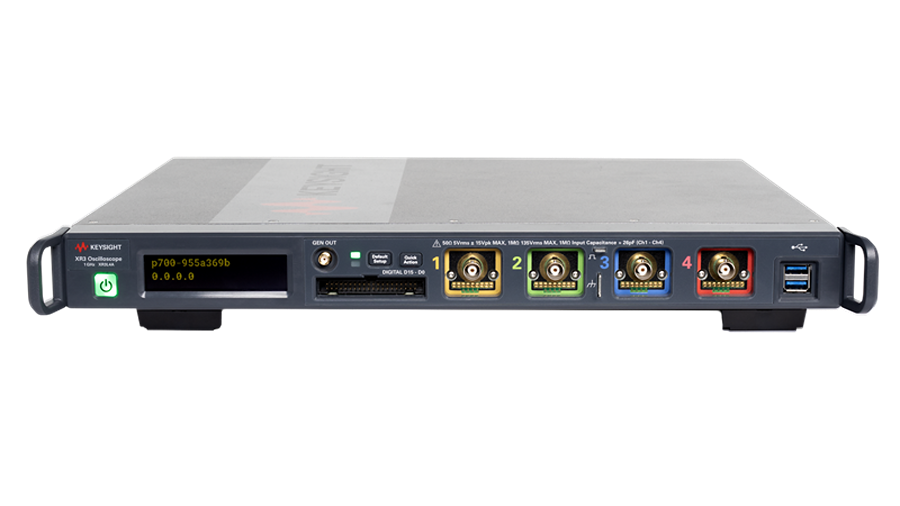 A rack blade rather than a bench box: the instrument targets multi-unit test enclosures.
For industrial test managers, the decision is no longer "which oscilloscope" but "which unit of capacity." The Keysight XR3 sells measurement capability by the rack slot: it occupies one rack unit, is a four-channel mixed-signal instrument with selectable bandwidths from 200 MHz to 1 GHz, and can be ganged into systems with over 100 synchronized channels. Choose it when density, cabling and time correlation dominate your cost per test point. Stay with benchtop boxes when one or two instruments plus an engineer closing a debug loop is the whole job — and look hard at modular chassis when pure channel count outranks instrument flexibility.
What is the Keysight XR3, in plain terms?
Keysight Technologies, Inc. announced the instrument in early November 2026 as a low-profile member of its Essential oscilloscope line. The answer for engineers: it is a full instrument, not a digitiser card, packaged for rack mounting.
The packaging question is why the launch matters to operations rather than only to the lab. Grand View Research projects the global automated test equipment market at USD 12.03 billion by 2033, a 5.2% CAGR from 2026, while market.us sizes the same sector nearer USD 7.2 billion in 2025; the spread in those estimates is itself the signal for plant buyers, because growth in that spending is being won or lost on how measurement capacity is packaged per square metre of rack.
- Front end: a 14-bit converter paired with Keysight's MegaZoom 5 custom ASIC, specified at a 50-microvolt root mean square (µVrms) noise floor and a 1.3 million waveforms per second update rate.
- Inputs: 4 analog and 16 digital channels per blade, so one rack unit carries analog plus logic-state capture in the same time base.
- Bandwidth ladder: options from 200 MHz to 1 GHz let a program mix blades by signal family instead of standardising on one expensive SKU.
- Capture depth: 100 Mpts of memory per channel is the number to check when a test must hold a long window and still zoom on a single glitch.
- Scaling: an autosensing 10 MHz reference input/output aligns clocks and triggers across blades, with hardware auto-sync, auto-discovery and auto-deskew; Keysight states the architecture supports over 100 channels, forming over 100 time-correlated channels in one multi-blade assembly.
Operationally, Infiniium 2026 software — native to the Keysight XR8 platform — can run on an external controller as a single screen that visualises and drives multiple blades, while protocol decode, power-supply and jitter applications run natively on the instrument itself.
Rack blade versus benchtop versus modular chassis: how do the trade-offs land?
Conclusion first: the three paths are not substitutes ranked by price; they allocate the same money differently — to operator access, to slot density, or to backplane synchronisation.
| Decision dimension | Benchtop oscilloscope | Keysight XR3 (1U rack-native) | Modular PXI-style chassis |
|---|---|---|---|
| Unit of purchase | One complete instrument with display, controls and front panel | One rack slot: four-channel mixed-signal capacity per one rack unit | A slot in a shared chassis with a common controller |
| Density logic | NI notes traditional benchtop designs repeat processor, display, power supply and fan for roughly every two to four channels | Density comes from removing the enclosure and front panel per channel group, not from a backplane | Density comes from shared chassis resources; NI cites systems built to 544 channels in a single 4U rack space |
| Synchronisation burden | Manual cable and reference setup; engineer verifies skew per session | Autosensing 10 MHz reference plus hardware auto-sync, auto-discovery and auto-deskew | Backplane timing and vendor sync APIs; strong for fixed production sequences |
| Operator workflow | Best for interactive debug and classroom-style troubleshooting | Headless by design; operator experience lives on an external controller running Infiniium 2026 software | Programmer-led; the instrument is mostly a software object |
| Resolution headroom | 8-bit parts still common for general purpose | 14-bit converter with a 50-microvolt root mean square (µVrms) noise floor | Varies by module; 12- to 16-bit digitisers exist, often trading bandwidth for resolution |
| Where it hurts | Space, cabling and skew grow with each added box | Requires rack real estate, a control host and a defined spares plan | Chassis, controller and licensing lock-in; less ad-hoc usability |
Read as a budget line rather than a spec sheet: the XR3 competes with benchtop inventory on floor space and integration labour, and with modular platforms on instrument-class usability — including real-time zoom, filters, zone triggering and colour grading that Keysight says run on hardware without reducing the 1.3 million waveforms per second update rate.
Why the 14-bit number matters more than the headline bandwidth
Resolution is what makes dense racks trustworthy. Keysight's own oscilloscope glossary frames an 8-bit converter as delivering roughly 42 dB of dynamic range, with 12-bit and above reserved for precision work; a 14-bit path plus the 50-microvolt root mean square (µVrms) noise floor specification is the difference between seeing ripple on a power rail and seeing the average of that ripple. For mixed-signal racks, that headroom is what allows a single blade to serve both a digital bus eye and an analog control loop without a second instrument.
Bandwidth selection is the opposite discipline: as a first-order engineering estimate (our analysis, not a vendor claim), choose from 200 MHz to 1 GHz by the fastest edge you must characterise, then subtract losses in cables, dividers and probe tips. Buying the top SKU "for safety" raises cost per slot and does nothing for a low-side current measurement.
Case walkthrough: sizing a 96-channel subsystem verification rack
A useful worked comparison for an aerospace and defense or rail subsystem qualification cell. Assume 96 analog test points: at four-channel per blade, that is 24 blades, or 24 rack units, and the same 24 slots carry 384 digital capture lines because each unit ships with 4 analog and 16 digital channels. That arithmetic lands the system comfortably inside the over 100 channels ceiling Keysight quotes for ganged instruments, and leaves slot budget for the control host, switching and instruments that are not oscilloscopes.
The software layer decides whether such a rack is usable. Keysight's aerospace and defense option for the family, XR3LAERA, is documented as supporting protocol triggering and decode down to MIL-STD 1553 command and status words, while the vendor's A&D use-case material describes validating subsystems with several Essential oscilloscopes tied to a shared 10 MHz reference. Tektronix, in a technical brief on synchronising its own 4-, 5- and 6-Series MSO instruments, reaches the same conclusion from the other direction: exceeding a single instrument's channel count is a documented multi-scope pattern whose difficulty lives in alignment and setup, which is precisely what auto-deskew and auto-discovery are meant to absorb.
What are the common misconceptions to avoid?
- "A shared reference clock is time alignment." A common 10 MHz input aligns sampling; it does not erase probe and cable propagation delay. Deskew — whether automatic or measured — remains a calibration step, and residual skew should be recorded in the test procedure.
- "Channel count scales with zero integration effort." The claim of over 100 time-correlated channels presumes a control host, licensed analysis software and a validated rack topology. Budget the host, KVM-style access and firmware baselines, or the rack stalls.
- "14-bit means filtering can be skipped." Resolution helps, but range selection, grounding and probe placement still govern whether a 50-microvolt root mean square (µVrms) figure is achieved on the bench.
- "Rack instruments are maintenance-free." They are calibration instruments like any other. Keysight's calibration services are offered at 6, 12, 24 or 36 month intervals, so a 24-blade rack multiplies a scheduling problem, not just a channel-count advantage.
- "One SKU for every test point." Bandwidth, memory and update rate are per-slot costs; over-specifying across a dense rack converts a capacity win into a procurement loss.
How should a plant or lab decide, and in what order?
- Inventory by signal group, not by instrument. List analog channels, logic thresholds and long-window capture needs, then map each group to a bandwidth from 200 MHz to 1 GHz and to the 100 Mpts of memory per channel requirement.
- Pilot one enclosure, not one blade. A 24-unit pilot reveals whether auto-discovery and auto-deskew behave with your cable tree; a single unit tells you nothing about the system-level claim of over 100 synchronized channels.
- Specify the control plane early. Decide who drives the rack: native protocol decode and analysis on the instrument, or an external controller running Infiniium 2026 software as the unifying interface for the whole assembly.
- Use the XR8 relationship deliberately. Where high-impedance, low-noise probing is needed, Keysight positions the XR3 alongside the XR8 to add Hi-Z channels without adapter-based conversion to a high-speed input; do not force marginal probing into a blade slot.
- Plan spares and calibration. Standardise cable lengths and probe families, keep one or two spare blades warm against a 24-slot rack, and set a risk-based interval within the 6 to 36 month range the vendor supports.
- Measure setup time as a KPI. Track time from unit-under-test changeover to first valid capture; density only pays when that number falls.
FAQ: what buyers ask about dense rack measurement
Is the XR3 a replacement for a bench oscilloscope?
Not universally. It replaces bench boxes whose only role is feeding a rack, and it complements a small number of front-panel instruments kept for interactive debug and training.
How many blades are needed to reach 100 channels?
Twenty-five four-channel units reach 100 analog inputs, and Keysight states the architecture extends to over 100 synchronized channels; in practice the limit is your chassis depth, reference fan-out and control host, not the blade itself.
Why does memory depth appear in the comparison at all?
Because dense racks are usually fault-hunting systems. 100 Mpts of memory per channel is what lets a blade capture a long event window and still resolve a rare, narrow anomaly without re-arming the sequence.
Can the rack run unattended in production?
Yes, provided the software stack is scripted and the sync path is validated. Headless blades depend on the autosensing 10 MHz reference plus auto-sync, auto-discovery and auto-deskew to make multi-unit sessions repeatable.
Does resolution affect cost, not just accuracy?
It affects accuracy in a way that changes cost: a 14-bit converter with a 50-microvolt root mean square (µVrms) noise floor can absorb measurements that would otherwise demand a separate precision instrument, freeing slots and reducing channel-to-channel correlation work.
Sources and further reading
- Keysight Technologies newsroom release on the XR3 low-profile 14-bit oscilloscope (November 2026): https://www.keysight.com/us/en/about/newsroom/
- Keysight InfiniiVision XR3 Series data sheet: https://www.keysight.com/fr/en/assets/3126-1847/data-sheets/InfiniiVision-XR3-Low-Profile-Oscilloscope.pdf
- Keysight use case, testing A&D subsystems with a synchronised multi-scope rack: https://www.keysight.com/us/en/use-cases/test-ad-subsystems-with-a-synchronized-multi-scope-rack.html
- Keysight oscilloscope glossary on dynamic range: https://www.keysight.com/used/us/en/knowledge/glossary/oscilloscopes/what-is-dynamic-range-in-audio-and-video
- Keysight calibration services, interval options: https://www.keysight.com/us/en/products/services/calibration-services.html
- NI, challenges of building high-channel-count, high-speed measurement systems: https://www.ni.com/en/shop/electronic-test-instrumentation/oscilloscopes/what-are-oscilloscopes/overcome-the-challenges-of-building-high-channel-count--high-spe.html
- NI PXI systems overview: https://www.ni.com/en-us/shop/pxi.html
- Tektronix technical brief, synchronising multiple MSO oscilloscopes for higher channel count: https://www.tek.com/en/documents/technical-brief/how-to-synchronize-4-5-and-6-series-mso-oscilloscopes-for-higher-channel-count
- Grand View Research press release on automated test equipment market size to 2033: https://www.grandviewresearch.com/press-release/global-automated-test-equipment
- market.us automated test equipment market report: https://market.us/report/automated-test-equipment-market/