
Stretch Gen 2 Dock Playbook: Planning, Staffing and Maintaining Robotic Trailer Unloading | Logistics
Short answer: Boston Dynamics unveiled Stretch Gen 2 on 3 November 2026, and the redesign is not mainly about peak speed. It targets dock availability: modular plug and play part swaps, internal cabling cut by 81 percent, automotive-grade connectors, and a swerve drive exchange that now takes about one hour instead of a full day. So the buying decision should be built on trailer mix, staging layout and who owns maintenance — not the headline 1,000 cases per hour.
Inbound unloading is where most industrial sites lose control of their schedule: crews are scarce, injury exposure concentrates on the dock, and a stalled trailer backs up putaway, replenishment and outbound waves. That is why this Logistics desk treats the new generation of mobile unloading robots as a cell-design problem rather than a gadget launch. The engineering detail below is drawn from the manufacturer's announcement and from the master specification sheet; everything that follows is a practical framework for planners, warehouse operations managers and automation buyers.
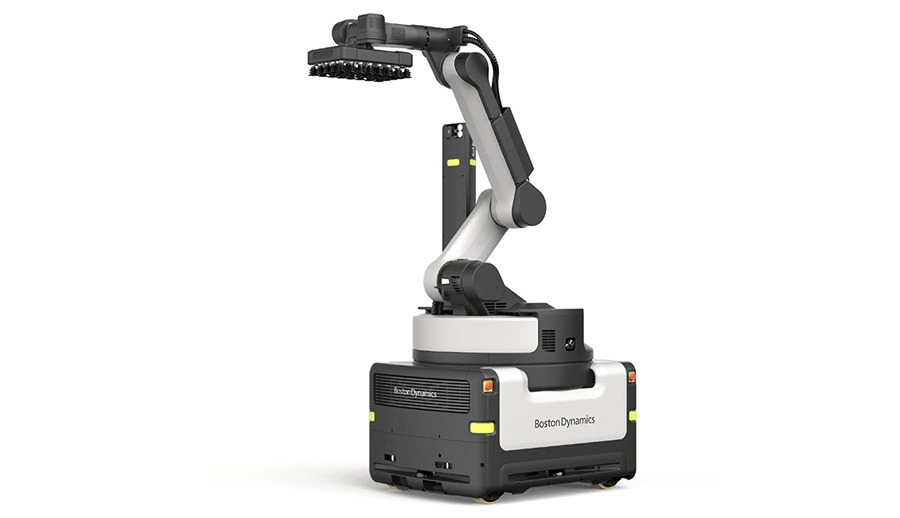
Stretch Gen 2, the autonomous mobile trailer unloading robot.
What is genuinely new, and why logistics teams should care
The conclusion first: the second generation is a reliability release, not a speed release. Boston Dynamics states that its team analyzed data from more than 100,000 operating hours and tens of millions of boxes already handled by Stretch to isolate the most common causes of unplanned downtime. For a logistics operation, that reframes the value case — an extra 100 cases per hour on paper is worth far less than removing one mid-shift fault that strands a driver, a dock door and a putaway crew.
The changes that matter at the dock are:
- Connection integrity. Heavy-duty automotive-grade connectors resist the vibration created by rapid, high-torque box handling and travel over uneven concrete — the classic source of intermittent faults on mobile equipment.
- Gripper and sensing. A revised gripper with new valve systems and finer sensing improves grasping and placement during fast picks, which is where jams and dropped cases usually begin.
- Joint architecture. Continuous-rotation joints operate beyond 360°, removing the hard stops that previously generated mechanical stress.
- Wiring removal. Eliminating 81 percent of internal cabling — about a half-mile’s worth — deletes what the vendor identifies as the largest source of intermittent electrical faults and wiring wear.
- Safety geometry. The emergency stop sits lower and recessed, and exterior panels use new materials so a falling box is far less likely to cause an unintended safety stoppage or break a panel.
How the hardware changes convert into dock availability
Treat each modification as an answer to a specific operational failure mode you have probably logged already.
| Design element | Failure mode addressed | Effect on your dock KPI |
|---|---|---|
| Automotive-grade connectors | Vibration-induced intermittent faults | Fewer random stoppages during peak inbound |
| 81 percent less internal cabling | Wire fatigue, chafing, replacement downtime | Lower spare-part burn rate and fewer electrical call-outs |
| Joints moving beyond 360° | Mechanical stress at hard stops | Longer component life, steadier pick cycle |
| Upgraded gripper, valves, sensing | Mis-picks, dropped cases, jams | Cleaner case induction, less manual rescue |
| Recessed, lower e-stop and tougher panels | Accidental safety stops, panel breakage | Higher usable run time per trailer |
| Modular plug and play swaps | Long repair windows, vendor dependency | Swerve drive change in about one hour, not a full day |
| Onboard diagnostics and service tools | Waiting for an external technician | Routine work moves to your own maintenance team |
The service-call frequency reduction is the quiet headline: standardised high-strength fasteners cut tool changes and hands-on repair time, and new onboard diagnostics hand routine service to a customer's own technicians, keeping the robot on the dock with less dependence on outside support.
Is 1,000 cases per hour the number you should plan around?
No — use it as a ceiling, not a capacity. Boston Dynamics is explicit that the up-to 1,000 cases per hour rate is heavily influenced by case weight and by how neat or disorderly the load is stacked, with a multipick feature pushing performance toward peak rates. In practice the trailer, not the robot, sets the pace.
Here is planning arithmetic (our own worked example, not a vendor figure) to show how to build the number into a shift plan:
- Sample your inbound profile. Log 30 to 50 trailers: average cases per trailer, weight band, mixed-SKU ratio, and stacking quality (floor-loaded, columnised, interlocked, or damaged).
- Apply an achievable-rate band. Model a clean, uniform trailer near the top of the range and a mixed, unstable trailer materially below it — never plan one average for both.
- Convert to dock-hours. Effective rate × available run minutes gives cases per trailer; add door-checkout, trailer swap, staging and exception handling as explicit overhead minutes.
- Test the constraint. If induction to conveyor, pallet build or putaway labour is slower than the robot, capacity is lost regardless of machine rating.
Energy planning is equally concrete. The battery lasts two shifts, and a fast charger reaches 90 percent charge in about 75 minutes, so a single unit can cover a two-shift inbound window if the charge slot is placed where inbound volume dips — typically a meal break or the low-volume hour between waves. Onboard lighting allows work inside dark trailers, and a pre-trained vision system detects most packages from day one with no programming needed, which removes the classic commissioning delay for new SKU sets.
How do you prepare an unloading cell before the robot arrives?
Sequence matters more than equipment. Use this seven-step order of work, which mirrors the site-assessment discipline recommended for autonomous mobile robot rollouts by Brain Corp's deployment checklist.
- Baseline the door. Choose a pilot door with stable volume, known trailer types and a clean floor. Avoid starting on your most chaotic inbound lane.
- Survey the floor and path. Check joint gaps, slope, debris, drainage channels and trailer-bed transition; a mobile robot inherits every defect between the staging lane and the nose of the trailer.
- Fix restraint and communication. Wheel chocks or restraints, light-signal or full-visual communication with the driver, and a documented door-occupancy rule so nobody walks or drives into an active cell.
- Design downstream. Specify induction conveyor height, staging lane length, de-staging or palletising position and putaway staffing. Robot output must land in a buffer, not in a queue.
- Confirm utilities. Charge position, circuit capacity, aisle clearance, and a network plan with an offline fallback so a dead Wi-Fi zone does not idle the trailer.
- Define the system handshake. Agree how the robot reports to the WMS and to inbound planning: trailer start and finish, cases unloaded, fault codes and exception counts — the data that makes uptime auditable.
- Set pilot acceptance criteria. Pre-agree measurable thresholds: cases per door-hour, faults per 1,000 cases, mean time to restore, and manual fallback time. Run the pilot only against those numbers.
Staffing changes are part of the same sequence, not a later HR task. Boston Dynamics CEO Robert Playter framed the shift plainly when discussing the company's automation roadmap: the people who used to unload trailers now operate the robot. Plan the conversion — manual unloaders become robot attendants, exception handlers and, with training, first-line technicians.
What should your in-house maintenance team hold on day one?
Because routine service is now onboard-tool driven, your readiness list is short but non-negotiable:
- A defined first-line scope. Document exactly which tasks your technicians own (modular part swaps, cleaning, inspection) and which remain vendor work.
- A spares kit matched to the wear list. Gripper consumables and valve components, panel parts, and one swerve drive module — the sub-one-hour swap only pays off if the part is on site.
- Standard tooling. The high-strength fastener standardisation is designed to reduce tool changes; make sure shift kits carry the right tools, not an improvised set.
- Lockout and rescue procedure. Written steps for a stalled trailer: how the crew enters safely, how the door is released, and the target manual fallback time.
- A downtime log. Capture fault code, cause, restore time and parts used from week one, so your fleet data is as useful as the more than 100,000 operating hours the vendor used to design the machine.
Which unloading option fits which operation?
| Criterion | Manual crew | Fixed robotic arm cell | Mobile unloading robot (Stretch class) |
|---|---|---|---|
| Labour exposure | Highest — repetitive case handling at the dock | Low at the arm, medium upstream | Low; one attendant per door |
| Trailer variability | Tolerates almost anything | Poor; needs a known, structured pattern | Designed for varied, floor-loaded trailers |
| Door mobility | Crew moves | Fitted to one position | Robot travels between doors and staging |
| Commissioning effort | None | High — integration and fixturing | Low, since the vision model works from day one without programming |
| Best fit | Very low volume, damaged or non-standard loads | Uniform, high-volume SKUs on a fixed lane | High-volume inbound with mixed case sizes and shift coverage gaps |
Common mistakes that stall unloading automation projects
- Signing off on the headline rate. Approving the deal against the rated 1,000 cases per hour instead of your own measured cases per door-hour on the trailer types you actually receive.
- Ignoring stacking quality. Disorderly or leaning loads are the main throughput variable, and they are a supplier-packaging problem the robot cannot fix.
- Automating the bottleneck door first. A pilot needs repeatability, not the worst conditions.
- Leaving downstream dry. Without conveyor, staging and putaway matched to robot output, the cell simply relocates the backlog.
- Underestimating uptime ownership. If every fault waits on an external visit, a repair measured in about one hour can still cost a full day of door time once travel and scheduling are added.
- No charging plan. Two-shift run time only holds if the 90 percent charge in about 75 minutes window is scheduled into a real gap in the shift pattern.
- Treating safety as inherited. Trailer restraint, driver communication and entry rules still belong to your site, not the machine.
Action plan for the next 90 days
- Days 1–20: trailer-profile 30–50 inbound loads; record stacking quality, case weight bands and current unload times per door.
- Days 21–40: shortlist one pilot door; complete the floor, restraint, network and staging survey; price the downstream buffer work.
- Days 41–60: agree pilot KPIs and data reporting with the vendor; write the manual-fallback and lockout procedures; name the attendant-to-technician training path.
- Days 61–90: run the pilot, log every fault and restore time, then decide scale-up on measured cases per door-hour and mean time to restore — not on demonstration numbers.
FAQ: what buyers ask before signing
Can the robot unload every trailer we receive?
No single machine handles every condition. Rate is driven by case weight and stacking order, and severely collapsed or non-standard loads still need a manual path. Keep a documented fallback shift and measure how often you use it — that number belongs in the business case.
Do we have to retrain the system for new SKUs?
The vendor's position is that the pre-trained vision system detects most packages from day one with no programming, and that ongoing software releases improve case detection, motion planning, pick strategies and world modeling across the fleet without hardware changes. New packaging families should still be observed during a pilot week.
Who actually fixes it when it stops?
Increasingly your own people. New onboard diagnostics and maintenance tools move routine service to the customer's maintenance team, and modular plug and play swaps keep the machine on the dock instead of in a service queue.
Is the throughput or the reliability argument stronger?
Reliability. The design was rebuilt around failure data mined from more than 100,000 operating hours, and the most expensive loss on an inbound dock is a stranded trailer, not a slower cycle.
Where do the safety gains come from?
From removing the human from the most exposed part of the task — inside the trailer, handling repetitive lifts. Federal data reviewed by the U.S. Department of Labor's Office of Inspector General (oig.dol.gov) put the warehousing injury and illness rate at 5.5 cases per 100 workers in 2021, more than double the 2.7 national all-industry rate, and National Safety Council analysis (injuryfacts.nsc.org) ranks transportation and warehousing highest for injuries involving days away from work.
Read next in Logistics
If your inbound volumes are stable and your trailer population is mixed, the practical question is no longer whether mobile unloading belongs in the plan, but whether your cell, your spares kit and your maintenance contract can keep the robot running through peak weeks. Score your doors on volume, floor condition and stacking quality, then pilot the one that produces the cleanest data.
References
- Boston Dynamics — official announcement of Stretch Gen 2, 3 November 2026: https://bostondynamics.com/news/boston-dynamics-launches-next-generation-stretch-robot/
- Boston Dynamics — Stretch product page: https://bostondynamics.com/products/stretch/
- U.S. Department of Labor, Office of Inspector General — warehousing injury and illness rate report (2021 data): https://www.oig.dol.gov/public/reports/oa/2023/19-23-013-10-105.pdf
- National Safety Council, Injury Facts — industry incidence rates: https://injuryfacts.nsc.org/work/industry-incidence-rates/occupational-profile/
- Business Insider — interview with Boston Dynamics CEO Robert Playter on robot operation of former manual tasks: https://www.businessinsider.com/boston-dynamics-ceo-humanoid-robot-factory-workers-hyundai-atlas-2026-1
- Brain Corp — autonomous mobile robot deployment checklist: https://www.braincorp.com/resources/deploy-autonomous-mobile-robots-successfully-with-this-checklist
- Thomasnet — independent summary of Stretch Gen 2 specifications: https://www.thomasnet.com/insights/boston-dynamics-stretch-gen-2-robot/