
WorldIndustrialWeekly General: Dense RF Cable Shielding, Mass Budgets, and the ARACON Textile Option
On the factory floor and in equipment enclosures, shielding is a mass, volume, and assembly decision. For decades, woven all-metal braid has protected cables by limiting emissions and rejecting interference. Figure 1 summarizes the familiar construction, which applies to coaxial cable, twisted pair, and multiconductor assemblies.
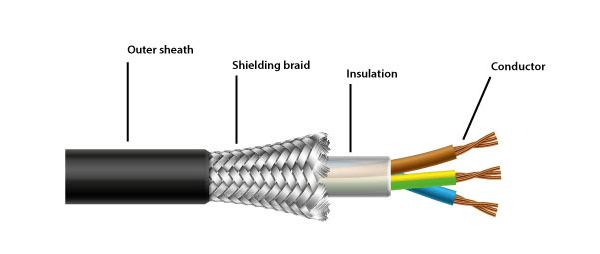
Figure 1 A schematic of a cable with conventional braided shielding shows the RF barrier it creates; it depicts multiple basic-wire conductors, yet the same idea applies to coaxial cables and twisted-pair cabling. Source: Stecker Express
The braid performs two complementary EMI functions: it reduces electromagnetic emissions from the cable and keeps interfering energy away from the cable. Designers often rely on it while resisting it, because it helps signal integrity but also adds bulk, weight, cost, and routing difficulty.
Where braided metal stops being only a supply-chain commodity
Termination is the first operational pain point. Experienced installers can tell horror stories about cleanly terminating the shield to the connector, especially when it is done by hand without the right tools or jigs. Tiny cut shards of braid may fall onto a cable or nearby circuit board, creating shorts and troubleshooting noise.
The trade-off tightens when cables carry signals from DC through the gigahertz range in small spaces. Conventional braided shields are usually copper, sometimes aluminum, and the shield's share of total weight and bulk grows as the core shrinks. When GHz cables approach millimeter-level diameters, shielding mass and volume become a serious design issue.
Performance is the second constraint. In multi-gigahertz operation, tiny voids in the woven structure become open windows to short-wavelength RF energy. The braid can also resist movement, be hard to handle, and store its original geometry: shape memory makes routing and rerouting more difficult.
Tighter weave helps partly, but it transfers cost into materials, flexibility, and weight. A foil-first layer plus a braid can bring RF shielding to nearly 100%, yet the stack raises weight, cost, and termination complexity. These are not cosmetic issues; they affect procurement, assembly labor, yield, and service access.
A case in textile-based RF shielding: ARACON from Micro-Coax
As dense RF cabling shifts, one documented response is ARACON shielding from Micro-Coax, a division of Amphenol. Instead of metal wire braid, it uses lightweight, ultrathin, extremely strong DuPont Kevlar fibers coated with nickel or silver, the latter choice supporting solderability. The composite textile is up to 80% lighter than copper while retaining EMI/RFI protection, lightning protection, and mechanical robustness.
The conductive coating on the fabric-like fibers creates a wrapper against electromagnetic energy. The thin braid-equivalent slips over the core like a flexible sock, and it can be applied to coaxial cable, twisted pair, or wire bundles. Figure 2 shows the construction.
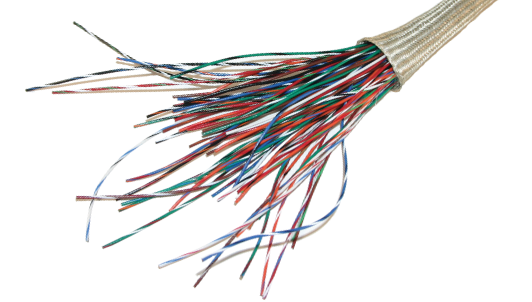
Figure 2 A thin but super-tough fabric sock from the ARACON shielding system slips over the conductor or wire bundle to be shielded. Source: Micro-Coax
Data points that explain the weight difference
Bulk is easier to understand through density:
| Material | Density |
|---|---|
| Aramid fibers | 1.44 grams per cubic centimeter (g/cc) |
| Copper | 8.9 g/cc |
| Coated fibers | 3 g/cc to 5 g/cc |
At the same time, the aramid core's tensile strength is 350 kilopounds per square inch (Ksi), 3 to 10 times higher than that of traditional or high-strength copper cores at 35 Ksi to 95 Ksi.
Flexibility and longevity also matter in production:
- Tested to withstand over 50,000 flex cycles over a 180-degree arc
- Installs easily, cuts like fabric with standard tools
- Offers corrosion resistance, relevant in many industrial settings
Termination techniques are similar to those for wire-braided shields. Micro-Coax says cable vendors can braid and fabricate ARACON using standard metal-wire equipment and supports crimping or banding, plus soldering when silver plated. The article notes that ARACON meets or exceeds many stringent mil/aero and space-related electrical, mechanical, and outgassing performance standards.
High surface-to-volume ratio in ARACON fibers supports effective RF EMI shielding that can exceed conventional shielding, as shown in Figure 3.
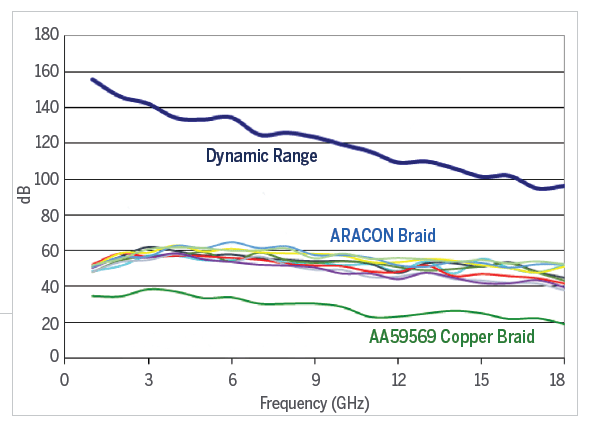
Figure 3 Even with reduced bulk and weight, the ARACON approach offers approximately 20 dB greater attenuation compared to conventional copper braid, here against industry standard AA59569. Source: Micro-Coax
Common misconceptions in shielding selection
| Misconception | What the engineering trade-off actually shows |
|---|---|
| Any braid is enough once the cable is shielded. | At multi-GHz frequencies, braid gaps act as open windows, so frequency margin must be checked. |
| Tighter weave is only a quality upgrade. | It can worsen material use, flex, and weight, and it does not remove termination problems. |
| Foil plus braid is a cost-free fix. | Nearly 100% shielding can still add weight, cost, and assembly complexity. |
| Lighter shielding must be weaker. | Aramid textile can be lighter than copper while having much higher tensile strength. |
Action advice for teams under RF and weight constraints
- Map each shielded cable by frequency, space, bend radius, and installation method before choosing braid, foil, or textile.
- Quantify shielding share of mass and diameter at the smallest cable size, not only the nominal part.
- Review termination tooling and work instructions to prevent braid shards from falling onto assemblies.
- Pilot textile shielding in weight-critical, high-traffic, or rerouting-prone assemblies where the approximately 20 dB RF margin and flexibility justify process change.
- Do not force substitution when cost dominates and standard braid meets emission and immunity requirements.
Field evidence, cost, and the decision
The approach is not only laboratory work: it has been in use for over 10 years and has been proven in the field in aircraft, space vehicles, and similar demanding systems.
A direct one-to-one price comparison is difficult, and the article does not provide confirmed cost figures. The reasonable working assumption is higher cost than standard metal braid. That premium may be acceptable when lower weight and bulk, flexibility, mechanical robustness, and RF margin are more critical than procurement cost.
Migrating away from familiar materials can feel like saying we’ve been a team all these years, but things have changed. The decision should not rest on nostalgia or novelty. It should rest on the measured constraints of the system: frequency, mass, termination yield, service access, and total risk.
FAQ
Is woven metal shielding obsolete? Not broadly. It remains available, workable, and useful for many cables, but its gaps, mass, shape memory, and termination issues become more visible in dense GHz designs.
Can a foil layer alone solve RF leakage? Foil plus braid can reach nearly 100% shielding, but the stack increases weight, cost, and termination complexity.
What is the main attraction of ARACON? A DuPont Kevlar textile coated with nickel or silver can be up to 80% lighter than copper while providing EMI/RFI protection, lightning protection, and mechanical robustness.
Should every manufacturer change cable shields? No. Change only when the application shows concrete benefits in weight, volume, flexibility, RF performance, or assembly behavior.