
Case File: Volkswagen Ran Two E/E Architectures at Once — What Parallel Tracks Cost the Plant Floor
Case file, WorldIndustrialWeekly industry desk | By Michael Torres
Buyers who live on component price lists and validation schedules rarely get to watch a shift in engineering authority in real time. Volkswagen's October calendar offers an unusually clean view of one. The first data point landed on October 26, when NXP and Volkswagen confirmed a strategic partnership that names the S32K5 microcontroller family as the core building block for zone control modules, with coverage across multiple brands and models and a first vehicle planned for 2027. The second arrived two days later at Volkswagen's inaugural Tech Day in China, where the group unveiled VEGA, a locally developed technology matrix spanning three areas: complete-vehicle platforms, the electronic/electrical architecture and advanced driver assistance systems (ADAS).
Counterpoint Research reads those two announcements as less contradictory than they look. In its analysis, the pairing marks a renegotiation of who owns global technical decision-making: the global architecture is optimised for scale and stability, the Chinese one for cycle time and market responsiveness. The same reading carries an uncomfortable line item for industrial operations — running two sets of architecture in parallel inflates validation and test work, supplier qualification, and long-term software maintenance. Whether the two tracks converge later, and which one leads, remains open.
Case at a glance: two tracks, four dates, one budget
| Dimension | Global track | China track |
|---|---|---|
| Public milestone | October 26 partnership with NXP; S32K5 selected for zone control modules | Tech Day two days later; VEGA released |
| Scope | Zone control MCUs across multiple brands and models | Three areas: vehicle platform, E/E architecture, ADAS |
| Time marker | First vehicle planned for 2027 | CEA 1.0 in place; chip and L3 milestones run to 2028 and beyond |
| Design logic | Scale, stability, group-wide reuse | Speed, local adaptation, cost efficiency |
| Open risk | Supplier of zone MCUs for CEA-based export products not disclosed | Whether local output reaches group-level scale |
Track one: zone control is bought as a subsystem, not as a chip
The 2027 hardware decision looks small on a bill of materials and large on a programme plan. Zone controllers aggregate functions that previously sat in dozens of distributed electronic control units, so the part selected in October effectively locks in a topology for several model years. NXP's own product literature positions the S32K5 family as an extension of its CoreRide platform with pre-integrated zonal and electrification system building blocks, with the device line rated up to ASIL D and temperature Grade 1 operation between -40 °C and 125 °C (nxp.com). For purchasing and supplier-quality teams, that framing matters: the OEM is buying a validated subsystem path, and the switching cost sits in requalification rather than in unit price.
The value at stake is not marginal. Yole Group forecasts the automotive semiconductor market roughly doubling from $77 billion in 2025 to $160 billion by 2031, with in-vehicle network ICs approaching $8 billion as Ethernet displaces CAN and LIN to serve domain and zonal architectures (yolegroup.com). Volkswagen's partnership therefore reads as an early capacity reservation inside a market that industrial suppliers expect to be tight.
Track two: the Hefei experiment treats cycle time as the deliverable
At the Tech Day, the most quotable numbers were not vehicle specifications but clock times drawn from the toolchain that supports the China electronic/electrical architecture CEA. Volkswagen disclosed that C-Brain, an AI toolchain built on CEA, compressed software function testing from 3 days to 2 to 3 hours, and software problem diagnosis from 2 weeks to 20 minutes.
Counterpoint Research cautions that such figures cannot be read straight through as a whole-programme efficiency gain. What they do demonstrate, in the firm's view, is a departure from the habit of routing every engineering step through one global process. VEGA's significance, on that reading, goes beyond assembling a technology stack: Volkswagen Group China is taking over decision rights on vehicle platform, E/E architecture and intelligent driving, which shortens the gap between a technical choice and a shipped product. Independent reporting suggests the target was already moving before October — Volkswagen said production of the CEA architecture began in January 2026, with the ID. UNYX 07 as the first CEA-based model off the Hefei line, developed with CARIAD and XPeng (volkswagen-group.com).
The staffing picture behind that speed is also measurable. The Hefei hub that houses Volkswagen Automotive Technology (China) Co., Ltd. (VCTC) is described as the group's largest research and development centre outside Germany, employing roughly 3,000 R&D professionals (english.news.cn). That density of engineers — sitting next to battery and intelligent-driving suppliers rather than at the end of a reporting chain to Germany — is the operating precondition for the two-to-three-hour test cycle Volkswagen now cites.
Architecture ownership: a borrowed starting point, a delegated definition right
CEA is central to the China stack but was not written from a blank sheet. In April 2024, Volkswagen and XPeng signed a strategic framework agreement on E/E architecture, confirming joint development based on XPeng's then-latest EEA 3.0 design. Volkswagen stresses that CEA was co-developed by Volkswagen Automotive Technology (China) Co., Ltd. (VCTC), CARIAD China and XPeng. Counterpoint Research characterises the result as a fusion of XPeng's architecture know-how with Volkswagen's functional-safety and validation discipline, localised into production by the China engineering team.
That borrowing creates a maintenance obligation. As XPeng moved its architecture forward to EEA 4.0 in 2026, CEA 1.0 faces continuous upgrading and the need to keep closing a generational gap. Counterpoint Research argues the deeper change is not which generation of technology Volkswagen adopted, but the fact that part of the architecture-definition right and technology-selection right was handed to the China team. A local department that once executed adaptation work is now influencing the underlying roadmap.
Silicon sovereignty: three ADAS routes, one in-house chip
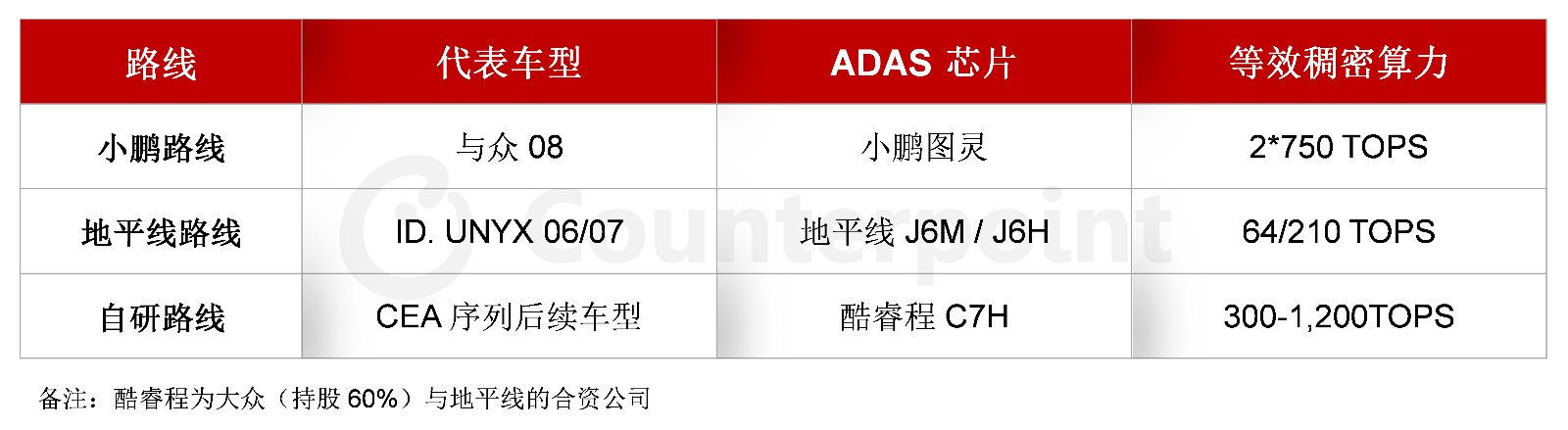
Counterpoint Research counts three ADAS chip technology routes running in parallel in China, one of them built around CARIZON, the joint venture Volkswagen set up with Horizon Robotics to develop in-house silicon. According to the firm, CARIZON is working on a C7H system-on-chip carrying the code name Nash Architecture, targeted for mass production in 2028. Counterpoint Research is explicit that C7H is not simply a Horizon Robotics IP-licensed product: Horizon's role is that of JV shareholder, AI foundation-model technology provider and chip supply-chain partner.
External reporting fits the same pattern of deepening local ownership. Reuters reported in November 2025 that Volkswagen's first self-developed chip would be produced locally through CARIZON, with CARIAD's China chief describing a 3-4 nanometre-class process node (reuters.com). The strategic intent behind in-house silicon, as Counterpoint Research frames it, is reduced dependence on external suppliers plus lower cost in the highest-value layer of the stack. The broader signal for the industry is that vehicle makers no longer accept standard chips as the ceiling of what their driving systems can do; they want definition power over performance, cost and differentiation.
L3: the calendar that engineering cannot compress
Volkswagen used the Tech Day to state that L3-level automated driving should be technology-ready in 2027. Counterpoint Research warns against translating readiness into availability. Technical readiness, road-testing permission and market access for individual users are separate gates. China's own sequence makes that concrete: the first L3 vehicle product approvals were issued in December 2025 to two sedans — a Changan model limited to 50 km/h on designated Chongqing routes and a BAIC model capped at 80 km/h on specified Beijing highways — and both were placed under operating entities rather than private owners (english.scio.gov.cn). With a second batch of approvals moving through the process during 2026, Counterpoint Research expects commercial availability of L3 for individual users in China no earlier than 2029.
Export test: CMP, and the cost arithmetic behind it
Volkswagen also plans to push its China-developed stack into more markets, including promoting the CMP platform — which integrates the CEA architecture — to South America, Africa and Southeast Asia. Counterpoint Research sees this as a play on the cost control and development efficiency of the Chinese R&D system to serve emerging-market product needs. Volkswagen's own published ambition for CMP is a 40 per cent cost reduction by 2026, attributed in particular to the zonal E/E architecture developed in China (volkswagen-group.com). The unresolved question sits upstream of the platform: the supplier of the zone-control microcontrollers for CEA remains undisclosed, and whether local Chinese silicon is used will determine how deeply China's automotive electronics chain can enter Volkswagen's global product system.
Four ways this case is commonly misread
- Reading a partnership as a parts order. Selecting S32K5 fixes a zone topology and a validation burden for several model years; the commercial lever is requalification cost, not piece price.
- Equating test-cycle numbers with programme efficiency. Counterpoint Research's own caveat applies: 2 to 3 hours of software function testing says nothing automatically about vehicle-level development time.
- Treating "technology-ready" as "for sale". Approval practice in China has so far coupled L3 use to designated corridors and licensed operators.
- Assuming zonal architectures cut cost everywhere. Harness and ECU consolidation moves complexity into software, redundancy design and factory assembly sequences; supplier-side analyses note the saving is real only where wiring, connector strategy and plant routing are redesigned together.
What operations, purchasing and engineering leads can reuse
- Qualify subsystems, not components. Where a zone controller arrives bundled with a reference platform, write the specification against the validated building block and price the requalification, as Volkswagen's 2027 window implies.
- Instrument two clock times before investing in tooling. The measurable gains in the Volkswagen case are test duration and fault-diagnosis duration; any AI toolchain business case in your plant should be built the same way.
- Map where decision rights actually sit. Ask which team signs off architecture, chip selection and feature sequencing. If a local centre can define, you can compress programme time; if it cannot, speed claims are marketing.
- Budget for parallelism explicitly. Two sets of architecture means duplicated validation, split supplier lists and two maintenance streams. Put that on the plan instead of discovering it in a test-lab overrun.
- Regulatory gates need owners on the org chart. Treat homologation, permit scope and operating-entity requirements as programme milestones, as the L3 track shows.
- Design for the second market from day one. A platform aimed at South America, Africa and Southeast Asia needs different tolerance, serviceability and local-supplier content assumptions than a home-market programme.
- Keep a fallback supplier for zone control. Until a public MCU choice exists for exported architectures, dual-source the function rather than the part number.
FAQ
Which vehicle marks the start of the NXP partnership?
Volkswagen has not named the model. NXP's S32K5 family is designated for zone control modules across several brands and models, with the first vehicle planned for 2027.
Is VEGA a car platform?
No. VEGA is a technology matrix disclosed at Volkswagen's Tech Day in China, covering three areas: complete-vehicle platforms, the E/E architecture and ADAS.
Was CEA developed alone in China?
It was co-developed by VCTC, CARIAD China and XPeng, on the basis of the April 2024 framework agreement drawing on XPeng's EEA 3.0 architecture and Volkswagen's safety and validation systems.
Does CARIZON simply license Horizon Robotics designs?
Counterpoint Research says no. For C7H, Horizon Robotics participates as JV shareholder, AI foundation-model provider and chip supply-chain partner, while the chip itself is being developed through CARIZON.
Will L3 be purchasable in China in 2027?
Not on the announced logic. 2027 is described as the readiness date; Counterpoint Research puts the earliest consumer-facing commercialisation at 2029, given the staged approval process.
Viewed as a case file rather than a press cycle, Volkswagen's autumn sequence is a governance experiment with a price tag attached. The group gained measurable speed by letting a China centre define architectures, chips and driving software, and it is now trying to export that advantage through CMP to South America, Africa and Southeast Asia. What remains unproven is whether two parallel technical systems can be sustained long enough for either to reach critical mass — and whether Germany's global architecture will absorb lessons from Hefei or simply coexist with it, billing the difference to validation labs and supplier lists.
Have an E/E, automation or supply-chain case file to share with this desk? Write to news@industrialweekly.com.