
Industrial Technology Brief: Volkswagen May Borrow From China for European Software, Reopening Rivian's Strategic Position
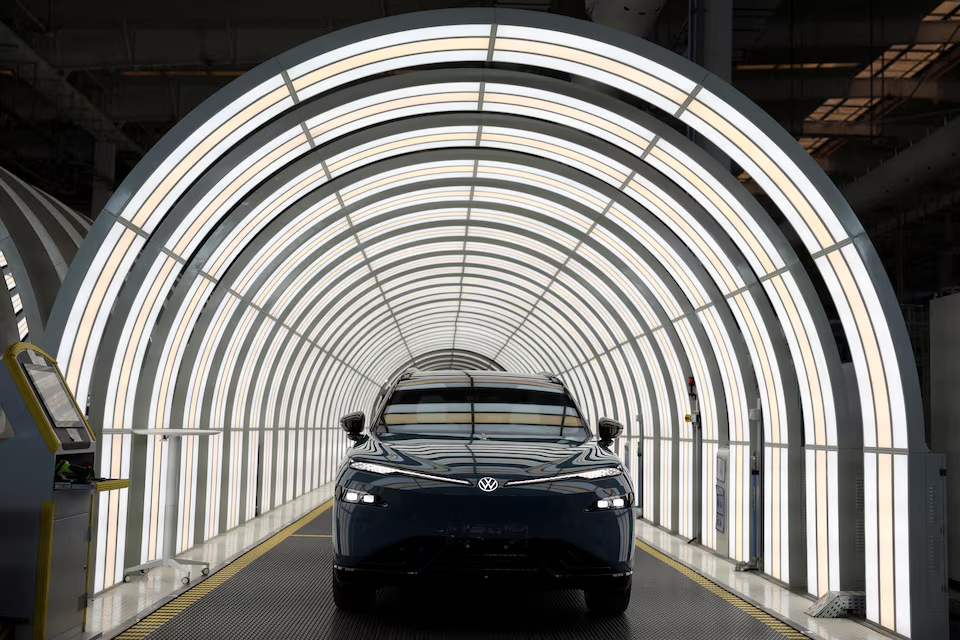
Industrial readers do not need another headline about a car maker. They need the operating question underneath it: when a group such as Volkswagen considers moving a software architecture developed for one regulatory and supplier environment into another, the decision changes platform planning, supplier dependency management, and engineering release discipline. Reuters, citing German business outlet Manager Magazine, says that question is now on the table because Volkswagen is considering bringing a software architecture used in Chinese-market models into European Volkswagen-brand vehicles.
Case snapshot: a report that puts architecture strategy before product announcement
The reported move is not framed as a new vehicle launch. It is a possible architecture decision. According to the report, future models for Volkswagen, Skoda and Cupra could rely on technology from an architecture co-developed with Xpeng Motors, described as a China electrical/electronic architecture. Those three brands are expanding electric-vehicle offerings in Europe. The case matters because software architecture is the control layer for features, supplier interfaces, and vehicle-program reuse.
Manager Magazine says Thomas Schäfer, head of the Volkswagen brand, is expected to present the plan to management on Tuesday local time. The proposal would reportedly cover about three-quarters of the next-generation models across the three brands. Volkswagen declined to comment on the report. That refusal does not erase the operational signal: a major industrial group is weighing whether a China-oriented architecture can be deployed in European vehicles.
What the report changes, and what remains unresolved
To date, Volkswagen has been developing software architectures along separate market paths. For the Chinese market, it uses an architecture co-developed with Xpeng. For Western markets, it is working with Rivian on a different technology. Rivian is a United States-based partner. Volkswagen invested $5.8 billion in Rivian, and the partnership is described as an important part of Volkswagen Group CEO Oliver Blume's software strategy.
The potential reuse of the China architecture in Europe could therefore put Rivian's role under pressure. Reuters says this development may expose Rivian to a risk of marginalization. The report does not state that the partnership with Rivian has ended, nor does it confirm that the China architecture has been approved for Europe. For industrial decision-makers, the practical distinction is between a possible internal presentation, a declined comment, and a confirmed deployment.
Data and fact anchors to read before interpreting the news
| Anchor | Reported fact | Editorial caution |
|---|---|---|
| Source | Reuters cites German business outlet Manager Magazine and sources. | The article is a report about a likely internal proposal, not a company confirmation. |
| Architecture | A China-market software architecture may move into European Volkswagen-brand models. | Market-specific architecture is shaped by supplier, regulatory, and feature ecosystems. |
| Brands | Future models for Volkswagen, Skoda and Cupra may use it. | Three brands do not imply the same timing across all models. |
| Coverage | About three-quarters of next-generation models for the three brands. | Proposed coverage is not confirmed rollout data. |
| Management | Thomas Schäfer may present it to management on Tuesday local time. | Internal presentation does not equal external implementation. |
| Rivian | United States partner Rivian worked on Western-market technology; Volkswagen invested $5.8 billion. | Investment and reported architecture strategy can point in different directions. |
| Group context | Oliver Blume's software strategy includes the Rivian partnership; Cariad faces scaling difficulty across many models, including Audi and Porsche. | Software reuse is an organizational scaling challenge, not only a code-porting task. |
Why architecture reuse is harder than product transfer
Reuters points out that Volkswagen has long struggled to keep pace with software development. The reason is structural. Volkswagen Group carries many vehicle lines, ranging from mass-market brands to premium brands such as Audi and Porsche. A software stack that works across those lines must meet different performance, safety, feature, and production expectations. Its internal software unit Cariad faces similar difficulty.
The reported China-to-Europe idea should therefore be understood as a platform-allocation question, not simply a sourcing decision. A Chinese architecture is developed for a particular supplier ecosystem, feature rhythm, and vehicle-program cycle. Moving it into Europe requires compatibility with European vehicles, suppliers, and program requirements. The same logic applies to any manufacturer considering cross-market reuse.
Common misconceptions in this type of industrial software story
- Confusing considering with decided. The reported proposal is under internal review; Volkswagen declined comment.
- Assuming Rivian is immediately removed. The article describes marginalization risk, not confirmed termination of the partnership.
- Reading the $5.8 billion investment as proof of final technical direction. Capital commitment and architecture strategy are separate layers.
- Expecting one architecture to solve scaling across every brand. The report says many brands and premium lines make mass rollout difficult.
- Treating a Tuesday internal presentation as public product information. Timing and approval status remain unconfirmed.
Action checklist for production, platform, and supplier managers
- Map architecture dependency by market: supplier, code, validation, and program interfaces.
- Separate reported facts from inferred strategy: source, proposal, coverage, approval, deployment.
- Review whether cross-market reuse changes changeover, test cycles, and supplier qualification for affected models.
- Track whether public statements replace may, reportedly and declined comment with confirmed decisions.
- Use the Volkswagen case as a reminder that software architecture choices shape long-term program leverage.
FAQ: what this report means for readers tracking industrial software strategy
Q: What is the core report?
A: Reuters says Volkswagen is considering moving a software architecture used in Chinese-market models into European Volkswagen-brand vehicles.
Q: Which brands are named?
A: Volkswagen, Skoda and Cupra.
Q: What is the proposed architecture's origin?
A: It is described as a China electrical/electronic architecture co-developed with Xpeng Motors.
Q: How does Rivian fit in?
A: Rivian, a United States-based partner, has worked with Volkswagen on Western-market software. Volkswagen invested $5.8 billion in Rivian, but the report says a China-to-Europe architecture move could leave Rivian at risk of being marginalized.
Q: Is the plan confirmed?
A: No. Manager Magazine says Thomas Schäfer may present it on Tuesday local time, and Volkswagen declined to comment.
For WorldIndustrialWeekly readers, the story is less about one brand's announcement and more about the operational leverage that architecture choices create. If a group can deploy a China-developed software foundation across Europe, it may reduce duplicated development. If it cannot, it still confronts the same problem Reuters described: scale across many models, premium demands, and internal software capacity. The final answer will come from confirmed program decisions, not from the report alone.