
Toyota's Robotics Move: Inside the 400,000-Robot Plan Reshaping Factory Competition
According to the Financial Times, Toyota is aiming to become a leading force in the global robotics industry. The ambition connects three separate pressures facing industrial leaders today: modernizing production lines, defending competitiveness against China, and finding growth outside automobiles.
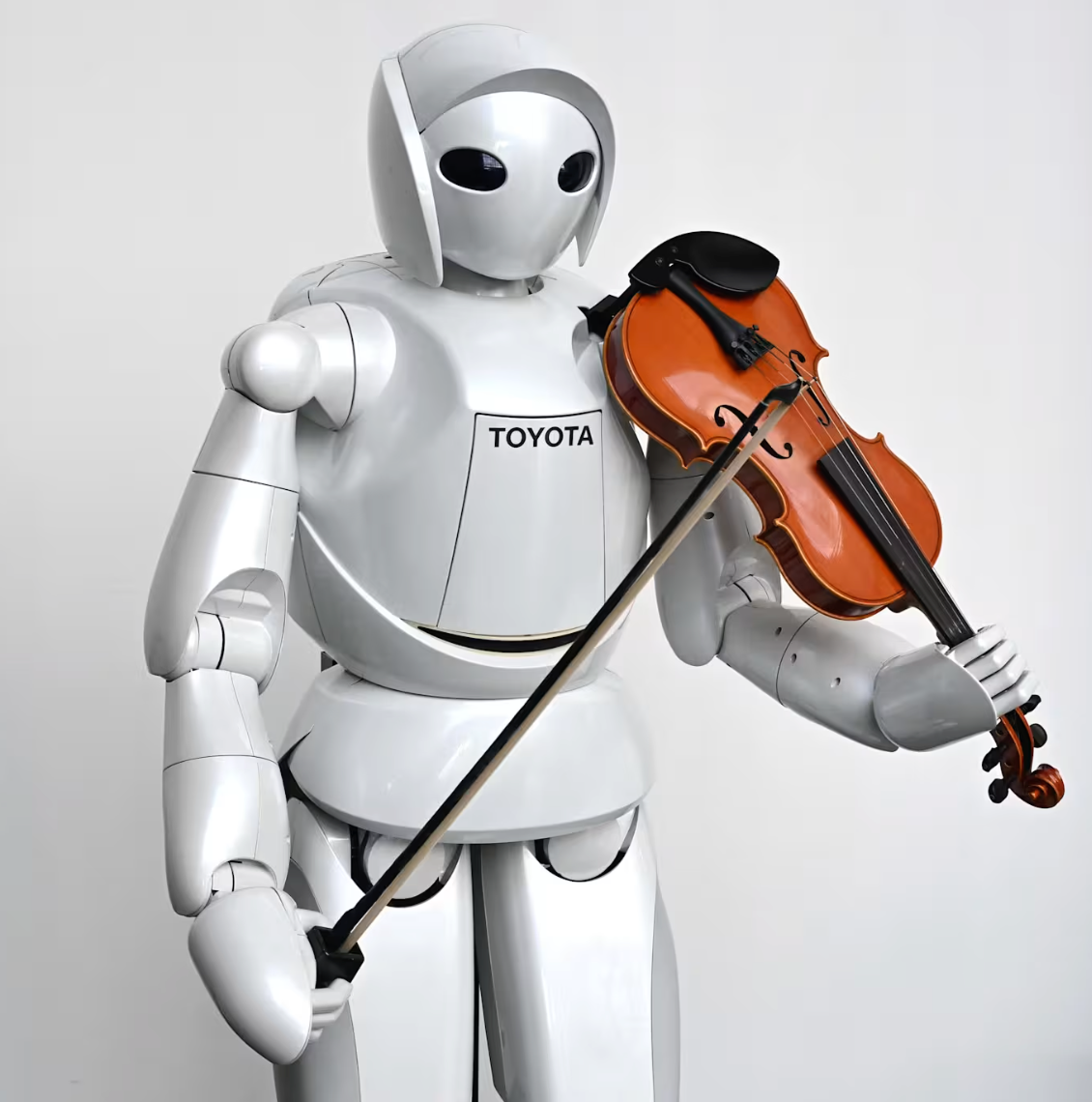
The image shows a humanoid robot developed by Toyota.
From assembly-line scale to robot scale
Toyota's executives are presenting a robotics strategy to investors worldwide. Under an investment plan of US$6.4 billion annually, the automaker plans to deploy 400,000 robots across manufacturing operations and accelerate factory automation. A dedicated robotics team will also be assembled under the chief production officer, a structure that links the robot program directly to production leadership rather than leaving it as a separate laboratory effort.
The company has spent about 20 years building robotics research experience. The current signal is that it wants to convert that accumulated capability into commercial humanoid and intelligent robots, while competing with Tesla, XPeng Motors and Hyundai Motor for attention from investors, industrial customers and policy observers.
Why the software layer matters
Toyota investors are reading the move as a possible platform shift. Carl Vine, a portfolio manager at M&G, said, "I believe Toyota could become the world's largest humanoid robotics company; they just need to go for it." He added, "Who controls the software layer controls global manufacturing. Toyota is developing its own large behaviour model ... and because of the scale of its business, it has massive internal data. These are critical elements."
Goldman Sachs also framed the opportunity in measurable terms. The bank's analysts estimate that, using its technology capability and mass production experience, Toyota could capture 3% to 8% of the global humanoid robot market by 2035, equivalent to selling 190,000 to 540,000 humanoid robots.
Competitor benchmarks remain noisy. Tesla CEO Elon Musk has said Tesla Optimus humanoid robots could become "the most important product ever" for Tesla, and has set a long-term goal of increasing annual output to 1 million units. At this stage, production has begun, but large-scale output has not yet been reached.
A late entrant, a changing contest
Robotics leadership is not new to Japan. During the first decade of this century and the second decade of this century, Honda introduced Asimo and SoftBank launched Pepper, making Japan almost synonymous with humanoid robots. However, as artificial intelligence rose and Chinese humanoid robots posted videos dancing or practicing martial arts online, the perception shifted: many observers now place the United States and China ahead of Japan.
In that context, Toyota is a later entrant. Its rivals have also turned to robotics, not only for public imagination but for industrial economics: lower automobile manufacturing cost and new revenue sources.
People close to Toyota said that after Kenta Kon became chief executive, the company suddenly amplified its messaging around robotics. The reason was internal recognition: Toyota must work harder to compete with China in factory lines and technology.
The reporting describes Toyota CEO Kenta Kon as advancing the company's robot agenda.
Case: a new Nagoya plant as the proving ground
Toyota has a possible deployment window in the early 2030s, when it may open a new car assembly plant near Nagoya. That site would also be the company's first new assembly plant in Japan since 2012. For operations executives, the location is important because it combines a greenfield factory, a fresh production layout and the chance to embed robotics before legacy lines harden.
A former Toyota executive put the strategic logic plainly. "Those responsible for production have hardly considered using new technologies to build cars anymore," the person said. "The production system is now one of the keys to competing with China. Robotics is an important means for Toyota to respond to manufacturing competition from China."
Data points industrial leaders should track
| Reported fact | Why it matters for operations and investment decisions |
|---|---|
| Financial Times says Toyota is targeting a top position in global robotics | Shows that a major automaker is treating robotics as a strategic growth axis, not only as automation equipment. |
| US$6.4 billion annually | The scale suggests sustained capital allocation rather than a pilot experiment. |
| Plan to deploy 400,000 robots | Creates a demand signal for components, integrators, software platforms and workforce reskilling. |
| About 20 years of Toyota robotics R&D | Provides a potential bridge between established manufacturing practice and humanoid commercialization. |
| Goldman Sachs estimate of 3% to 8% global humanoid market share by 2035 | Indicates that a large share of the eventual market may be contested, not yet decided. |
| 190,000 to 540,000 humanoid units in Goldman Sachs' 2035 estimate | Translates percentage share into a unit range that manufacturers can compare with production capacity. |
| Tesla Optimus target of 1 million units per year | Shows the competitive ceiling being discussed, even though large-scale production has not begun. |
| New Nagoya plant in the early 2030s and first new Japanese assembly plant since 2012 | Highlights how robotics adoption may move with factory construction cycles. |
Common misconceptions
- Misconception: this is only a public-relations story. The original reporting ties the robot push to a production system, a dedicated team, factory automation and investor expectations, which makes it an operating-capability issue as well as a messaging issue.
- Misconception: humanoid robots will instantly replace conventional factory automation. The plan described by Toyota is linked to a broad deployment of 400,000 robots and an existing production network, suggesting a staged transition rather than a single product swap.
- Misconception: early Japanese humanoid projects mean Japan automatically retains leadership. The original article notes that Honda's Asimo and SoftBank's Pepper created a strong image in the first decade and second decade of this century, but that perception changed as artificial intelligence advanced and China became more visible.
- Misconception: Tesla has already mass-produced Optimus at its stated long-term scale. The article says production has started but has not entered large-scale output, even though a long-term target of 1 million units annually has been discussed.
Action recommendations
- Treat robotics as part of production-system design. If a factory upgrade is planned, evaluate whether robot platforms can support both current assembly tasks and future flexible operations before legacy lines are fixed.
- Track software and data as closely as hardware. The investor commentary points to control of the software layer and internal manufacturing data as decisive factors; operations teams should therefore assess model updates, integration layers and data governance.
- Use market-share estimates as a range, not a promise. Goldman Sachs' 3% to 8% forecast for 2035 and 190,000 to 540,000 units suggest uncertainty. Capital allocation should be staged around milestones, supplier readiness and demonstrated line performance.
- Watch competitor moves beyond automakers. Tesla, XPeng Motors and Hyundai Motor are also using robotics to reduce automobile production cost and find new revenue. Purchasing and engineering teams should benchmark component sourcing and integration partners accordingly.
- Prepare workforce planning for phased automation. A 400,000-robot deployment signal implies changes in maintenance, programming, quality assurance and production scheduling, even if the timeline remains long.
FAQ
Why is Toyota moving into robotics?
The original reporting frames Toyota's push as a combination of production modernization and growth-seeking. The automaker is responding to competition from China while also looking for opportunities beyond automobiles. The planned deployment of 400,000 robots and the annual US$6.4 billion investment indicate that this is not a small pilot.
How large could Toyota's humanoid robot market share be?
Goldman Sachs estimates that Toyota could reach 3% to 8% of the global humanoid robot market by 2035. In unit terms, that would correspond to 190,000 to 540,000 humanoid robots, based on the bank's analysis of Toyota's technology capability and large-scale production experience.
Where might the strategy become visible first?
A likely point is Toyota's possible use of robotics at a new assembly plant near Nagoya in the early 2030s. That project would be Toyota's first new car assembly plant in Japan since 2012, making it a useful case study for how robotics can be incorporated into a modern production layout.
What is Tesla's role in the competition?
Tesla is also part of the humanoid robotics contest. CEO Elon Musk has described Optimus as "the most important product ever" and set a long-term target of 1 million units annually. Still, the article notes that Optimus has started production but has not yet reached large-scale manufacturing.
Does the strategy show that Toyota has caught up with robotics leaders?
Not necessarily. The article positions Toyota as a later entrant. Japan once had strong symbolic presence through Honda Asimo and SoftBank Pepper during the first decade and second decade of this century, but the rise of artificial intelligence and visible Chinese humanoid robots changed the competitive image. Toyota's strength is its manufacturing scale, internal data and production-system experience, not a simple claim of immediate market leadership.
For industrial leaders, the more useful question is not whether one automaker will become the biggest humanoid robot company, but how a robot-heavy factory future changes production planning, capital budgeting, supplier selection and workforce skills. The reported Toyota strategy turns robotics from a showcase topic into a test of whether a large industrial system can absorb new technology while competing against fast-moving manufacturing rivals.