
Factory-Scale Robotics in Massachusetts: How The Grid Rewrites the Economics of High-Mix Circuit Board Supply
Today, a machine that behaves less like a production line and more like one very large robot is quietly resetting the arithmetic behind small-batch electronics. The Grid, a factory-scale system running in Massachusetts, has been building boards for paying customers for five years, and its existence forces a practical question on every operations lead, sourcing manager and engineering director reading WorldIndustrialWeekly: does assembly still have to follow the cheapest labor market?
The legacy that shaped today's supply chains
For 30 years, the relocation of electronics manufacturing out of the West followed a simple logic. Placement and soldering were labor-intensive, wage levels decided the outcome, and volume migrated to markets where that input cost less. Teams designed in the US and built in China, and the split held up well enough for decades.
Automation is now bending that pattern, but so far mostly at the extreme end of the volume curve. SpaceX builds Starlink dishes by the million in Bastrop, Texas, precisely because repeating one identical product at that rate justifies capital tied to a dedicated line. Where repetition disappears, the same capital logic collapses.
The gap most hardware organizations actually live in
Very few companies reach Starlink-type throughput. The realistic demand profile is ten of this, a hundred of that, plus a fresh board revision landing next week. High-mix work has resisted automation because every new design historically dragged hours of setup and manual changeover behind it. That overhead is why the work went offshore, or to expensive quick-turn houses.
How the Massachusetts system is architected
The point of difference is structural rather than incremental. Instead of a fixed line that must be reconfigured between products, the plant is orchestrated as a single robot: levitating carriers move each board and its component set between stations that deposit solder paste, place parts, reflow, solder and inspect. A blend of learned models, AI agents and classic optimizers schedules the flow across those stations.
Routing therefore happens per unit, not per batch. With no changeover event and no per-design setup to amortize, a single run covering 100 different designs flows as smoothly as 100 units of one design, and prototype lots share the same equipment as production lots.
The customer profile is not a startup-only story either. Large manufacturers carry long tails of low-volume boards: test stations, tooling, R&D rigs and thin production series. A leading EV maker, a top AI lab and household-name technology companies already build on The Grid.
Benchmark case: one 4-layer motor controller
A single priced comparison makes the trade-off legible. One 4-layer motor controller drawing 118 parts per board, of which 38 are unique part numbers, was quoted as five assembled boards, components included, delivered to a US address — once on The Grid and once at a typical quick-turn shop in Shenzhen.
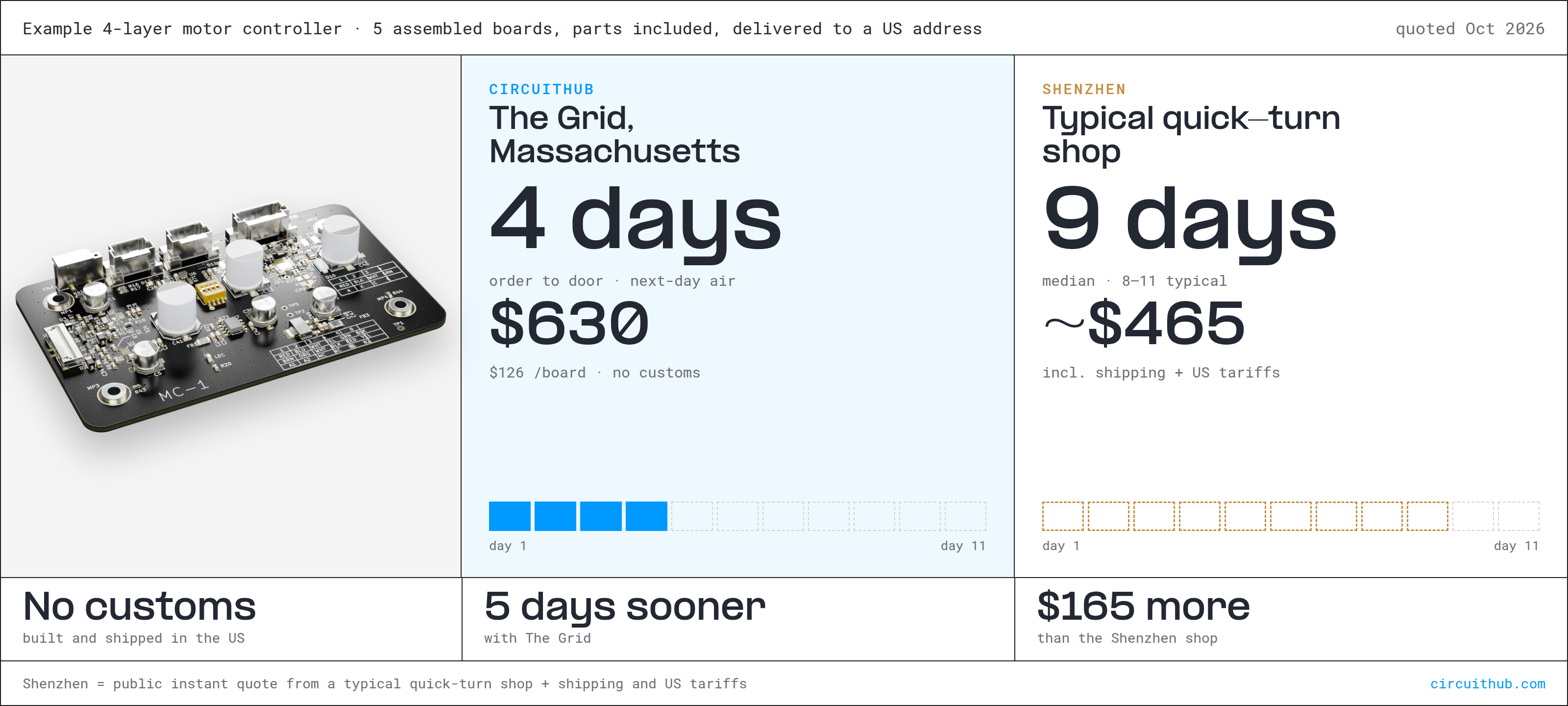
| Route | Elapsed time | Delivered cost |
|---|---|---|
| The Grid (domestic, on-demand cell) | 4 days to the buyer's door | $630, components included, no customs step |
| Typical quick-turn shop in Shenzhen | 9 days at the median | about $465 after shipping and US tariffs |
Read as a program variable rather than a unit price, the delta is about $165 spent to recover five days of calendar, drop a customs process and shorten the planning chain. Most hardware teams will find that five days of engineering time is worth considerably more than $165 — particularly when the revision in question gates a test build or a customer demo.
Common misconceptions to stress-test before re-sourcing
- "Automation only pays at enormous volume." That holds for dedicated lines built around repetition. It does not hold where setup is engineered out, because the cost driver was changeover labor, not throughput.
- "A lower quoted unit price is a cheaper program." The Shenzhen benchmark lands at roughly $465 versus $630, but only after shipping and US tariffs are absorbed and after five additional days of elapsed time.
- "On-demand assembly is a prototyping service." Prototypes and production batches run on the same machines here, and the reported record covers tens of millions of dollars of electronics a year.
- "Reshoring is a wage question." The case study reframes it as a technical one: whether a given board family can be produced without per-design setup.
- "Only small innovators benefit." The stated user base includes a leading EV maker, a top AI lab and established consumer technology brands.
Operating record versus demonstration
Managers evaluating any new manufacturing claim should separate pilots from production. The Grid reports five years of work for external customers and annual output described as tens of millions of dollars of electronics a year. Across CircuitHub, the wider operation says it has shipped more than 2.2 million boards, placed more than 150 million parts and served more than 26,000 engineers. These are operator-reported figures, not third-party audited data, and should be weighted accordingly during supplier qualification.
Capacity trajectory and what remains unresolved
Demand is already running ahead of installed output. The build plan is to lift capacity 5x This year, with another step change penciled in for 2027. The stated long-horizon objective has not moved since day one: make building hardware as fast as designing it.
What remains genuinely open is whether the model holds as the design mix shifts from boards to broader electromechanical assemblies, and how pricing behaves once promised capacity is installed. Neither question can be answered from the current operating record. For now, the credible finding is narrower and more useful: the barrier that pushed assembly out of the West was the inability to automate at typical batch sizes, and The Grid is evidence that this barrier is no longer absolute.
Action recommendations for production and sourcing leaders
- Segment your board portfolio by mix and lot size, then flag the families that currently route to quick-turn or offshore vendors purely because of changeover hours.
- Rebuild your comparison model around landed cost and calendar. Add shipping, US tariffs, customs handling and elapsed days to the quoted number, as the 4 days versus 9 days benchmark does.
- Re-test your internal automation threshold. If per-design setup disappears, the minimum economic lot drops sharply and small series become candidates for domestic supply.
- Book capacity early where the market is tight: reported demand already exceeds available output, and expansion of 5x is planned for This year with a further jump in 2027.
- Capture your internal low-volume tail — test stations, tooling, R&D rigs — as a formal demand stream instead of treating each request as a one-off favor from engineering.
- Verify operator-reported volumes and pricing against a trial order before committing a program; the five assembled boards benchmark above is a useful template for that test.
FAQ
What is The Grid?
A factory-scale robot in Massachusetts that manufactures circuit boards on demand. Levitating carriers move each board between solder-paste, placement, reflow, soldering and inspection stations, with learned models, AI agents and classic optimizers handling the schedule.
Why does it matter for industrial supply chains?
Because it attacks the specific reason assembly left the West: high-mix work with hours of setup per design. Removing changeover means one run spanning 100 different designs behaves like one run of 100 units.
Which board was used for the cost comparison?
A 4-layer motor controller with 118 parts per board, 38 of them unique, quoted as five assembled boards with components included, delivered to a US address: $630 in 4 days on The Grid versus about $465 at the median in 9 days from a typical quick-turn shop in Shenzhen.
Is this still a prototype?
No. The reported record covers five years of customer production, tens of millions of dollars of electronics a year, more than 2.2 million boards shipped, more than 150 million parts placed and more than 26,000 engineers served across CircuitHub.
What comes next?
Capacity is planned to rise 5x This year, with a further step in 2027, against demand that already exceeds output.
Industrial Weekly's editorial desk covers automation, reshoring and electronics supply chains on WorldIndustrialWeekly. Corrections, documents or tips from plant and procurement teams can be sent to news@industrialweekly.com.