
Korea's Trillion-Dollar Export Run: A Data Watch on Chip Prices, Concentration and the Missing Factory Payoff
By Michael Torres | Industrial Weekly (WorldIndustrialWeekly Data Watch)
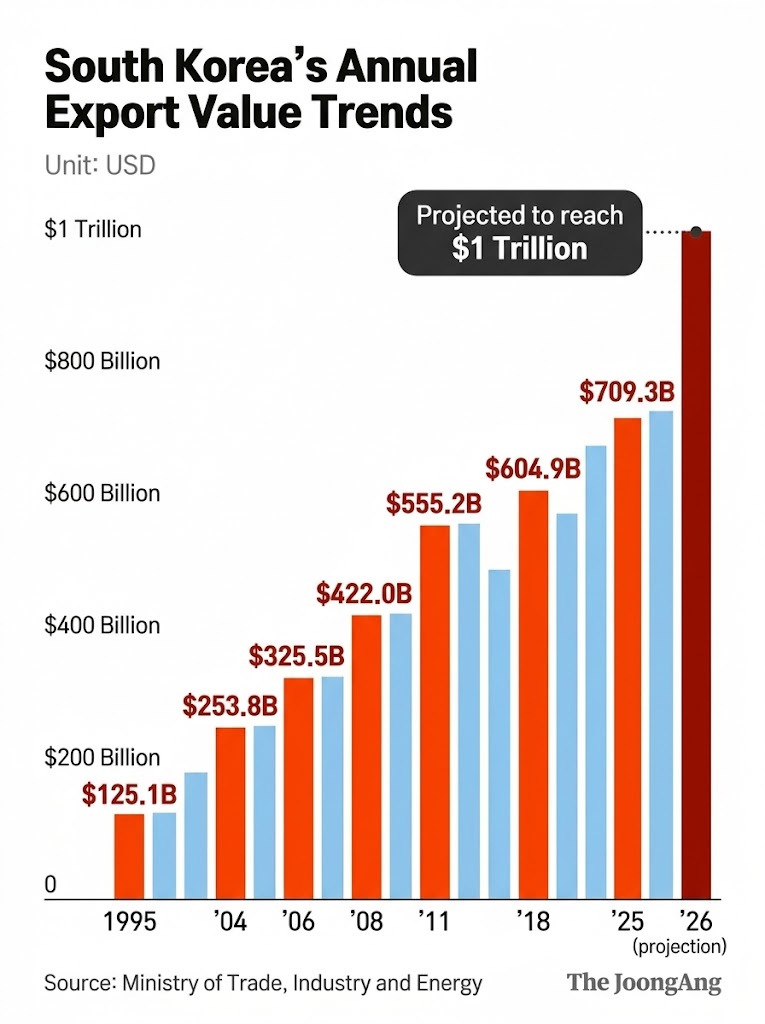
Read South Korea's customs ledger the way a plant controller reads a variance report, and the headline stops being the story. Jan-Oct 2026 shipments have already accumulated roughly $930 billion, according to figures carried by Xinhua on 1 November 2026, and the Korea Customs Service expects the annual total to cross $1 trillion in early December. That would make South Korea the fourth economy to clear that bar — a distance covered in 31 years, since exports first crossed $100 billion in 1995. The analytically useful question is not whether the milestone arrives, but how many products, how many firms and how many price points are holding it up.
The dataset: one month, two engines, half the ledger
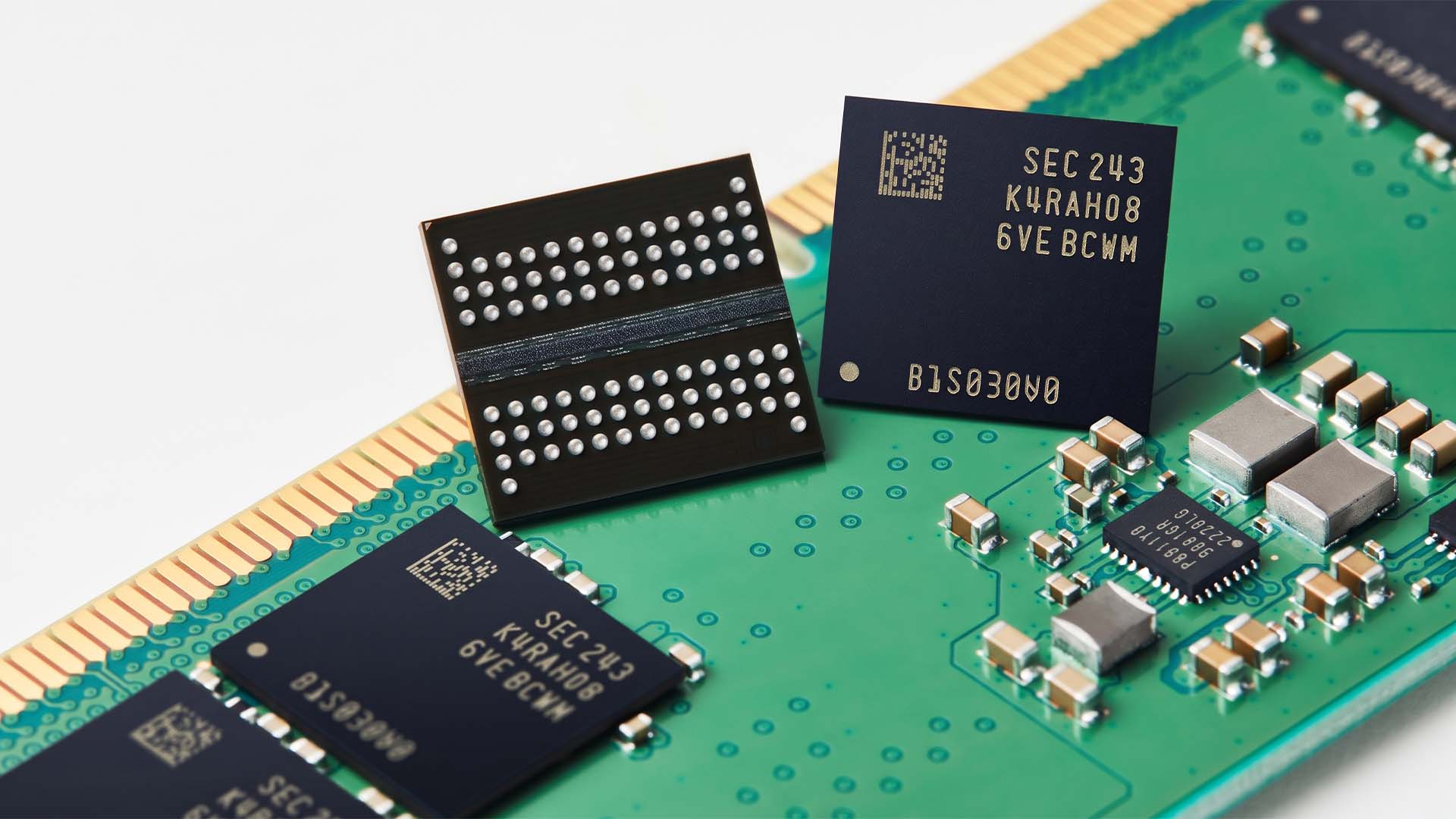
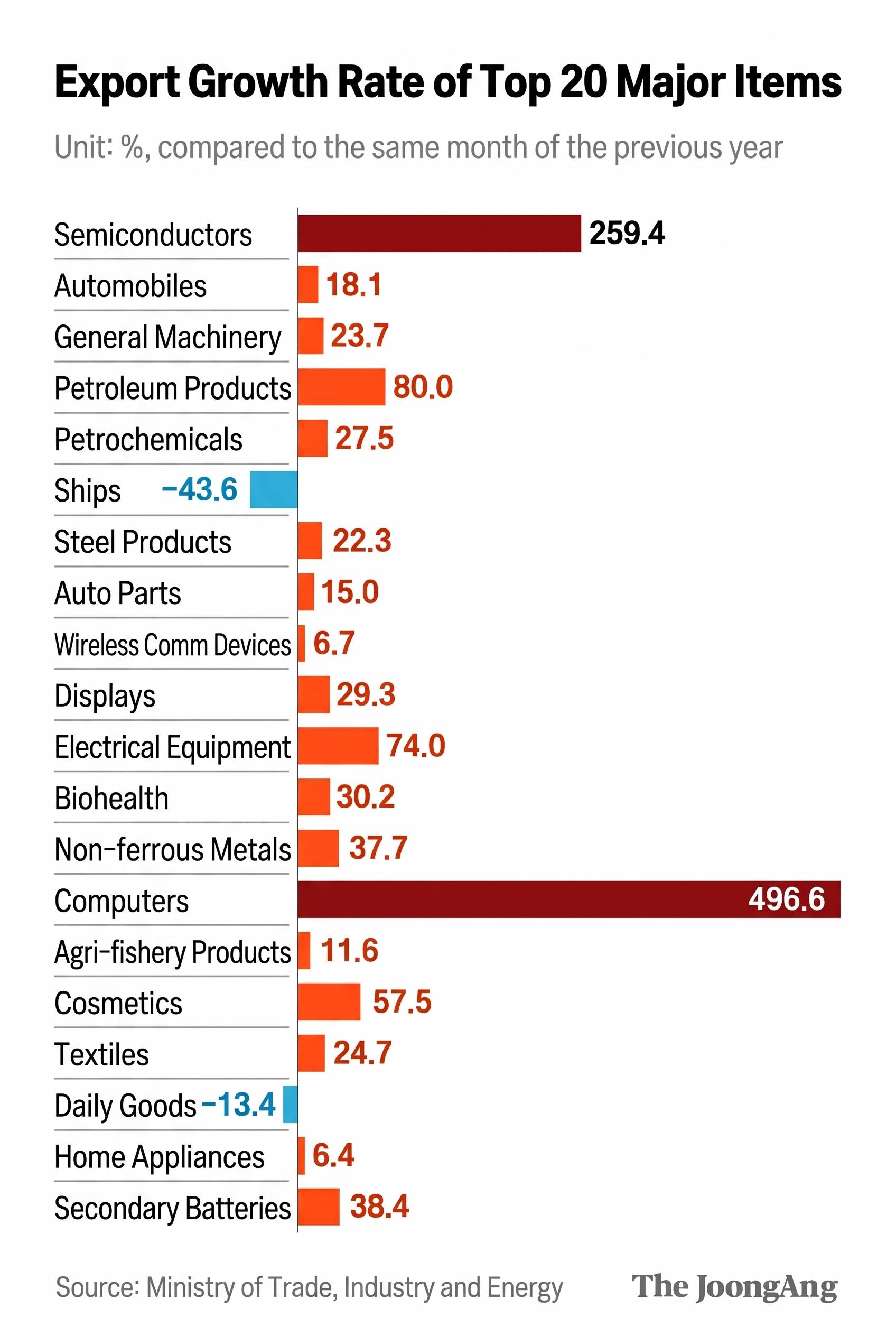
October is the cleanest single data point available. Semiconductor shipments came in at $56.44 billion, up 259.4% year on year, and a single product category accounted for 49% of the month's total exports. Samsung Electronics and SK Hynix sit at the centre of that flow, supplying the advanced memory that AI data-centre builds are consuming. The second engine is even steeper off a small base: computer and server-class equipment linked to the same AI chain grew 496.6% year on year.
Everything else in the October export basket tells a different story — and that spread is the most under-reported number in the trillion-dollar narrative. Sector detail released by the Ministry of Trade, Industry and Energy on 1 November 2026 shows a K-shaped ledger rather than a broad industrial upswing.
| Export category (October 2026) | Value (US$ billion) | Year-on-year change |
|---|---|---|
| Semiconductors | 56.44 | +259.4% |
| Computer / server equipment | 5.85 | +496.6% |
| Displays | 19.0 | +29% |
| Automobiles | 17.0 | +15% |
| Rechargeable batteries | 7.0 | +38% |
| Wireless communication gear | 1.95 | +6.7% |
| Ships | 2.6 | -44% |
Table compiled from the MOTIE monthly export release dated 1 November 2026 (reporting mirrored at ithome.com/1/020/867.htm). Memory and computing hardware alone contribute more export value in one month than autos, batteries, displays-for-phones and wireless gear combined.
The pace inside the month matters as much as the monthly total. Korea Customs' first-ten-day release showed a record $26.1 billion; the 1-20 October release showed exports up 105% year on year with chips up 222.5% and representing 44.7% of that early window (Reuters, 21 October 2026). September had already broken $120 billion for the first time as a monthly total, with chip shipments up 263%. For procurement and demand-planning teams, these fortnightly prints have become the fastest public proxy for AI infrastructure capex anywhere in the world — quicker than hyperscaler guidance.
Price or volume: decomposing a 259.4% jump
Raw year-on-year percentages reward the wrong variable. Memory is a commodity with a contract market, and a meaningful part of October's dollar surge is unit price rather than units shipped. Contract reference prices published alongside the MOTIE data put 16Gb DDR5 DRAM at $50.00 in October, $2 higher than September, while 128Gb NAND held at $30.60. TrendForce's 30 September 2026 forecast projected conventional DRAM contract prices rising 10-15% quarter on quarter in the fourth quarter of 2026 and NAND 15-20%, a range its 20 October update revised upward to roughly 20% for conventional DRAM.
Two consequences follow. First, export value can decelerate sharply even if shipped bit volumes keep climbing, because the price leg reverses first — and it reverses fastest exactly in the memory categories that dominate Korean shipments. Second, the downside is convex: if AI infrastructure budgets are cut, order volumes and average selling prices fall together rather than in sequence. Korea's own export record already demonstrates how symmetrical this is in reverse — ship exports ran at -44% in the same month the chip line tripled.
Four leading indicators to track each quarter
- Contract-price negotiation outcomes for server DRAM and enterprise SSD, not spot prices.
- Front-end equipment purchase orders: semiconductor imports rose 91.5% and chip-making equipment 44.8% in one recent monthly read (Tech Times, 11 September 2026), signalling capacity being added today for supply pressure tomorrow.
- Module and channel inventory weeks at data-centre integrators.
- Monthly export share of the top five exporters, a concentration test that has been trending upward all year.
Where the demand lands: markets, capex and a re-routed supply chain
Destination data shows the boom is broad in geography but narrow in content. Exports to China rose 133.6% year on year, shipments to the United States climbed 185.8%, and flows to Europe and Southeast Asia stayed strong. The resulting surplus has placed South Korea among the clearest winners of the current AI build-out cycle.
Domestically, the structural shift is measurable. A Bank of Korea review reported that semiconductors have expanded to over 30% of total Korean manufacturing output, while the routing of chip exports is also changing: Taiwan, which took 9.0% of Korean semiconductor exports in 2022 as the fourth-largest destination, has been gaining share as AI packaging and testing capacity absorbs intermediate flows. In other words, part of the value in the trillion-dollar line is moving through new intermediaries rather than straight to end markets.
Case in point: the supplier tier that never felt the gold rush
For a concrete read on transmission, look at the tier of materials, parts and equipment firms that sit under the two chipmakers. A July 2026 investigation by the Korea JoongAng Daily found that the average operating margin of 176 listed Korean semiconductor suppliers in the first quarter was only about 8% — a fraction of the profitability recorded by the memory makers they serve, and far too thin to fund capacity expansion, wage growth or automation.
Survey evidence points the same way. A Korea Institute for Industrial Economics and Trade poll of 1,500 manufacturers put the second-quarter business sentiment index at 90 against a benchmark of 100, with a semiconductor sales sub-index at 103 but refining at 78, home appliances at 84 and display panels at 86; 73.2% of respondents cited rising input costs, 33.1% falling orders and 31.6% higher ocean freight. By October the manufacturing business survey index had slipped to 78 from 79 the previous month (Trading Economics).
The domestic-demand picture is consistent. Retail sales in the third quarter fell 0.5% year on year, breaking the prior growth trend and ranking among the steepest declines in an extended period. Employment and household consumption show no matching recovery. The Korea Development Institute raised its 2026 growth forecast to 3.2% on the AI-driven chip cycle while cutting its employment outlook (JoongAng Daily, 19 August 2026); the OECD's June 2026 outlook for Korea projects 2.6% growth in 2026 and 1.9% in 2027 on the same export engine. A 0.6-percentage-point spread between two credible forecasts of the same economy is itself the signal: how much of this growth is labour-intensive enough to be felt in a workshop.
Economists quoted in the original reporting note the structural reason — semiconductor manufacturing is high-skill, capital-intensive and thinly linked to local service and component ecosystems, so it does not propagate into jobs and consumption the way automobiles, construction or consumer services do. Analysts therefore argue that South Korea needs new growth industries and stronger domestic consumption to balance the ledger. The risk of single-category dependence is explicit: if global technology companies trim AI infrastructure investment, Korean chip export momentum takes the hit directly.
Common misreadings of the trillion-dollar headline
- "A record export year means manufacturing recovered." Output, sentiment and retail data are diverging; a 0.5% third-quarter fall in retail sales does not accompany a healthy broad recovery.
- "259.4% growth is a demand-volume story." Part of it is memory contract price. Price-led growth is the leg that unwinds first.
- "Chip exports create chip jobs." The capital intensity of the category and KDI's downgraded employment outlook both argue against a strong jobs read-through.
- "49% of one month's exports is strength." It is concentration. A single category, two listed firms and one demand driver now underwrite the national trade statistic.
- "Monthly comparisons are like-for-like." Working-day counts and fortnightly customs releases distort month-to-month jumps; the intra-month data is a leading indicator, not a substitute for quarterly decomposition.
Action notes for production, procurement and capital teams
- Index your memory spend. Purchase agreements tied to contract-price bands, or with renegotiation triggers at defined quarterly steps, protect margins when the price leg reverses.
- Run three demand scenarios, not one. Build planning on bit-growth, ASP-growth and revenue-growth separately — a flat-ASP, rising-bit year looks nothing like 2026.
- Book capacity early where AI exposure is real. Fab and packaging bottlenecks move in the same direction as prices; reservation windows close before the shortage is visible in headlines.
- Stress-test your tier-two suppliers. An 8% average operating margin in the supplier base means quality, delivery and continuity risk are financial, not operational. Co-invest or dual-source where single-sourced.
- Hedge the logistics and FX tail. Freight inflation and currency weakness were both flagged in manufacturer surveys; they erode the benefit of a strong export order book.
- Diversify before you have to. Korea's own policy debate — new growth industries plus domestic demand — is the same agenda an export-dependent component maker faces at firm level.
FAQ: what industrial readers ask next
Is the $1 trillion target the right number to watch?
It is a symbolic threshold, not an operating metric. The variables that actually move margins are the October share of semiconductors (49%), the concentration of the top exporters, and memory contract prices. Watch those.
Why does South Korea's boom not translate into domestic demand?
Because the value chain is short and capital-heavy. Chip revenue lands in two listed firms and flows to imported equipment and materials, while roughly 8% supplier margins and a downgraded employment outlook keep the multiplier small.
What is the single biggest downside risk?
A cut in AI infrastructure investment by large technology companies. Volume and price decline together in that scenario, and categories already weak — ships at -44% — offer no cushion.
Should buyers outside Korea care?
Yes, if you specify memory, SSD or server-class hardware. Korea's fortnightly customs prints are the earliest public indicator of AI build-out intensity and should sit in your cost model as a leading input.
How long can this asymmetry last?
Indefensibly long for the export line, but the turning point is usually visible in contract-price negotiation rounds before it appears in totals. The coming years of observation are less about whether Korea reaches $1 trillion than whether the memory boom converts into broader, more sustainable growth.
Datasets like this one are useful precisely because they are unforgiving: a trillion-dollar export line assembled from half a month of memory shipments, one price cycle and two companies is a signal to plan around, not to celebrate. The editors of Industrial Weekly welcome operational perspectives from plant, procurement and supply-chain readers on how AI-driven component cycles are reaching your order books — write to news@industrialweekly.com.