
WorldIndustrialWeekly Industrial Energy Brief: Solar Surpasses Nuclear as Costs, Chinese Manufacturing and Storage Rewire Power Supply
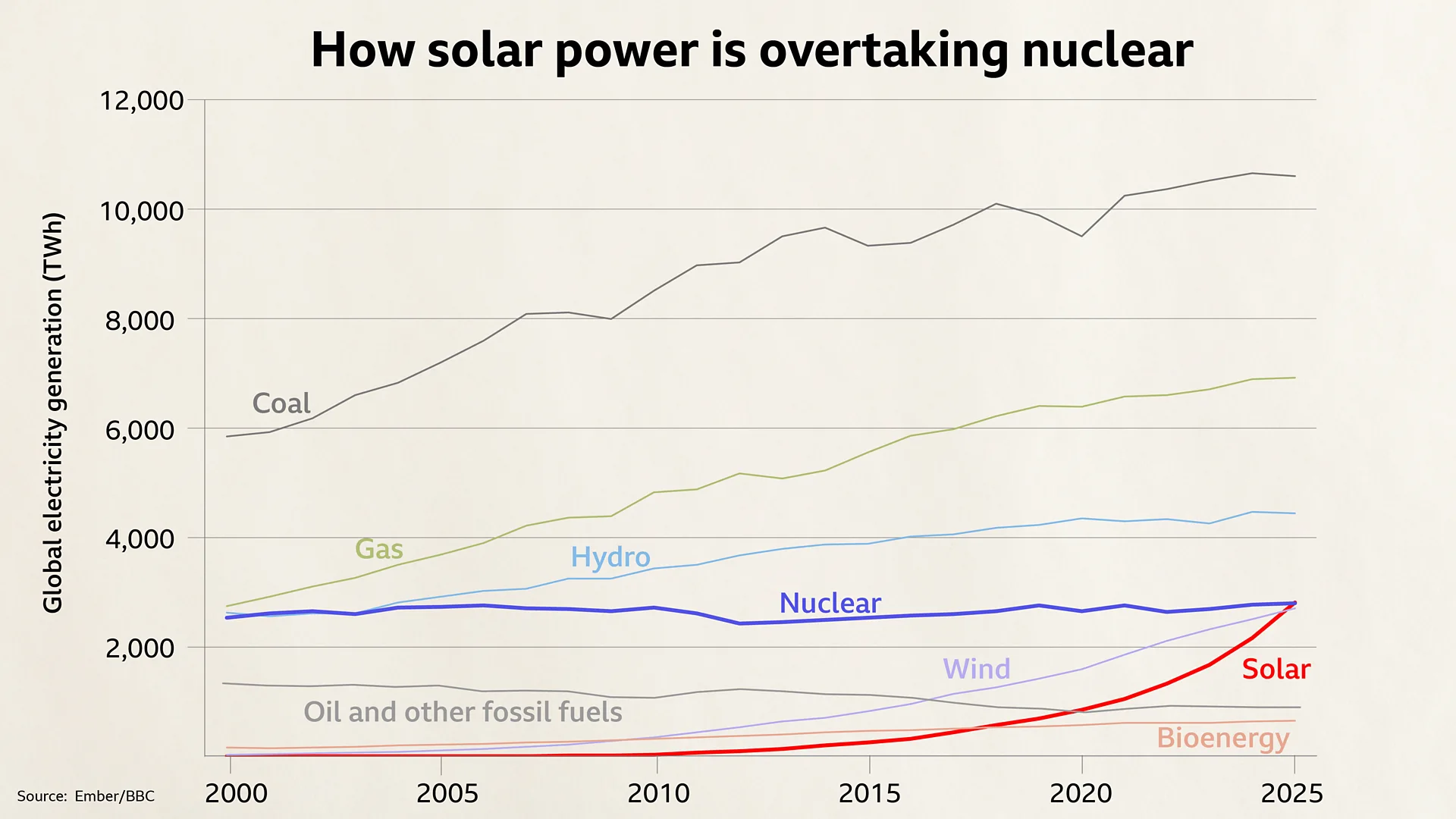
For industrial operators, energy procurement leaders and infrastructure planners, the global power mix has crossed a visible threshold. Across the past decade, solar generation moved from a marginal contributor to a decisive expansion source. In 2025, global annual solar generation edged past nuclear power for the first time, and the gap widened further in 2026. Energy think tank Ember's data analysis shows that during the 12 months to September 2026, solar generated about 13% more electricity than nuclear. This WorldIndustrialWeekly brief translates that statistic into the operating, supply-chain and project-planning questions that matter for factories, mines, data centres, utilities and commercial estates.
From a small share to a system-defining growth source
Ten years ago, solar accounted for only about 1% of global electricity supply, while nuclear generation was roughly ten times solar output, and wind power also led solar. Since then, photovoltaic module prices have continued to fall, factory scale has increased and storage technologies have matured. The result has been faster expansion than many institutional forecasts assumed.
Ember's statistics show that global solar generation in 2025 reached about 2778 terawatt-hours, up 30% from the prior year. Solar was the fastest-growing major electricity source and met about three-quarters of new global power demand in that year. Nuclear generation, by contrast, has shown limited overall change since 2000, while solar has grown thousands-fold over the past two decades or more.
Jan Rosenow, an Oxford University energy and climate policy specialist, sees solar as a central force in the global energy transition. He points out that older mainstream predictions often assumed linear solar growth and slowly declining module prices. In practice, technology improvements and manufacturing scale effects repeatedly pushed development beyond expectations.
Why the cost curve moved faster than expected
The most immediate driver is cost. As photovoltaic technology matured, cell conversion efficiency improved while manufacturers used less silicon and silver in each module. China's extensive solar manufacturing chain expanded production scale, and competition together with periods of overcapacity pressed module prices down.
Ember co-founder David Jones notes that during the 2023 to 2024 period, photovoltaic module prices fell sharply, moving solar into a very low cost phase. A standard PV module can now cost less than $100, generate power for 30 to 40 years under suitable conditions, and require almost no additional fuel while operating.
That changes the economic comparison with coal and gas. Traditional power plants must buy fuel continuously and pay for transport, storage and price volatility. Solar plants mainly commit capital during construction; later costs are shaped more by equipment maintenance, land, financing and grid connection. The economic appeal is strongest where electricity prices are high and fuel supply is unstable.
China's manufacturing base and overseas diffusion
China plays a critical role in this transition. It is both the world's largest solar market and a major manufacturer of photovoltaic modules, cells and related equipment. Its large capacity has lowered global solar product prices, allowing more countries to build solar plants at lower cost.
Although the growth of China's domestic new solar capacity may start to slow, low-cost modules produced in China continue to flow into overseas markets. For many developing countries, importing solar equipment is easier to start than building large conventional plants and supports a faster expansion of electricity supply.
Regional demand signals: the United States, India, Australia and unreliable grids
The United States remains the world's second largest solar market. Even where government tariffs and other restrictions apply, solar installations continue to grow. Researchers at the University of Maryland observe that trade barriers and policy limits may increase photovoltaic costs and slow deployment, but solar's underlying economic advantage remains strong. In many regions, new solar facilities are still one of the least expensive ways to add electricity supply.
India is also accelerating solar development. Over the past two years, solar met about 60% of India's new power demand. In Australia, more than 4 million households have installed rooftop solar systems, accounting for more than one-third of all households. Solar is no longer only a large-project category for utilities; it has become an energy asset that households and firms can deploy themselves.
In countries such as Pakistan, Lebanon and Nigeria, solar adoption is closely tied to unreliable conventional supply. Some areas lack adequate grid coverage, while households and businesses have long depended on diesel generators. When oil prices rise and diesel costs increase, solar becomes a more attractive replacement.
Case focus: Pakistan's rooftop shift
Pakistan provides a concrete example for emerging-market project developers and manufacturers with captive power needs. In 2019, solar supplied less than 2% of the country's electricity, while it now reaches about 24%. High and unreliable grid tariffs, combined with low-cost photovoltaic modules imported from China, pushed many households and businesses to install rooftop systems. Instead of waiting for large power plants or grid upgrades led by government, end users can invest directly in solar and quickly reduce their exposure to conventional energy systems.
Storage, intermittency and the limits of cheap panels
Solar generation has a limit that cannot be avoided: it produces electricity only when sunlight is available. Even if module prices are low, solar alone cannot reliably meet round-the-clock demand without suitable storage and grid systems.
Battery technology is changing that equation. As battery costs fall, more solar plants add storage facilities, capturing surplus daytime generation and releasing it in the evening or at night. Energy specialists note that in high-sun regions, solar paired with storage can already compete economically with newly built fossil-fuel plants.
California, in the United States, offers evidence. During the first half of 2026, solar and battery storage systems together supplied more than one-quarter of electricity demand during the 7 p.m. to 9 p.m. peak period on average. That shows solar's influence is no longer limited to midday generation; through storage, it is beginning to shape the broader grid supply structure.
Batteries mainly address the problem of shifting power within a single day. To handle extended cloudy weather, seasonal variation or long winters, systems still need longer-duration storage, inter-regional grid connections and other dispatchable resources. The energy system cannot rely only on installing more solar panels; it must also build infrastructure that can absorb and dispatch electricity.
New loads, grid bottlenecks and planning risk
Global electricity demand is changing because of electric vehicle adoption, industrial electrification and growth in artificial intelligence data centres. Solar can provide low-cost electricity for these added loads and reduce reliance on coal, natural gas and oil. However, if demand grows faster than grid expansion and storage deployment, rapid solar growth may encounter a new bottleneck.
Julia Souder, an energy specialist, warns that electrification does not automatically strengthen energy system resilience if it is not paired with planning. Large new loads without flexible scheduling capacity can make grids more fragile. The principal constraints facing the solar industry are increasingly shifting from module prices and manufacturing capacity to grid construction, storage deployment and electricity demand management.
Technology paths still unfolding
Photovoltaic technology continues to evolve. In Germany, balcony solar systems have spread rapidly in recent years, allowing residents to use small photovoltaic modules to supply part of household electricity through ordinary sockets. These devices generate far less than larger rooftop systems, but they lower the barrier for ordinary people to participate in the energy transition.
Agrivoltaics is attracting attention. In some regions, farmers can continue crop production or livestock grazing under solar panels, reducing single-purpose land occupation by solar plants. Some solar farms in the United States have allowed sheep to graze between photovoltaic arrays, helping control vegetation while keeping land productive for agriculture.
Floating solar plants, mirror-concentrated solar facilities, perovskite PV cells and solar windows that can generate electricity may all broaden applications. They may not replace conventional crystalline silicon modules immediately, but they could bring solar into environments where large arrays are difficult to install.
Growth pause, dispersion and long-term outlook
Even with strong momentum, solar's new installation growth rate may slow for the first time in 2026. The main reason is China. In summer 2025, China adjusted price mechanisms and support policies for new energy projects, prompting many projects to be built early and connected before the old policy period ended. This concentrated build-out partially pulled forward demand from the following year.
Excluding the China market, solar modules installed in other parts of the world in 2026 may still exceed the comparable level of the prior year. That means solar growth is not entirely dependent on China's domestic market and is spreading to more countries and regions.
The International Energy Agency expects global solar generation by 2030 to reach twice the 2025 level, and to surpass hydropower around 2029 as the world's third largest generation source. As solar expands, the global power mix may continue shifting from coal and other fossil fuels toward lower-carbon sources.
Solar's rise does not make nuclear valueless. Nuclear can supply continuous low-carbon electricity, does not depend on sunlight and can provide firm power in grids. As AI data centres and industrial electrification raise demand, nuclear may attract new investment in some countries. The comparison between solar and nuclear reflects different technology trajectories, not a certainty that one must replace the other.
What changed in the energy business model
The real change is economic logic. A decade ago, many countries still treated solar as an alternative requiring policy subsidy. Now low module prices and improving storage technology have made solar one of the most competitive new generation options in an increasing number of markets.
Climate change risks continue to intensify, and the world is increasingly likely to breach the Paris Agreement's 1.5 degrees Celsius limit. Yet fast solar growth also shows that energy transition progress can exceed even optimistic forecasts. The expansion of clean electricity has already reduced the need for new coal-fired projects in some regions.
Common misconceptions for industrial energy teams
- Assuming cheap modules guarantee reliable power. The evidence still shows solar is intermittent, so grids, storage and dispatch capability remain necessary.
- Assuming batteries solve all timing problems. The data indicates batteries mainly handle daily shifting, while prolonged cloudy periods, seasons and winter demand require longer-duration storage, cross-region connections and dispatchable sources.
- Assuming nuclear is obsolete because solar passed it. The comparison reflects growth paths; nuclear can still provide stable low-carbon power when data centres and industrial electrification raise load.
- Assuming local installation policy is enough. University of Maryland researchers and Julia Souder's points show that trade policy, grid construction, storage deployment and demand management now shape solar outcomes.
Action recommendations for managers and project owners
For readers planning energy assets, the evidence points to a practical sequence:
- Separate module procurement from system delivery. Module prices under $100 help, but O&M, land, financing and grid connection decide final delivered electricity reliability.
- Model solar generation against 7 p.m. to 9 p.m. peak demand, not just midday generation, using the California example as a reference point.
- Treat storage as a bridge to longer-duration planning. Batteries can reduce evening reliance on conventional plants, but seasonal or multi-day events need explicit contingency capacity.
- Plan new load growth early. Electric vehicles, electrified industrial processes and AI data centres may increase demand faster than grid expansion can absorb, creating a bottleneck.
- Diversify equipment sourcing and project risk. China's capacity lowers prices globally, but tariff and policy changes can affect costs and deployment speed; overseas diffusion beyond China is now measurable.
| Planning question | What the evidence says | Implication for operators |
|---|---|---|
| Is solar still forecast-dependent? | Ember shows solar generation about 13% above nuclear during the 12 months to September 2026, and 2025 solar growth reached about 2778 terawatt-hours with 30% year-on-year expansion. | Use recent realized data, not old linear forecasts, when building power procurement cases. |
| Does low module price solve all constraints? | A standard module can be under $100 and operate 30 to 40 years, yet the evidence notes storage and grid systems are required for round-the-clock use. | Cost modelling must extend beyond capital equipment to integration, storage, grid upgrades and dispatch. |
| Should firms keep nuclear options open? | Nuclear generation has shown limited overall change since 2000 but can provide continuous low-carbon power not dependent on sunlight. | Firms needing firm power may evaluate nuclear alongside solar and storage instead of treating the sources as mutually exclusive. |
| Where is growth risk concentrated? | 2026 growth may slow mainly because China's summer 2025 policy changes pulled projects forward, but other regions may still exceed prior-year installations. | Do not read one market's adjustment as the end of global diffusion; track China separately from rest-of-world demand. |
FAQ
Does solar generating about 13% more than nuclear mean solar is now the dominant global source?
No. The comparison described in the evidence is between annual generation of solar and nuclear. Solar became the fastest-growing major source and met about three-quarters of 2025 new global power demand, but the transition still requires grid and storage capacity.
What role did China play in lowering solar costs?
China is both the world's largest solar market and a major manufacturer of PV modules, cells and equipment. Its large capacity, competition and periods of overcapacity lowered global prices, making solar cheaper to build in many countries.
Why did growth in Pakistan matter?
Pakistan shows how unreliable conventional supply and high tariffs can accelerate distributed solar. Solar moved from less than 2% of electricity supply in 2019 to about 24%, driven partly by imported low-cost modules and direct household or business investment.
Does battery storage replace the need for more grid infrastructure?
Not completely. California's first-half 2026 data showed solar and batteries supplied more than one-quarter of 7 p.m. to 9 p.m. peak demand, but the evidence still calls for longer-duration storage, inter-regional grids and dispatchable resources for weather and seasonal risks.
What is the next practical milestone?
The International Energy Agency expects global solar generation to double by 2030 relative to 2025 and to surpass hydropower around 2029, becoming the world's third largest generation source.
For decision-makers, the closing question is no longer whether solar will grow, but whether grid capacity, storage systems, flexible markets and trade channels can expand quickly enough to convert cheap sunlight into dependable industrial power.