
Solar Crosses Nuclear: Seven Industrial Drivers Reshaping Energy Decisions | WorldIndustrialWeekly General

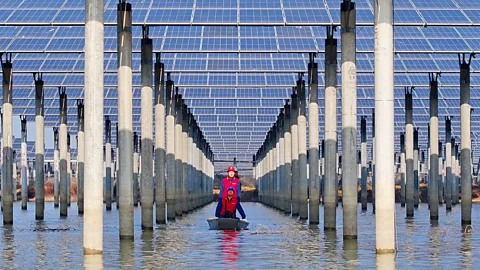 Getty Images
For plant, grid and capital teams, the baseline has shifted. A decade ago, solar supplied 1% of global power; in 2026 its share is expected to hit 10% and surpass nuclear, a mainstay since the late 1970s. Ember data reviewed by BBC for the 12 months up to September 2026 show solar 13% above nuclear output, turning an abstract forecast into a decision point for industrial energy managers.
Dave Jones, Ember co-founder, framed the milestone bluntly: [Solar] generating more electricity than all the world's nuclear power plants is a pretty insane stat, for sure, but the dataset makes the transition visible.
From factory rooftops to transmission systems, there are seven reasons behind the rise and what may come next. The phrase It's offensively cheap captures part of the cost dynamic, but the industrial story also involves supply chains, storage, electrification and grid integration.
Forecasts missed the slope of change
Jan Rosenow, a professor of energy and climate policy at the University of Oxford in the UK, said Solar is now the engine of the power transition, and the pace surprised analysts.
Solar has become the fastest-growing source of new electricity in history and the largest source of new electricity globally. In 2025, it met three-quarters of the growth in the world's demand for electricity, overtaking wind power generation, which is also growing, just a little more slowly.
It wasn't expected, Rosenow said. Mainstream projections, including outlooks from the International Energy Agency (IEA), an influential intergovernmental organisation based in Paris, assumed linear growth and slowly falling costs, and got both wrong.
Over 2026, multiple sources indicate solar electricity generation will almost certainly far exceed nuclear globally. Nuclear's electricity generation has remained more or less constant since 2000, while solar's has increased some 2,700-fold.
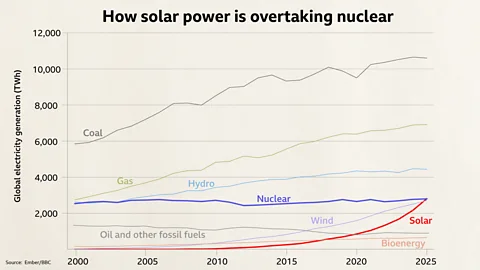 Ember/ BBC: Ember data shows solar electricity generation narrowly surpassing nuclear in 2025. In 2026, it will almost certainly well exceed it.
It's offensively cheap: module prices reset procurement math
Solar, a mature technology for some 15 years now, became the cheapest electricity in history in 2020. Since then, solar has scaled, efficiency has risen, and the amount of silicon and silver used in panels has gone down, leading prices to fall yet further, Jones said.
Jan Rosenow observed: Massive Chinese manufacturing scale and current overcapacity have pushed module prices to record lows, and manufacturers have been able to turn that price signal into deployment.
A large fall in the price of panels in 2023-24 pushed the market into what Jones calls an offensively cheap era. A panel in itself is just so unbelievably cheap, he said. It's well under $100 (£75)… and that's going to keep you generating electricity for 30, 40 years without any input at all.
Cost effects are not limited to capital and operating outlays. Researchers have calculated that the US's rising wind and solar generation brought it $249bn (£186bn) in climate and health benefits between 2019 and 2022.
Deployment is broad, not concentrated
China is still the world's biggest solar power by far but is by no means the only player.
Despite the US imposing a variety of tariffs on solar, it remains the second country when it comes to installations, which are still skyrocketing, especially in states won by President Trump in 2024. In fact, the US now has enough solar to power more than one-third of its households.
Alicia Zhao, a US mitigation pathways expert at the University of Maryland, said: Tariffs and other federal policies that constrain renewable energy growth are certainly expected to raise costs and slow expansion relative to what we otherwise would have seen, However, economics are a key part of why solar has been able to grow so quickly. Even with rising costs, solar is still one of the cheapest sources of new power in the US. And it is getting built regardless of political lines.
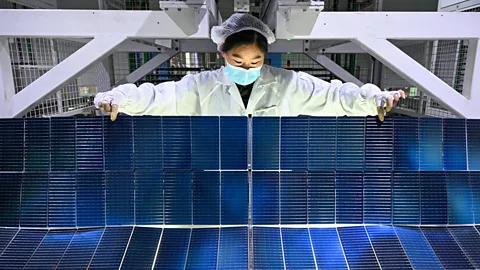 Getty Images: China's internal solar boom is now slowing down, but its cheap solar exports to other countries are still increasing.
India, meanwhile, is moving away from fossil fuels far faster than China did, and new solar has met 60% of its rise in power demand in the past two years.
In Australia, over four million homes now have rooftop solar: well over a third of all households.
Fossil volatility moves cost risk onto plant operators
Countries like Pakistan and Lebanon have also begun installing solar at breakneck speeds, while across Africa countries are installing some 100,000 solar panels per day.
In many places, escalating diesel prices, driven by the Russia-Ukraine conflict and US-Israel war with Iran, have swung the cost needle yet further in solar's favour. This is especially the case in many African countries where home diesel generators are a mainstay due to unreliable grids. Rooftop solar panels, nearly all of them imported from China, have now taken off as an alternative.
Ethiopia has even banned the import of petrol and diesel cars in a bid to tackle oil dependency and pollution, Jones said.
Case snapshot: Pakistan shows how speed and affordability interact
Solar is rapidly providing new electricity where fossil-based grids cannot keep up with demand. Pakistan, for example, has become a surprising poster child for the solar revolution due to its extraordinarily rapid rise in installations. In 2019, solar provided less than 2% of its electricity; now it's 24%, driven by costly, unreliable grid electricity combined with cheap solar imports from China.
Dave Jones said: What's really incredible in Pakistan is… generally most of the solar boom has been out of people's pockets, People can afford it, without needing to take out loans.
A similar story has been seen in several other sun belt countries, from Lebanon to Nigeria. Rosenow said [Solar] lets households act without waiting for governments or utilities, In uncertain times, that speed and independence is extremely valuable.
Batteries convert daytime resource into evening supply
Solar power can only be produced during the day when the sun is shining. To turn it into electricity that can be dispatched at any time, it needs to be paired with batteries.
Batteries have had their own cost revolution, supporting solar rollout. Jan Rosenow said: Solar plus storage is now routinely cheaper than new fossil plants in sunny regions, Batteries have largely solved the daily problem of shifting midday sun into the evening.
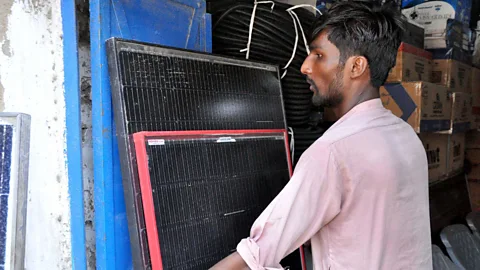 Alamy: Solar has gone from Pakistan's fifth-largest electricity source in 2023 to its largest in 2025, Rosenow said.
In California, solar and batteries met on average over a quarter of electricity demand from 19:00-21:00, the evening peak, over the first half of 2026. US states such as Vermont are now rolling out grid-integrated systems of home batteries, often paired with solar.
Barriers still remain for longer-term storage of solar across seasons, cloudy periods and monsoon seasons, though, both Rosenow and Jones said. It means the integration of solar into the wider electricity system still matters, Rosenow said.
Electrification creates new load, not just new panels
Solar is seen as a key part of the push towards electrification, reducing fossil fuel use in areas that previously didn't use electricity, such as via electric cars. Electrification has been chosen as a major theme at this year's UN climate talks in Turkey.
Jones said: That's where solar's going, to not just be king of electricity, but king of energy, and industrial demand growth is part of that transition.
Still, Julia Souder, chief executive of the Long Duration Energy Storage Council, a global executive-led non-profit established at COP26, warned recently. There is an inherent danger in uncontrolled electrification, and adding massive new loads without built-in flexibility creates a fragile system, she wrote in a blog for international policy network Ren21. Electrification is not automatically resilient.
Rosenow said: The bigger question is no longer whether solar grows but whether our power systems and institutions can keep up.
In the US, data centres and electrification mean power demand is growing for the first time in decades, Zhao said, with energy security a national priority.
Zhao said: Renewables already make up over 90% of new capacity in the US, This need for secure, quickly deployable electricity could create a critical opportunity for [further] renewable energy growth even without support from the current federal government.
Technology formats expand where solar can be installed
In the past few years, plug-in panels, or balcony solar, have started spreading rapidly in Germany. These generate less electricity than rooftop panels but feed it directly into homes via a standard socket.
They have now been approved in several other countries and US states including California.
Meanwhile, agrivoltaics, which combines food production and solar panels, is being touted as a solution to concerns in some areas about the land use of solar.
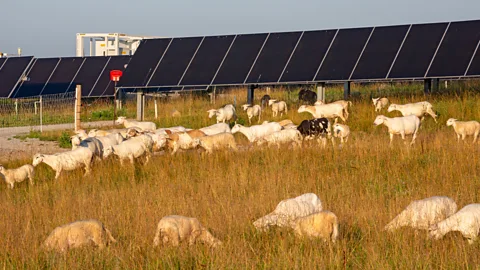 Getty Images: In Kentucky, US, a solar ranch pays a local farmer to graze his sheep among its solar panels, producing pasture-fed meat while keeping grass and weeds down.
Other technologies from floating and mirror solar plants to perovskite panels and solar windows could all see growth in coming years.
Outlook: strong growth, but with new constraints
In 2026, the world's solar capacity will go on rising, but the rate of expansion may slow down for the first time ever, Jones said.
This is down to China: last summer, it changed its regime for managing and supporting new solar installations, leading to a burst of installations in 2025 to fall under the old price regime.
Elsewhere, the picture differs. Jones said: If you exclude China, there's more panels being installed this year than last year, so deployment outside China remains active.
By 2030, the IEA thinks solar power generation will have reached double that of 2025's levels, with solar overtaking hydro to become the world's third-largest electricity source.
Rosenow said: Wherever grid power is costly and unreliable, the economics keep pulling people towards solar, There is one caveat: if Chinese solar panels are difficult to import this will not happen at speed.
Climate context remains difficult. It's now incredibly likely the 1.5C global limit set in Paris in 2015 will be breached, the world is seeing rising climate impacts and is edging towards several climate tipping points this century.
But the solar story shows progress that many observers did not predict. A decade ago, Jones noted no one was getting close to expecting that to happen, and the growth in clean electricity has directly translated to fewer coal plants being built.
Jones said: Now, worst cases [of climate change] are somewhere between 2-3C of warming, rather than 4C of warming.
Data citations used in this report
| Source | Finding retained in this variant |
|---|---|
| Ember | Global solar generation narrowly surpassed nuclear in 2025; 12 months up to September 2026 show 13% higher output. |
| BBC | Analysis of Ember data supports the crossover over 2026. |
| International Energy Agency | Forecasts often assumed linear growth and slowly falling costs, and got both wrong; 2030 outlook sees double 2025 generation and third-largest source. |
| University of Oxford | Jan Rosenow describes solar as the engine of the power transition and highlights grid, storage and electrification-speed limits. |
| University of Maryland | Alicia Zhao finds tariffs may slow US expansion, but solar remains cheap and continues to be built. |
Common misconceptions for industrial decision-makers
- That tariffs end economics: Zhao's assessment says policy may raise costs, yet solar is still one of the cheapest sources of new power in the US and installation has grown.
- That batteries have solved every solar timing problem: Rosenow says daily shifting is largely solved, while barriers remain for longer-term storage across seasons and cloudy periods.
- That electrification automatically strengthens resilience: Souder warns that adding massive new loads without built-in flexibility creates a fragile system.
- That solar deployment has stalled because of China alone: Jones says capacity growth may slow for the first time ever due to China's policy change, but outside China there's more panels being installed this year than last year.
Action recommendations derived from the reported evidence
| Decision area | Industrial implication | Evidence anchor |
|---|---|---|
| Energy budgeting | Treat panel price volatility and long operating life as separate risk lines. | Jones: It's well under $100 (£75)… and that's going to keep you generating electricity for 30, 40 years without any input at all. |
| Supply-chain planning | Monitor import access because deployment speed depends on panel availability. | Rosenow: There is one caveat: if Chinese solar panels are difficult to import this will not happen at speed. |
| Resilience design | Pair solar with storage for evening peaks, but do not assume seasonal storage is solved. | California 19:00-21:00 demand over the first half of 2026; Rosenow on longer-term barriers. |
| Grid integration | Build flexibility into new loads such as data centres and electrified processes. | Souder: There is an inherent danger in uncontrolled electrification, and adding massive new loads without built-in flexibility creates a fragile system. |
FAQ
Is solar already larger than nuclear?
Ember statistics, analysed by BBC, show a narrow global overtaking in 2025 and clearer 13% lead over the 12 months up to September 2026.
What limits solar if panels are cheap?
Rosenow says limits are grids, storage and electrification speed, not panels or cost.
What does the IEA expect by 2030?
It thinks solar generation will reach double 2025 levels and overtake hydro as the third-largest electricity source.
Why might growth slow in 2026?
Jones points to China's last summer policy change; after 2025 pull-forward, expansion rate may slow first time ever, while China-excluded installations are still rising.