
WIW General FAQ: Can Solar Panels Measure Rain? How to Read the Fraunhofer IDMT 1.88 mm/h Result
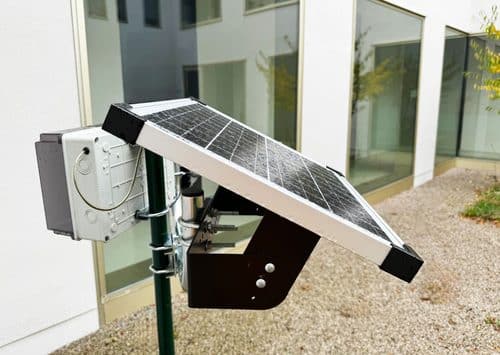
The precipitation test rig in the courtyard of the Fraunhofer IDMT (image: Fraunhofer IDMT)
Short answer: a photovoltaic array can estimate light rain, but it cannot replace a rain gauge. Researchers at the Fraunhofer Institute for Digital Media Technology (IDMT) in Ilmenau captured the vibrations raindrops produce on solar glass and inferred rainfall from those signals, reporting a mean absolute deviation of 1.88 mm/h for rates between 2 and 5 mm/h. That sits inside the World Meteorological Organization (WMO) ceiling of 2 mm/h for low intensities. Above that band, nothing has been proven.
Take one number to a capital review: 1.88 mm/h measured against a 2 mm/h tolerance, a margin of roughly 6%. On a plant roof or a pumping-station forecourt, that margin is the line between a sensor you can use for trend alarms and an instrument you can cite in a filing. The research programme behind it, lokalRAIN, ran between October 2024 and June 2026 under Germany's Central Innovation Program for SMEs (ZIM) and delivered a prototype. The practical questions facility and operations teams keep asking are answered below.
What did the Fraunhofer IDMT team actually build?
Answer: a listening device, not a weighing device. Scientists at Fraunhofer IDMT mounted structure-borne sound sensors on solar panels to capture the vibrations produced when raindrops strike the surface. Each sensor unit runs a machine learning algorithm on an energy-efficient microcontroller and transmits only compact measurement data wirelessly, so the panel itself becomes the sensing element rather than a mounting bracket for a separate funnel.
Pan Acoustics, the project partner based in Wolfenbüttel, built the sensor-node hardware and the wireless transmission technology. Fraunhofer IDMT collects and analyses data from several locations centrally, which produces a more detailed picture of local rainfall than any single node. Because the sensors have no moving parts, maintenance needs may be lower than for mechanical instruments — a point that matters on rooftops where a service visit is the real line item, not the hardware. Our own reading is that edge inference per node is the architecture choice that keeps this viable: each node does its work before transmission, in line with the trade-offs we mapped in low-power edge silicon and long field life.
How accurate is the reading, and who grades it?
Answer: proven only for drizzle and light rain, against a published tolerance. The method first went through a laboratory rain simulator, with trials covering different rainfall rates, drop sizes and photovoltaic modules. The team then installed three outdoor measurement systems at the IDMT courtyard, at Pan Acoustics, and at the weather garden of the Technical University of Ilmenau.
For light rain between 2 and 5 mm/h, the system showed a mean absolute deviation of 1.88 mm/h compared with reference measurements. Fraunhofer states that this meets Class C of the World Meteorological Organization (WMO) accuracy classification for low rainfall intensities, which permits a maximum deviation of 2 mm/h. Two readings of that result are worth separating: the number clears a published bar, and the number was earned inside one narrow intensity band. WMO guidance on catching-type gauges is built around tip resolution steps of 0.2 mm, so an 1.88 mm/h deviation is a statement about rate accuracy, not about totals.
Why is heavy rain still an open question?
Answer: the data set is empty, not disappointing. Heavy rain remains a key limitation because the team still lacks sufficient training and test data for high rainfall intensities, so accuracy under those conditions has not been established. "We have proven the feasibility of our approach for light rain," said Jakob Bergner, group leader for Smart Acoustic Solutions at IDMT and scientific head of the project.
Here is the part competitors in this topic usually miss: the unproven band is also where the incumbent instrument is weakest. Peer-reviewed calibration work published by the American Meteorological Society found that tipping-bucket gauges suffer nonlinear underestimation once rainfall rates exceed roughly 50 mm/h, because each tip takes time to complete; a 2025 review in the journal Weather reaches the same direction, with error growing as intensity rises and shrinking as gauge resolution improves. So a storm-rate figure from a bucket gauge is already a corrected estimate, and a storm-rate figure from a vibrating panel does not exist yet. Neither is a plug-and-play answer for flash-flood triggers.
Should you swap an existing gauge for a panel sensor?
Answer: no. The technology is intended to support conventional rain-gauge systems rather than replace them. Read the comparison below as a role assignment, not a score.
| Decision factor | Vibration sensor on a PV module (lokalRAIN prototype) | Catching-type rain gauge (installed baseline) |
|---|---|---|
| Measurement basis | Structure-borne sound of drop impact, inferred by on-node machine learning | Counted tip events, calibrated volume per tip |
| Proven accuracy band | Between 2 and 5 mm/h, 1.88 mm/h mean absolute deviation | Long operating history across intensity ranges, with known rate error at high intensity |
| Heavy rain | Not established; training and test data still insufficient | Underestimates at high rates because of tip-cycle time |
| Mechanical wear | No moving parts, so maintenance needs may be lower | Moving parts, debris and evaporation losses to service |
| Siting | Reuses an existing solar surface | Needs ground space, levelling and clearance rules |
| Intended role per Fraunhofer | Add-on source of local rainfall data | Reference instrument |
Where does extra rainfall density actually pay for itself?
Answer: where the problem is coverage, not calibration. Possible applications named by the project include urban digital twins, municipal control rooms and flood monitoring, and Fraunhofer reports that operators of municipal infrastructures and firefighting brigades have expressed interest in a tool for rainfall measurement.
The reason density matters is documented. A 2025 study in Hydrology and Earth System Sciences on the torrential Valencia rainfall event found that volunteer personal weather station coverage ran at roughly seven times the density of the official rain gauge network operated by the Spanish Meteorological Agency, and concluded that accurate national networks are typically too sparse to describe areal rainfall. Rooftop arrays sit in the same blind spot as those volunteer stations: distributed, powered and already maintained. Distributed solar capacity is growing faster than official statistics can capture, and every one of those roofs is a candidate sensing surface for a project like lokalRAIN.
What still has to be fixed before this is a product?
Answer: enclosure, quality assurance and storm data. lokalRAIN produced a prototype that is not yet a marketable product. Further work is needed to improve the housing of the sensor and its electronic components and to perform quality assurance of the system. The next priorities are to collect more data during heavy rains and to test the technology in varying environmental situations. Without that information, the system can only be considered a source of additional local rainfall data, not a substitute for traditional rain gauges.
Connectivity is the other gate. During field trials, the wireless link reached four kilometers in urban settings and over 35 kilometers in rural settings in line-of-sight mode, and each sensor node processes the data before transmission. Those are trial figures, not a site guarantee: in our analysis, roof geometry, mounting height, neighbouring structures and radio licensing dominate the outcome, so treat both numbers as a starting point for your own path test rather than a specification.
Five mistakes to avoid when reading this result
- Treating 1.88 mm/h as a general accuracy claim. It is a deviation measured only for light rain between 2 and 5 mm/h.
- Conflating acoustic rainfall sensing with raindrop energy harvesting. This project extracts information from impact, not power from it.
- Assuming WMO Class C clears a regulatory or insurance use case. Classification of an instrument and acceptance of your data filing are separate decisions.
- Ignoring the sensing surface. Glass soiling, hail damage, snow load and panel tilt all change the vibration signal; the project does not yet publish that behaviour.
- Copying the range figures. four kilometers urban and over 35 kilometers rural were achieved under trial conditions at three specific sites.
Decision FAQ
Is a solar panel now a rain gauge?
It is a rain estimator for light rates. The evidence covers drizzle-to-light-rain intensities at three outdoor locations, with Class C behaviour against the 2 mm/h limit.
What is the shortest honest justification for piloting it?
Coverage gaps at assets that already have modules on the roof and no gauge on the ground — and a node with no moving parts to service.
Can it trigger a flood or shutdown alarm today?
No. High-intensity accuracy is not established, so storm triggers still belong to a calibrated reference instrument.
When could the picture change?
Project work runs to June 2026, with heavy-rain data collection and enclosure hardening listed as the next priorities. Until those are published, the prototype stays in pilot scope.
What does the project cost model look like?
Not disclosed. Funding came from Germany's ZIM programme through the Central Innovation Program for SMEs (ZIM); no price point exists for a non-market product.
A framework you can copy
If you want to test this without betting a compliance workflow on it, run the same five steps we would use on any measurement retrofit.
- Define the band you actually act on. If your thresholds sit above 5 mm/h, this prototype cannot serve them yet.
- Co-locate with a reference gauge and compute deviation per band, the way the IDMT team did at the weather garden of the Technical University of Ilmenau.
- Path-test the radio at your own roofs; do not inherit four kilometers or over 35 kilometers from someone else's trial.
- Assign the node an explicit role: density layer, trend layer or reference. Only one per site.
- Write the failure rule before deploying. A silent node must read as missing data, never as no rain.
The reusable part of lokalRAIN is not the panel. It is the discipline of putting an unvalidated instrument in a supervised role, measuring its deviation against a reference, and refusing to promote it until the hard band is covered. That is also how you should evaluate every new-sensing pitch that lands on an engineer's desk this year.
Sources
- Fraunhofer IDMT, lokalRAIN project page: https://www.idmt.fraunhofer.de/en/institute/projects-products/projects/lokalrain-rain-measurement-aoustic-sensors.html
- Humphrey et al., "A New Method for Automated Dynamic Calibration of Tipping-Bucket Rain Gauges", Journal of Atmospheric and Oceanic Technology (1997): https://journals.ametsoc.org/view/journals/atot/14/6/1520-0426_1997_014_1513_anmfad_2_0_co_2.xml
- Dunn, "Tipping-bucket rain gauges: a review of the undercatch", Weather (2025): https://rmets.onlinelibrary.wiley.com/doi/10.1002/wea.7736
- HESS (2025), torrential rainfall in Valencia recorded by personal weather stations: https://hess.copernicus.org/articles/29/6715/2025/