
AI Memory Supply Through 2030: How SK Hynix's Record Q3 Affects Industrial Buyers | WorldIndustrialWeekly
For managers who plan server hardware, data-center expansion, automation platforms and component sourcing, the message from SK Hynix's third-quarter report is not only a financial milestone. It is a reminder that memory can move from a routine bill-of-materials item to a strategic constraint. On October 28, 2026, the company disclosed quarterly revenue of 104.6155 trillion South Korean won, operating profit of 83.3338 trillion won and net profit of 39.7756 trillion won. Revenue crossed 100 trillion South Korean won for the first time, while the operating margin reached 80%, showing how strongly artificial-intelligence-related storage demand and higher-value product mix are lifting profitability.
At WorldIndustrialWeekly, the practical reading is broader than one company's earnings. The report links AI infrastructure growth, advanced packaging, fab timing and supply contracts into a single planning problem: what happens when buyers need more bandwidth, more capacity and more predictable memory availability across 2026, 2027 and the years toward 2030.
What the numbers show
| Reported item | Value | Planning implication |
|---|---|---|
| Quarterly revenue | 104.6155 trillion South Korean won | First quarter above 100 trillion South Korean won |
| Operating profit | 83.3338 trillion South Korean won | High-value AI products are changing profit structure |
| Net profit | 39.7756 trillion South Korean won | Demand strength is translating into company-level results |
| Operating margin | 80% | AI memory supply can command unusually favorable economics |
The AI memory demand engine behind the quarter
SK Hynix attributes the improvement to stronger shipments of DDR5 server memory and high-bandwidth memory HBM4, plus sales growth in 321-layer TLC enterprise solid-state drives. The company's explanation links these products to expanding AI model scale. Data centers now need not only more storage capacity, but also higher data transfer bandwidth and lower access latency. That turns memory into critical infrastructure hardware rather than an optional upgrade.
Compared with traditional personal computer memory, HBM manufacturing is more complex. It stacks multiple memory chips and runs with computing chips through advanced packaging. As NVIDIA and other AI accelerator makers continue to introduce newer generations, demand for HBM rises quickly. That also encourages storage suppliers to shift production resources toward higher-margin products.
Why SK Hynix expects tightness through 2030
Two forces are colliding: demand is becoming broader, while supply cannot flex quickly. SK Hynix describes a self-reinforcing AI investment cycle. Enterprises use AI to improve software development, customer service and search efficiency, gain new revenue and then invest more in AI applications and infrastructure. Investment is no longer limited to a small number of large technology companies. More ordinary enterprises and national-level projects are joining, keeping data-center construction demand high.
Future memory demand is not expected to rely only on large language models and cloud computing data centers. As physical AI applications such as autonomous cars and robots develop, devices must process more data from sensors, cameras and real-time control systems. That raises requirements for memory capacity, speed and reliability.
Supply response is slower. Advanced DRAM process development and mass production are becoming more difficult. A new semiconductor plant also involves fab construction, cleanroom deployment, production equipment installation, process tuning and yield ramp-up, which usually takes years. Even if suppliers decide to increase investment significantly, new capacity cannot become market supply immediately.
For those reasons, SK Hynix expects the global memory market to remain structurally undersupplied until 2030. The company had previously warned that 2027 may become one of the years with the tightest memory supply. Even if capacity keeps expanding over the coming years, new supply may still fail to fully satisfy demand created by continued AI infrastructure expansion.
Capacity and product roadmap
| Area | What SK Hynix plans | Why industrial buyers may care |
|---|---|---|
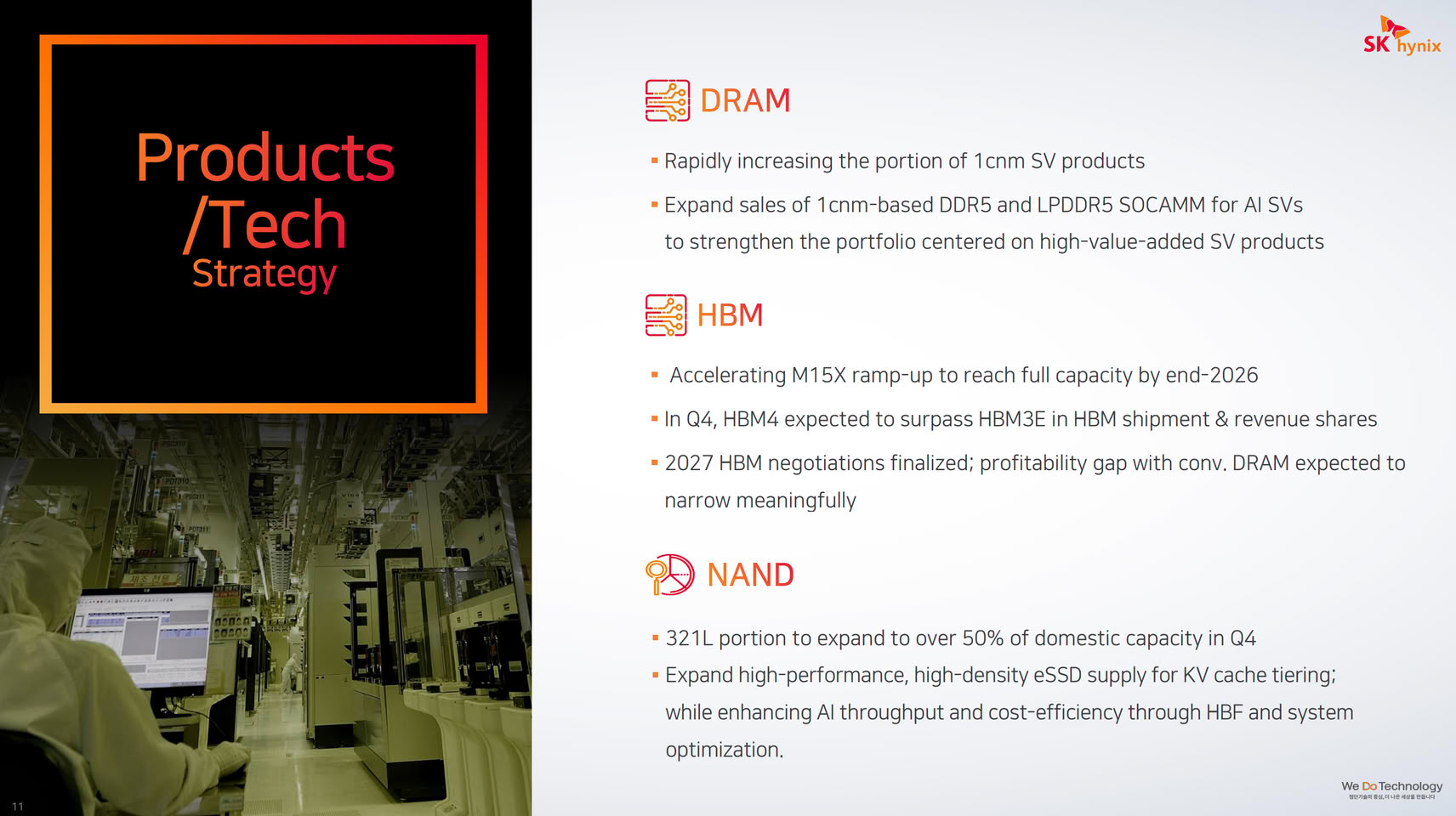
| HBM | Raise capacity at the South Korea M15X plant to the highest level before year-end; increase HBM4 production; expect HBM4 shipments and sales revenue to surpass HBM3E in the fourth quarter of 2026, or Q4 2026. | A product-generation crossover may affect advanced packaging allocation and priority for AI accelerator supply chains. |
| Traditional DRAM | Increase the share of sixth-generation 10-nanometer-class process, called 1c; expand DDR5 and LPDDR5 SOCAMM products for AI servers. | Server refresh plans, AI workstation configurations and embedded memory choices may shift alongside the new process mix. |
| NAND | Raise the production ratio of 321-layer NAND to increase supply of high-performance, large-capacity enterprise solid-state drives. | Data-center storage, AI training data pipelines and enterprise backup systems may be influenced by SSD cost and availability. |
| Customer agreements | Have signed long-term supply agreements with 14 major customers, including global large cloud service providers. The covered volume equals more than 50% of total capacity for 2027 and 2028; discussions are underway to extend contract periods, with some common terms around five years. | Large buyers may secure supply earlier, while smaller consumer-channel buyers may face residual availability and price volatility. |
Case view: SK Hynix as a planning signal
The case is useful because it converts an earnings release into an operational forecast. SK Hynix's record quarter reflects a new market structure: memory is no longer simply a component purchased after a product design is fixed. It can influence whether AI infrastructure projects, automation upgrades, robotics roadmaps and server programs proceed on schedule. If a project depends on DDR5, HBM4 or 321-layer NAND enterprise drives, procurement must treat lead time, specification stability and allocation risk as part of the engineering plan.
The company's own caveat matters: expecting supply shortage to continue until 2030 does not mean that every memory product price will rise for the next four years, nor that every memory type will always be out of stock. Different categories may behave differently. Supplier expansion pace, rival investment, customer purchasing plans and changes in AI industry growth can still affect actual price movement.
Common misconceptions
- "A shortage through 2030 means every memory type will be scarce." The company does not describe a uniform shortage across every product.
- "Only AI giants need memory." Future demand is also linked to autonomous cars, robots, broader enterprise AI use and national-level infrastructure projects.
- "More capital solves supply instantly." New fabs and advanced DRAM nodes require construction, cleanrooms, equipment installation, process tuning and yield ramp-up over years.
- "Long-term contracts protect all customers." Large cloud service providers and AI chip companies can lock volume through contracts, while personal computer makers, phone makers and retail channels may absorb residual supply and market-price swings.
- "Advanced memory replaces ordinary DRAM overnight." Traditional DRAM still evolves through the sixth-generation 10-nanometer-class 1c process, DDR5 products and LPDDR5 server-oriented offerings.
Action recommendations
- Map memory exposure by project. Identify which systems depend on DDR5, HBM4, 321-layer NAND, LPDDR5 or enterprise SSDs, and note the specification points that cannot change without redesign.
- Use the Q4 2026 HBM4-versus-HBM3E milestone as a planning checkpoint. If that generation transition proceeds as SK Hynix expects, resource allocation may move further toward the newer product.
- Review supplier commitments against the 14 long-term agreement customers. Understand whether your demand is likely to sit inside secured capacity or remain exposed to residual supply and pricing volatility.
- Coordinate engineering and procurement calendars. The company says agreements already cover more than 50% of total capacity for 2027 and 2028, which makes demand visibility more important than spot purchasing.
- Stress-test product configuration options. If memory costs remain a variable, makers may reduce base configurations, raise prices for higher-capacity versions, widen price gaps, delay upgrade plans or prioritize higher-margin products.
- Monitor capacity signals. Watch M15X ramp-up, the sixth-generation 10-nanometer-class 1c share, 321-layer NAND production ratio, long-term contract extensions and any change in AI investment growth.
FAQ
Why did SK Hynix's operating margin reach 80%?
Because artificial-intelligence-related storage demand was strong and higher-value products gained price traction. The third quarter benefited from growth in DDR5 server memory, HBM4 shipments and 321-layer NAND enterprise SSD sales.
How long does SK Hynix expect AI memory tightness to last?
The company expects structural undersupply to continue until 2030. It has also warned that 2027 could be one of the tightest years for memory supply.
Will consumer devices automatically become more expensive?
Not uniformly. Higher memory and flash prices can raise production cost for computers, phones and solid-state drives. Manufacturers may reduce base configurations, charge more for higher-capacity versions, adjust price gaps between models, delay upgrades or assign limited memory to higher-margin products.
Do long-term supply agreements remove risk for everyone?
No. The agreements help large customers lock supply and help SK Hynix plan production equipment, plant construction and capital spending. But smaller consumer-market buyers may still be affected by the amount of remaining supply and by price movement.
What should industrial readers watch next?
Track the fourth quarter of 2026 HBM4 transition beyond HBM3E, the highest M15X capacity target before year-end, the more than 50% coverage of 2027 and 2028 capacity through long-term agreements, and whether demand for autonomous cars, robots and AI data centers continues to outpace new fab capacity toward 2030.
Bottom line
SK Hynix's earnings report shows that the artificial-intelligence cycle has changed how global memory investment works. In earlier cycles, personal computer and smartphone demand often created clear swings between shortage and oversupply. Now, large AI data centers have become a new and important demand source, and related infrastructure investment often carries a longer construction horizon.
If AI applications keep expanding, memory suppliers will have more reason to maintain high capital spending and prioritize HBM, server DRAM and enterprise SSDs. If AI investment slows, or if new capacity arrives in a concentrated wave, the supply-demand balance may change again. The company's current judgment is that advanced memory manufacturing capacity is still expanding more slowly than demand. For industrial and consumer electronics buyers, that means memory is no longer a predictable background cost. It has become a planning variable that may shape product pricing, hardware configuration and supply-chain decisions over the next four years and toward 2030.