
SK Hynix Cash and Profit Strength Signal HBM4, 321-Layer NAND and a 2030 Memory Supply Gap for Industrial Buyers
For manufacturing, data-center and systems-integration teams, the latest SK Hynix results look less like a routine earnings update and more like a cross-industry signal about how AI-linked component demand is moving through the industrial supply base. Profitability remains elevated, liquidity is improving, and the product roadmap is being reorganized around HBM4, server memory and high-bandwidth flash at the same time that the company warns a broader memory shortage may extend through 2030.

Financial picture: profitability remains high while net cash improves
At the income-statement level, SK Hynix reported operating profit of 83.3 trillion won and net profit of 39.8 trillion won. The accompanying profitability indicators were about 80% for operating margin and about 38% for net margin, underscoring the strong earnings performance described in the report.
| Financial metric | Reported value | Timing or comparison |
|---|---|---|
| Operating profit | 83.3 trillion won | Quarterly earnings result |
| Net profit | 39.8 trillion won | Quarterly earnings result |
| Operating margin | about 80% | Profitability measure |
| Net margin | about 38% | Profitability measure |
| Cash and cash equivalents | 114.5 trillion won | As of the end of the third quarter |
| Change in cash | up 26.5 trillion won | Versus the previous quarter |
| Borrowings | 15.8 trillion won | Down 2.8 trillion won from the prior quarter |
| Net cash | 98.7 trillion won | Improved financial position |
Balance-sheet data showed cash and cash equivalents at 114.5 trillion won as of the end of the third quarter, up 26.5 trillion won from the previous quarter. Borrowings fell to 15.8 trillion won, down 2.8 trillion won from the prior quarter. The combination lifted net cash to 98.7 trillion won, strengthening the company’s financial position.
Case in point: M15X, server memory and the HBM4 shift
For the next quarter, the company expects HBM4 to overtake HBM3E in both shipment volume and revenue contribution, making HBM4 the main product. This transition is not limited to high-bandwidth memory: server DDR5 sales have grown markedly, and demand for LPDDR5 SOCAMM modules for AI servers is also rising.
The new M15X fab is expected to reach full utilization by the end of this year, with monthly output of about 55,000 to 60,000 1b DRAM wafers. The share of next-generation 1c DRAM technology used in LPDDR6 products is also increasing steadily.
NAND case: 321-layer embedded SSD growth and HBF as an AI storage path
In NAND, SK Hynix said 321-layer TLC flash chips are gaining sales rapidly in the embedded SSD market, and the company expects 321-layer products to account for more than half of its South Korea NAND capacity by year-end.
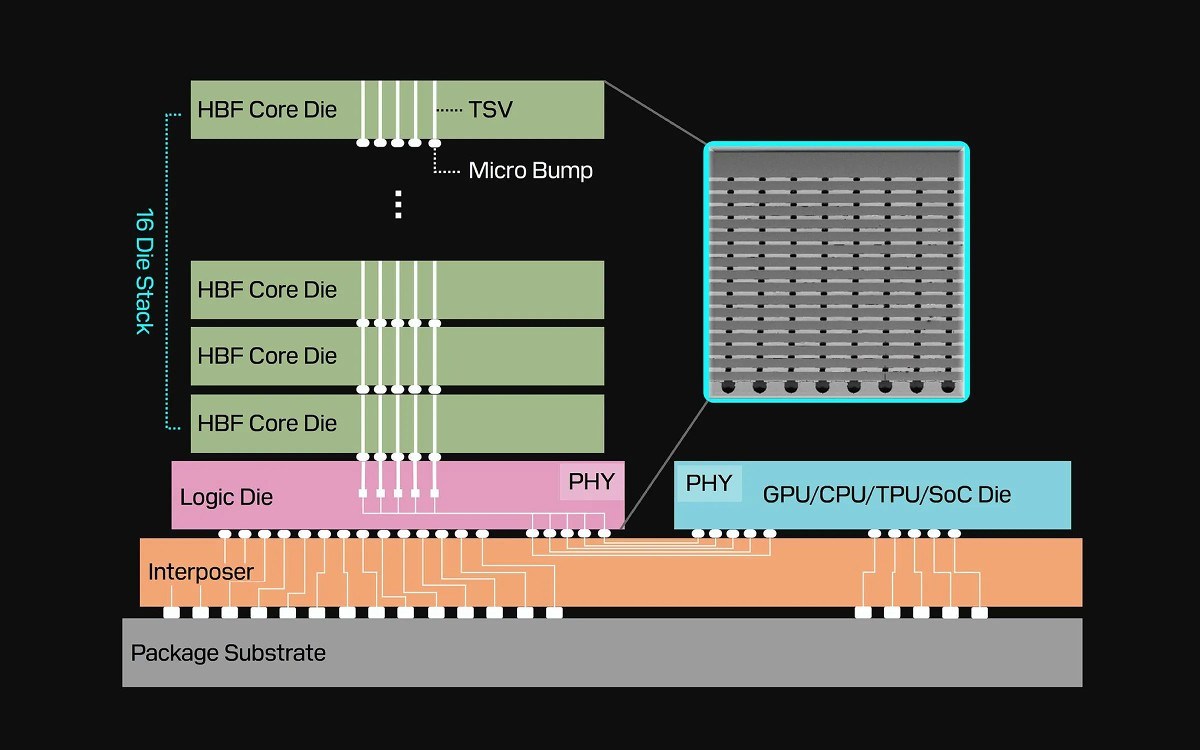
Alongside the 321-layer transition, it is developing HBF (High Bandwidth Flash), a solution for AI servers that borrows the bandwidth logic of HBM but is aimed at long-term data storage rather than traditional memory functions. The intended role is to let AI systems retrieve very large datasets that cannot all be held in RAM, easing memory-capacity constraints.
Supply risk: a shortage signal running to 2030
The most operationally important warning is that the global memory supply shortage is expected to persist until 2030. Although the company plans to accelerate capacity expansion, added manufacturing capability takes time, so the short term remains difficult for supply to fully satisfy market demand.
SK Hynix identified enterprise AI and personal AI as the main demand drivers over the next few years. Looking to the medium to long term, AI applications in autonomous driving and robotics are also expected to become important sources of demand, further lifting need for advanced memory products.
Data citation: Counterpoint Research September ranking
Counterpoint Research released a report this September showing that, measured by revenue, SK Hynix is currently the second-largest DRAM manufacturer with about 25% market share. Samsung Electronics leads with 38%, while Micron Technology ranks third with 24%. All three suppliers also provide LPDDR and NAND storage products to Apple and many smartphone makers.
| Ranking by revenue | Company | Approximate market share |
|---|---|---|
| First | Samsung Electronics | 38% |
| Second | SK Hynix | about 25% |
| Third | Micron Technology | 24% |
Solidigm IPO withdrawal explained by CEO Kwak Noh-Jung
SK Hynix Chief Executive Officer Kwak Noh-Jung addressed the decision by Solidigm to withdraw its initial public offering plan. He explained that the IPO had originally been considered to raise external funding for expanding Solidigm production facilities, thereby reducing the investment burden on the group and improving shareholder return capability. After evaluating the recent financial market environment and other factors, the company concluded that proceeding with the listing at the current stage would make it difficult to achieve the intended objectives, so it terminated the related review process.
Common misconceptions to avoid
- HBM4 overtaking HBM3E does not mean HBM3E instantly disappears; it indicates the expected center of shipments and revenue contribution for the next quarter.
- Capacity expansion is not an immediate shortage fix: SK Hynix warned that new manufacturing capability takes time and that the shortage may persist until 2030.
- HBF should not be read as a simple replacement for RAM; it is aimed at long-term data storage while relieving the capacity limits created by AI datasets that cannot all fit in RAM.
- Solidigm’s IPO withdrawal does not equal abandonment of facility expansion; the CEO framed the decision around recent market conditions and expected objectives at the current stage.
Action recommendations for managers and procurement teams
- Treat memory as a multi-year planning item: when component shortages may persist to 2030, procurement calendars should assume longer lead times and less short-term elasticity.
- Map designs to the HBM4 transition: platform teams should confirm whether next-quarter shifts in shipment and revenue contribution affect bill-of-materials assumptions.
- Use 321-layer and HBF signals to structure storage discussions: embedded SSD demand growth and HBF’s AI-server use case provide two concrete areas for supplier technical reviews.
- Track fab ramp milestones: M15X full utilization by year-end and the rising 1c share for LPDDR6 are useful checkpoints for capacity visibility.
- Keep market-share context visible in negotiations: Counterpoint’s rankings show a concentrated supplier base where Samsung Electronics, SK Hynix and Micron Technology hold major shares.
FAQ
What changed in SK Hynix’s cash position?
Cash and cash equivalents were 114.5 trillion won as of the end of the third quarter, an increase of 26.5 trillion won from the previous quarter. Borrowings were 15.8 trillion won, a decrease of 2.8 trillion won from the prior quarter, while net cash rose to 98.7 trillion won.
Which products are expected to move first?
HBM4 is expected to exceed HBM3E in both shipments and revenue contribution next quarter and become the main product. Server DDR5 is growing significantly, and LPDDR5 SOCAMM demand for AI servers is also rising.
Why does the shortage matter to industrial buyers?
Because SK Hynix expects the global memory supply shortage to continue until 2030, and new capacity takes time to come online, buyers may face constrained availability in the short term even as the company expands output.
What is Solidigm’s IPO status?
Solidigm withdrew its IPO plan. CEO Kwak Noh-Jung said the listing was originally intended to raise external funding for production-facility expansion, reduce the group investment burden and improve shareholder returns, but after assessing recent market conditions the company concluded that continuing at the current stage would make it difficult to achieve the goals, so the review was terminated.
Read together, the earnings, capacity, product and market-share signals point in one direction: AI-driven memory demand is reshaping both the financial profile of leading suppliers and the planning assumptions of downstream industrial buyers. For managers responsible for equipment, storage, automation platforms or data-infrastructure procurement, the practical takeaway is to move beyond short-term availability checks and incorporate HBM4, 321-layer NAND, HBF, M15X ramp milestones and a potential 2030 supply shortage into multi-year sourcing and product-roadmap reviews.