
Inside the Self-Verifying Design Loop: What the Latest Fuse EDA AI Agent Update Means for Long-Running Chip and PCB Work
The part of semiconductor and PCB design that resists automation is rarely the simulation itself. It is the time between simulations — the failed run, the log review, the configuration change, the rerun, the argument over whether one more operating corner has to be characterized. That supervisory layer is where engineering hours quietly accumulate, and it is the layer that agentic software is now being pointed at.
Siemens has broadened its partnership with Nvidia so that the Fuse EDA AI Agent can support self-verifying, long-running workflows for semiconductor and printed-circuit board (PCB) design — agents that remain active across an entire multi-week job rather than answering a single prompt and stopping.
How the stack is assembled
Functionally, the capability links Siemens’ electronic design automation (EDA) software with Nvidia’s AI open models, agent software, secure runtime and accelerated computing stack. It reaches across Siemens’ EDA technologies: Catapult high-level synthesis, custom IC design and verification with Solido, Aprisa physical implementation, Calibre signoff verification, and Tessen design-for-test.
Deployment sits inside Intelligence Center X, the enterprise industrial AI environment Siemens launched recently, where agent creation and orchestration take place. The self-verifying pattern means autonomous, long-running EDA AI agents continuously validate their own decisions against proven engineering tools: an agent can monitor a workflow, inspect results, alter its configuration and run other operations while checking progress against established EDA engines.
Siemens uses the term self-verification for this arrangement, and the distinction matters to anyone budgeting for it. A language model alone does not decide whether a design is correct. Instead, the agent relies on simulation, verification and physical design tools to create the engineering evidence needed for the next decision.
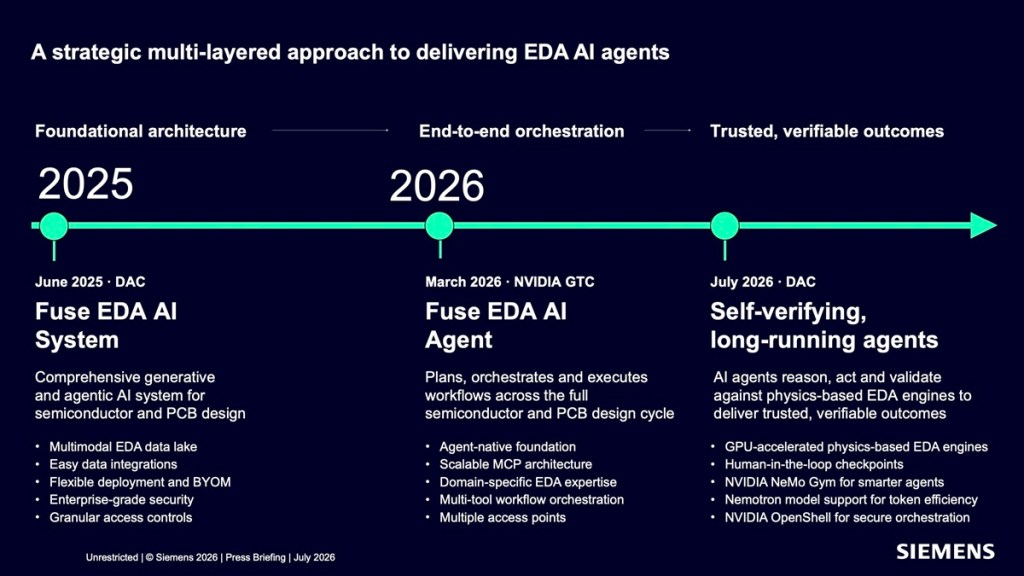 Figure 1: The Fuse EDA AI platform roadmap advances from a foundational AI architecture in 2025 to end-to-end orchestration and self-verifying, long-running agents in 2026. (Source: Siemens)
Three steps from data infrastructure to long-running autonomy
The architecture did not appear in one announcement. Read as a sequence, it shows how the vendor moved from model infrastructure, to an execution layer, to agents that survive failure.
| Milestone | What it contributed |
|---|---|
| DAC 2025 | The Fuse EDA AI System provided the data and model infrastructure needed to apply generative AI to EDA data. |
| Nvidia GTC, March 2026 | The Fuse EDA AI Agent added an execution layer: a supervisory agent that breaks an engineering objective into tasks, delegates work to specialized agents, and connects to EDA applications through Model Context Protocol (MCP) interfaces. |
| DAC 2026 | Long-running agents that keep working after the first tool call — launching a simulation, inspecting returned logs, identifying a failure, modifying the setup, and trying again. |
Extending the agentic AI workflows with Nvidia’s Nemotron 3 Ultra model supplies reasoning for planning and multi-step execution, while the Nvidia NeMo Gym open library is used to evaluate agent behavior to improve results and optimize workflows. Nvidia OpenShell secure runtime provides a secure environment for running the agents.
The engineering result, however, comes from Siemens’ EDA tools. A model may decide which SPICE analysis to run or whether another process, voltage and temperature (PVT) corner is needed, but the simulator produces the electrical result.
“The goal is not to replace physics with AI,” said Timothy Costa, general manager for industrial and computational engineering at Nvidia. The objective, he added, is to connect AI reasoning with accelerated simulation and physics-aware models while keeping trusted engineering tools as the source of validation.
Case in focus: library characterization as a supervisory loop
Library characterization illustrates why this type of agent can be useful even when the underlying simulations are already automated. For a standard-cell, memory or custom-IP library, characterization across different operating conditions is required before its timing and power models can be used.
Engineers first configure the library and run preliminary simulations to confirm that the environment is working correctly. Amit Gupta, senior vice president and general manager of Solido Custom IC and chief AI strategy officer at Siemens EDA, Siemens Digital Industries Software, described this process as “pipe cleaning.”
If simulations fail because of an incorrect setup or a convergence issue, an engineer has to inspect the result, change the configuration and rerun the task. Only once the setup is stable does the full characterization run begin. Engineers continue to monitor failures, review outliers and decide whether additional PVT corners need to be simulated before the Liberty models can pass quality checks.
“It comes out to about a four-to-six-week process for a library,” Gupta said.
Against that baseline, the company reports the following effects for library characterization using Siemens’ Solido Characterization Suite with agentic AI:
| Measure | Reported figure |
|---|---|
| Characterization turnaround | Reduced by more than 10× |
| Token cost | Reduced by 5× to 10× |
| Manual baseline per library | A four-to-six-week process |
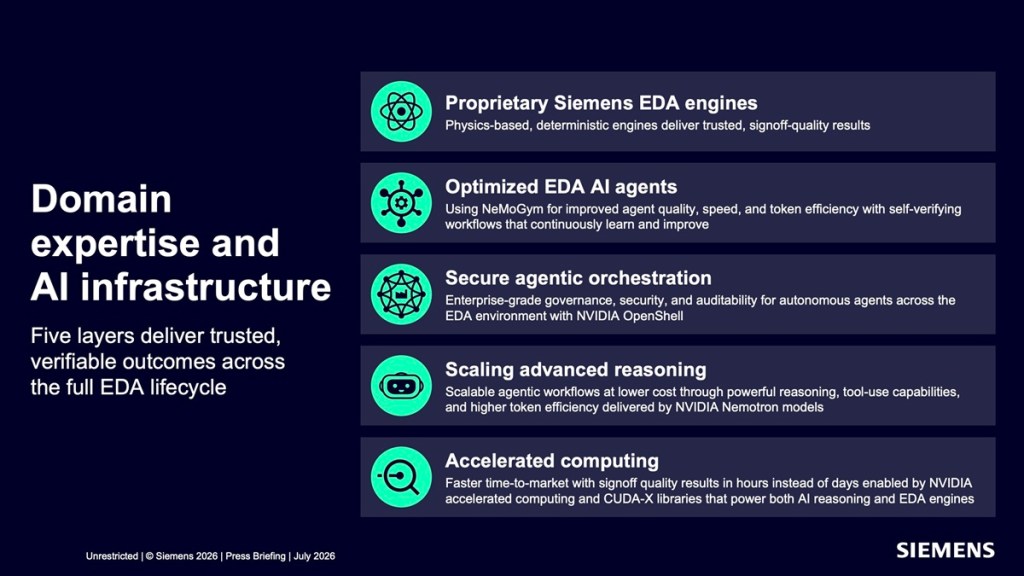 Figure 2: Siemens’ self-verifying EDA architecture combines deterministic EDA engines, optimized AI agents, secure orchestration, Nemotron reasoning models, and CUDA-X accelerated computing. (Source: Siemens)
The Solido Characterization agent automates much of this supervisory loop. Gupta said an engineer can initiate the process with a single prompt; the agent can launch hours-long runs, monitor them, react to failures, change configurations, rerun jobs and perform final quality assurance steps. These agentic workflows automatically generate and verify Liberty files.
The workflow divides work across four components:
- Solido Characterizer manages the characterization tasks.
- Solido LibSPICE runs the circuit simulations.
- Solido Generator produces the Liberty models.
- Solido Analytics examines the results and supports outlier analysis.
The productivity gain comes from reducing the manual work between simulations. Nvidia CUDA-X libraries can also accelerate the numerical operations used by the simulation and physical verification tools, shortening the time between an agent’s action and the feedback it needs for the next decision.
Nvidia’s PhysicsNeMo, an open-source PyTorch framework for physics AI models, adds another layer in which physics-aware models give the agent fast estimates to explore a design and decide where a higher-fidelity simulation is required. Costa said those models are not a substitute for engineering validation: trusted solvers, test data and domain-specific criteria are the final references.
Cross-domain autonomy remains the harder problem
The Solido characterization example is a workflow with well-defined inputs, tools and acceptance checks. Extending the same autonomy across several EDA domains is more difficult.
Gupta said Siemens is currently focused on long-running agents within individual areas such as custom IC design, digital verification, design-for-test and Calibre physical verification.
“What we see as the next step is being able to stitch those product families together,” he added.
Siemens has demonstrated an early example in which Calibre detects a design rule violation and the agent invokes Aprisa semiconductor software for a digital physical design repair, or Solido for an analog repair. That moves the agent from identifying a problem to changing the design — and creates new verification requirements, because fixing a local design rule check violation can create a timing, congestion or signal integrity problem somewhere else in the design.
The challenge is more than exposing additional applications through MCP. Even a cross-domain agent has to understand how different representations of the same design correlate with one another. Gupta explained that Siemens is developing EDA ontologies that map relationships between different domains and improve the models’ ability to understand the different data types. This context is necessary because a change in one stage may invalidate results elsewhere.
Human judgment remains part of the design and verification workflow. When an agent repairs a design rule violation, it can create another physical problem, so engineers need to observe the agent’s actions, pause or stop execution, and redirect the workflow. Near-term deployment will remain domain-scoped and supervised; fuller autonomy comes when EDA companies can preserve engineering intent while agents move across multiple tools, data models and verification steps.
Six misconceptions that distort the business case
| What teams often assume | What the disclosed architecture actually does |
|---|---|
| A large model signs off the design. | Self-verification keeps reasoning tied to simulation, verification and physical design tools; a language model alone does not decide correctness. |
| AI displaces the physics-based solvers. | “The goal is not to replace physics with AI”; trusted solvers, test data and domain-specific criteria remain the final references. |
| Speed comes only from the model. | The reported gain comes largely from removing manual work between runs, with CUDA-X accelerating numerical operations. |
| Autonomy covers the whole flow today. | Near-term deployment is domain-scoped and supervised; stitching product families together is described as the next step. |
| Connecting every tool through MCP is enough. | Cross-domain agents also need EDA ontologies that map relationships between domains and data types. |
| Fast physics-aware estimates can replace validation. | Models built on PhysicsNeMo help decide where a higher-fidelity simulation is needed, not whether the design is correct. |
What engineering and operations leaders should do now
- Map the supervisory loop in your own flow — environment configuration checks, failure triage, reruns, outlier review, corner decisions — before assigning any of it to an agent. The disclosed case measures savings against a four-to-six-week manual baseline, and a baseline you have not measured is a benefit you cannot verify.
- Keep acceptance criteria inside deterministic tools. Require agents to carry engineering evidence from simulation, verification and physical design engines into every handoff, rather than a model’s stated confidence.
- Build control surfaces first: the ability to observe an agent’s actions, pause or stop execution, and redirect the workflow must exist before unattended runs are approved.
- Pilot within one domain — custom IC design, digital verification, design-for-test or physical verification — and treat cross-domain stitching as a later phase, since representations of the same design do not yet correlate automatically.
- Track cycle time and compute cost as separate metrics; token cost can fall by 5× to 10× while turnaround falls by more than 10×, and the two do not move in lockstep with your own workloads.
- When evaluating vendors, ask how many product families an agent can actually orchestrate, and what ontology work that requires, rather than counting exposed MCP interfaces.
- Align procurement and rollout plans with availability: the expanded EDA AI capabilities will arrive in upcoming releases of Siemens’ AI-native EDA portfolio.
FAQ
What does “self-verifying” mean in this context?
It means an autonomous agent continuously checks its own decisions against proven engineering tools. The agent monitors the workflow, inspects results and adjusts configuration, but correctness is established by simulation, verification and physical design engines — not by a language model.
How much time and cost does the reported case claim?
For library characterization with the Solido Characterization Suite driven by agentic AI, Siemens cites a reduction in characterization turnaround of more than 10× and a reduction in token cost of 5× to 10×, measured against a process described as “a four-to-six-week process for a library.”
Can an agent change a design without an engineer?
Partly, and under supervision. In the demonstrated example, Calibre flags a design rule violation and the agent invokes Aprisa for a digital physical design repair or Solido for an analog repair. Because a local repair can create timing, congestion or signal integrity problems elsewhere, engineers still observe, pause, stop and redirect the workflow, and near-term deployment remains domain-scoped.
Which compute and model components sit underneath the agent?
Reasoning for planning and multi-step execution uses the Nvidia Nemotron 3 Ultra model; Nvidia NeMo Gym evaluates agent behavior; Nvidia OpenShell provides a secure runtime; CUDA-X accelerates numerical operations; and PhysicsNeMo, a PyTorch framework for physics AI models, supplies fast estimates. Agents are created and orchestrated inside Intelligence Center X.
Does this make the deterministic EDA tools optional?
No. The disclosed position is the opposite: the agent keeps the workflow moving and decides what should happen next, while the deterministic EDA engines and human engineers determine whether the results can be trusted.
Availability will follow upcoming releases of the AI-native EDA portfolio, and the sequencing of capabilities — single-domain agents first, stitched product families later — is the part of the roadmap that most affects how an organization should plan staffing, governance and tool spend. Read as a management signal rather than a product launch, the update narrows the question facing engineering leaders to one of oversight: how much of a long-running design loop an organization is willing to let software supervise on its own, and what evidence that software must produce before a human signs the result off.