
Case Review: Seequent's Takeover of Eliis and the Subsurface Workflow Gap It Closes
Consolidation in industrial software usually fails in the hand-off, not the handshake. A buyer closes, the acquired engineers stay a year, and the workflow the sales deck promised never becomes part of the delivery model. That operational risk is the lens worth applying to the announcement that Bentley Systems, Incorporated has acquired seismic interpretation developer Eliis for Seequent, The Bentley Subsurface Company. The interesting question for a plant, an engineering office or an exploration team is not whether the deal was signed, but whether interpretation, modelling and simulation can now be run as a single production line.
Read as a case file, the transaction is tidy. Seequent absorbs a product family and the people who wrote it: PaleoScan, the seismic interpretation platform that carries Eliis' Relative Geological Time technology and AI-assisted interpretation; PaleoModel, a co-innovation project aimed at supporting downstream reservoir simulation; and a team that includes more than 100 geoscientists, technical specialists and researchers. The acquired company is young by software-industry standards but mature inside its niche, having been founded in 2007 and built from Montpellier, France, where its staff develop tools that process and analyze seismic imaging data and construct subsurface models. Getting high-resolution geophysical data for analysis at depth still depends on seismic methods, which is precisely why the interpretation layer matters so much to project economics.
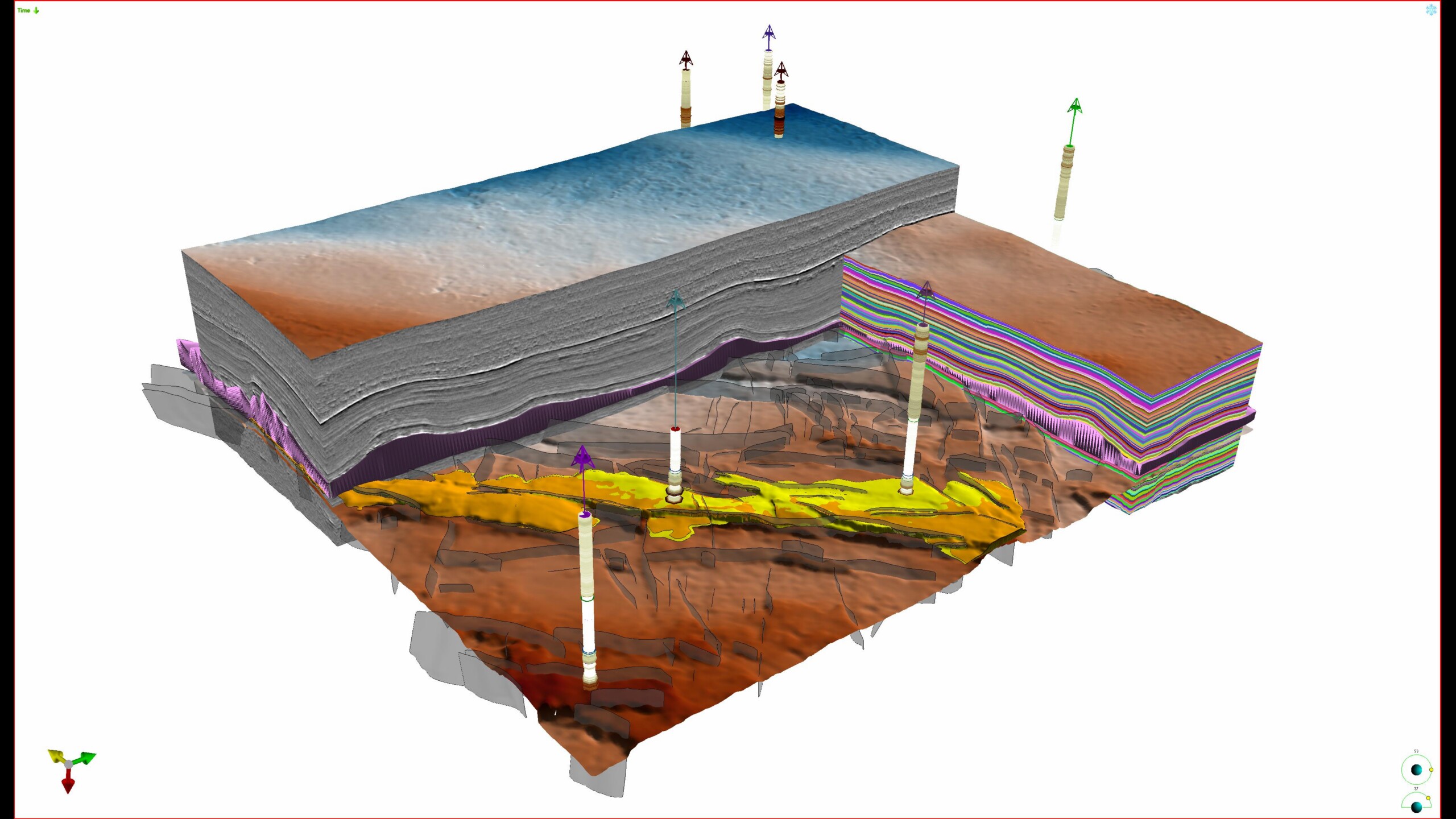 The render shown at announcement is a 3D PaleoScan view, the kind of output that now sits next to Seequent's modelling tools rather than across the vendor table from them.
The gap that was actually bought
Seequent's subsurface portfolio has long been anchored by implicit modelling, with Leapfrog as the workhorse for turning scattered observations into a defensible 3D earth model. What it did not own outright was the seismic side: the discipline of reading amplitudes and turning them into stratigraphically ordered surfaces. Eliis closes that distance. For anyone managing a subsurface program, the practical consequence is a shorter chain of custody between the interpreted volume and the model that a drilling, tunneling, geotechnical or storage decision rests on.
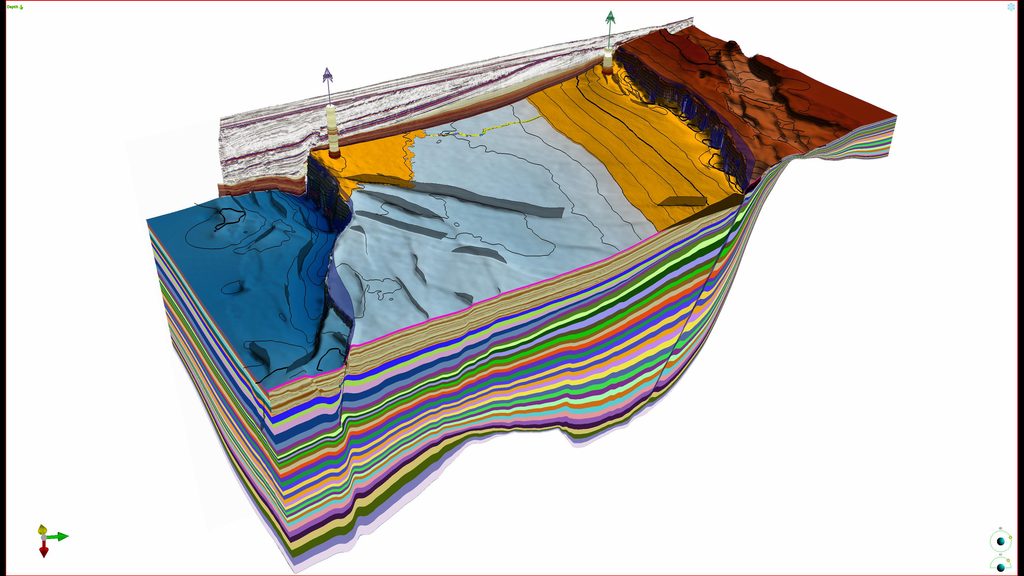 The second published visual shows 3D seismic interpretation in PaleoScan using RGT to sharpen stratigraphic analysis, a workflow that historically forced teams to export into a separate modelling product.
A workflow map makes the fit concrete:
| Workflow layer | Portfolio position before the deal | What the acquisition adds | Project-level effect |
|---|---|---|---|
| Seismic interpretation | Outside the core Seequent stack | PaleoScan with Relative Geological Time technology and AI-assisted interpretation | Amplitude volumes and stratigraphy are handled in one environment |
| Geological modelling | Implicit modelling via Leapfrog | Interpretation outputs feed the same subsurface portfolio | Fewer manual hand-offs and less version drift |
| Reservoir simulation hand-off | Dependent on partner or third-party tools | PaleoModel, the co-innovation project targeting downstream simulation | Earth-model updates reach flow models faster |
| Human capacity | Modelling and geophysics specialists | more than 100 geoscientists, technical specialists and researchers | Support depth for interpretation-heavy projects |
| Transaction execution | — | Legal advice to Bentley and Seequent from Dechert LLP and Simmons & Simmons LLP | A structured, counsel-led integration path |
Process anatomy: how we got here
This is the second structural move in the same neighbourhood, and the sequence explains the logic. Bentley publicly disclosed an agreement of roughly $1.05 billion to acquire Seequent back in March 2021, according to the company's investor-relations releases, positioning the New Zealand-born modeller as the backbone of its geoscience offering. Adding Eliis extends that backbone from modelling into seismic interpretation, a market that analysts treat as growing at double-digit rates: Coherent Market Insights puts the global seismic data processing and imaging software market at about USD 10.93 Bn in 2026 and projects USD 20.89 Bn by 2033, an 11.4% CAGR. Grand View Research frames the wider seismic services market more conservatively at USD 9.8 billion in 2025, heading for USD 14.5 billion by 2033 at a 5.1% CAGR. Either number supports the same management conclusion: interpretation capability is scarce, and owning it is cheaper than competing for rented licences and scarce specialists year after year.
The target had also been repositioning itself. In June 2025 Eliis announced a strategic IP acquisition alongside the launch of the PaleoModel Joint Industry Project, describing it as a way to integrate seismic, well and production data into reservoir modelling (see eliis-geo.com). A co-innovation vehicle like that is attractive to a large software house precisely because it locks in participating operators before the product is general availability. The financial context on the buyer's side is equally telling: Bentley's Form 10-K filed with the SEC shows fiscal 2024 revenue of roughly $1.35 billion, a scale at which bolt-on capability purchases are funded from recurring subscription cash flow rather than from a bet on the next quarter.
Three lessons that travel outside geoscience
- Buy the layer that creates rework. In most engineering stacks the expensive defect is not the missing solver but the manual transfer between tools. This deal targets that transfer directly, the same logic that pushes plant owners toward integrated design-to-operations platforms.
- Team absorption is the deliverable. A platform's roadmap dies with its authors. Bringing in more than 100 specialists, researchers included, is the signal that Seequent intends to keep developing the product line, not merely reskin it.
- Portfolio breadth is not interoperability. A single vendor owning two tools does not guarantee a clean data path. Eliis, for example, has demonstrated joint workflows with SLB's Petrel platform (software.slb.com), which is a reminder that buyers should test integration rather than assume it after a merger.
Common misconceptions
- "AI-assisted interpretation retires the geoscientist." Peer-reviewed work on machine-learned relative geologic time volumes, such as the 2021 study in Journal of Geophysical Research: Solid Earth (agupubs.onlinelibrary.wiley.com), treats automated RGT estimation as an assist to structural and stratigraphic reasoning, not a substitute for it.
- "An RGT volume is objective truth." A relative time field is an interpretation hypothesis expressed as a volume. Research on fault analysis from the Snøhvit field in the Barents Sea (Solid Earth, 2021, se.copernicus.org) shows how interpretation method choices materially change structural conclusions.
- "Subsurface software only serves oil and gas." The same interpretation stack is being repurposed for carbon storage screening and geothermal siting; an AAPG Explorer feature on carbon capture and geothermal (aapg.org) describes seismic reservoir characterisation as decisive in site selection, and a 2025 Scientific Reports study on the Havnsø site in Denmark (nature.com) demonstrates seismic-led storage characterisation.
- "One vendor now, so migration is automatic." Licence terms, file-format support and integration with existing modelling and simulation tools still need to be contracted line by line.
Where this pattern bites hardest
Energy transition projects are the most likely early beneficiaries. Storage permitting and geothermal drilling both demand defensible, repeatable subsurface models built from seismic data at depth, and both are budgeted with far less tolerance for iteration cost than a classic exploration campaign. Mining and civil teams see the mirror image: Leapfrog's implicit modelling is already standard in resource estimation and geotechnical work, and adding a seismic interpretation layer opens the door to cover-flow and pre-excavation ground models built from survey data rather than from face mapping alone. Procurement teams should expect bundling conversations in the next renewal cycle, since a wider portfolio gives the vendor more room to trade discounts across modules.
Action list for engineering and procurement leads
- Inventory every point where interpreted seismic data is currently re-keyed into a model, and cost that rework in person-hours before evaluating any vendor claim.
- Ask the supplier for a written roadmap on file-format round-tripping and named-version support; treat post-acquisition product commitments as contract terms, not marketing.
- Benchmark one live project end to end on the combined stack, including fault and stratigraphy uncertainty handling, before migrating the portfolio.
- Verify key-person continuity on the support side, since absorbed teams are the asset that erodes quietly in year two.
- Keep a second-source interpretation path for regulatory or partner-facing deliverables, so a single-vendor outage does not stall permitting.
- Put data governance in writing: who owns the interpreted volumes, the model versions and the audit trail once tools are consolidated.
FAQ
Who bought whom?
Bentley Systems, Incorporated said that Eliis was acquired by Seequent, The Bentley Subsurface Company, folding seismic interpretation into the group's subsurface activities and widening the software Bentley can offer.
What does Eliis actually make?
Its line centres on PaleoScan, a seismic interpretation platform built on Relative Geological Time technology with AI-assisted interpretation, and includes PaleoModel, the co-innovation project supporting downstream reservoir simulation.
How many people moved?
Seequent absorbs Eliis' team, which includes more than 100 geoscientists, technical specialists and researchers.
Where is the company based and when did it start?
Eliis was founded in 2007 and operates from Montpellier, France.
Does this change anything for teams that never interpret seismic data?
Directly, no. Indirectly, buyers of subsurface modelling such as Leapfrog should expect tighter coupling between interpretation and modelling deliverables, plus new licensing conversations at renewal.
Who advised on the deal?
Legal advice to Bentley and Seequent during the transaction was provided by Dechert LLP and Simmons & Simmons LLP.
Bottom line
The acquisition is best judged a year from now, on integration evidence rather than announcement language: whether interpretation and modelling outputs share a version-controlled path, whether the acquired specialists remain, and whether storage and geothermal teams can build a permit-grade model without leaving the vendor boundary. For managers watching industrial software roll-up elsewhere, the transferable discipline is simple: price the hand-off, contract the roadmap, and treat the absorbed team as the deliverable. This report is filed under the General desk; for tips on industrial software consolidation, contact the Industrial Weekly newsroom at news@industrialweekly.com.