
Saskatchewan's Semiconductor Assets Compared: Compute, Qubits, EDA Talent and Beamlines | WorldIndustrialWeekly
Start with the count on the ground: more than 500 people are working on the initial 300-MW campus outside Regina, and the first data hall is targeted for the first half of 2027. That is the checkable number. Saskatchewan does not run one semiconductor programme; it runs four separate assets — AI compute, quantum research, electronic design automation (EDA) talent and materials characterization — and none of them pays off alone.
Reading a Canadian semiconductor story is map work. Expertise sits in scattered regional hubs, and the distances make collaboration a scheduled activity rather than something that happens at a networking lunch. Tyler Morhart, associate scientist and beamline lead at the Canadian Light Source's Synchrotron Laboratory for Micro and Nano Devices (SyLMAND), told EE Times that the country is enormous and its research infrastructure is equally large. Saskatchewan — a landlocked Prairie province with fewer than 1.3 million residents, anchored by Saskatoon and the capital, Regina — is where that connecting logic is easiest to inspect.
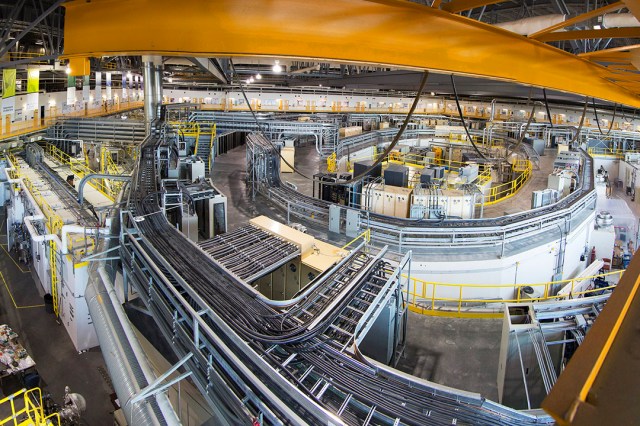 With 22 beamlines adapted to different experiments, the Canadian Light Source (CLS) behaves like a Swiss army knife, supplying the characterization layer underneath semiconductor-related work.
What is committed near Regina, and what is still an option?
Conclusion first: the province's compute story is an option on capacity, not a delivery of it. A non-binding agreement announced by Bell and Saskatchewan opens a path to another 900 MW of AI infrastructure capacity, lifting the potential provincial total to 1.2 GW. If fully developed, the data centers, tenant computing equipment and power generation could involve more than C$50 billion (~$35 billion) in capital investment, and Bell plans to establish an AI Fabric head office in Saskatchewan.
The dated part is smaller and easier to audit. The initial 300-MW campus sits in the Rural Municipality of Sherwood, just outside Regina; Bell named CoreWeave and Cerebras as anchor customers when that campus was announced in March 2026, and the expansion path to 1.2 GW followed on 14 September 2026, according to the company's newsroom and trade coverage. Bell's project page describes the campus drawing its first 300 MW from SaskPower. First data hall: the first half of 2027.
For anyone weighing Canadian sites, that sequence is the lesson. Gigawatt headlines are conditional rights of way; the operating question is who supplies the power, at what tariff, and on whose schedule.
Which asset answers which question?
Six rows, six different purchase decisions. These are not competing vendors; they are the questions a design or research team eventually pays to have answered.
| Layer | Asset | Question it answers | Status | Access route |
|---|---|---|---|---|
| AI compute | Bell Canada campus near Regina | Where do large training and inference jobs run in Canada | first data hall targeted for the first half of 2027 | colocation and AI Fabric services |
| Quantum research | USask nine-qubit Rigetti Novera system | Can our problem be written as a quantum circuit | acquired, in commissioning | academic partnership, DISH network |
| Design capability | Siemens EDA Saskatoon | Who can do the design work with mature tools | operating | university pipeline, hiring, contract design |
| Materials evidence | CLS and SyLMAND | Why does the device or interface degrade | operating | proposal-based beamtime |
| Radiation testing | TRIUMF, British Columbia | Does the electronics survive a radiation field | operating | commercial test campaign |
| Conventional processing | nanoFAB, Edmonton, Alberta | Can we prototype the device itself | operating | open-access user facility |
Two of those rows sit outside the province, and that is the point. Saskatchewan's contribution is strongest where it is specific; the missing links are filled by partners in Alberta and British Columbia rather than duplicated locally.
Why would a province planning gigawatts buy a nine-qubit machine?
Because the two purchases answer different questions. The University of Saskatchewan's acquisition of a full-stack quantum computer, built around a nine-qubit Rigetti Novera processor, is modest beside the ambitions attached to Bell's development — and it was never meant to compete with them. Rigetti confirmed the sale of a 9-qubit Novera quantum processing unit to USask in an investor release dated 31 March 2026; EE Times has noted the vendor's roots in Moose Jaw, Saskatchewan.
The case for owning the box is grounded in problems researchers already have. Earlier this year, Steven Rayan, director of USask's Centre for Quantum Topology and Its Applications, described opportunities spanning vaccines, agriculture, energy and secure communications. Researchers had already used quantum hardware in Quebec to investigate protein networks relevant to vaccine design, and developed a quantum circuit to model northern microgrids combining solar generation and diesel power.
Institutional pull followed. Hosted at the University of Calgary, the Canadian government's Quantum Defence Innovation Secure Hub, or DISH, selected USask as a primary academic partner. The Bureau of Research, Engineering, and Advanced Leadership in Innovation and Science is establishing a national network of DISHes to provide secure, collaborative spaces for government, industry, academia, the Canadian Armed Forces and national security partners. Saskatchewan's story is also not confined to Saskatoon: the University of Regina conducts research in AI and machine learning.
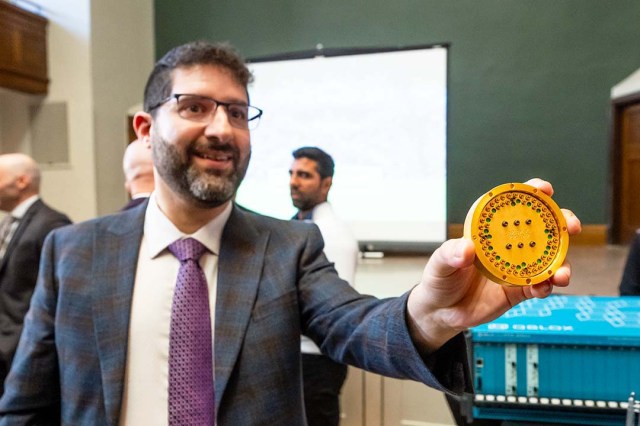 USask's Steven Rayan has mapped practical uses for the university's recently acquired quantum computer across vaccines, agriculture, energy and secure communications.
Decision rule for a technology buyer: nine superconducting qubits buy method development and trained people, not throughput. The defensible first line item is a scoping project measured in engineer-months on shared hardware; ownership only makes sense when a team holds a recurring class of problems and the staff to work them.
How does talent turn into a company in Saskatoon?
Compute capacity alone does not make an ecosystem; someone still has to build the tools and do the design work. Siemens EDA's Saskatoon operation is the long, unglamorous version of that argument. Aaron Genest, technical director at Siemens EDA, explained to EE Times when it reported on Canada's chip design capabilities that growth has depended on university relationships, internal training and an environment that encourages employees to stay. Experienced EDA specialists are not waiting on every street corner. Canada's Semiconductor Council framed the same constraint nationally in its 2025 Talent & Workforce Development Report.
The university-to-industry pathway also produces companies. Novigrad founders Christopher Elash and Lars Kishchuk met as USask engineering students and worked together on university space projects; their early ambition was straightforward — make chips. Conversations with potential customers redirected that enthusiasm to another bottleneck: determining whether electronics can survive radiation exposure.
The ecosystem those founders describe has useful resources but not every capability. TRIUMF in British Columbia supplies radiation-testing infrastructure, and USask contributes expertise in semiconductor radiation effects. TRIUMF lists proton and neutron irradiation facilities used for space-radiation effects testing, and the Canadian nuclear regulator's facility profile records that the lab also tests computer hardware, avionics and communications equipment for resistance to ionizing radiation. That is a buyer's checklist for a qualification campaign, not merely a physics experiment.
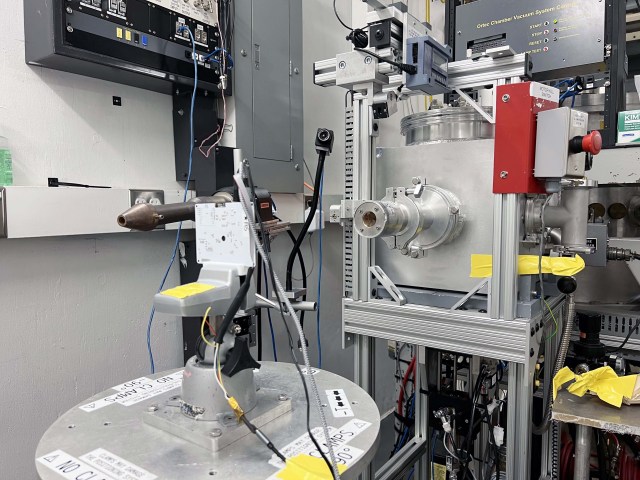 Novigrad, the Saskatchewan startup, expects steady demand from Canadian chip companies that need radiation-testing evidence for their customers.
Why do materials come before machines?
CLS adds a nearby resource that is critical for AI infrastructure but rarely discussed: the materials underneath the hardware. Everything’s downstream of materials, Morhart said — conversations jump from software straight to economic opportunity, but the hardware still has to work.
Morhart, an analytical chemist, runs the SyLMAND laboratory at CLS. He described CLS as essentially a Swiss army knife, with 22 beamlines adapted to different experiments. For semiconductor-related research the contribution is advanced materials characterization, not conventional CMOS processing; the laboratory focuses on non-silicon microdevices and X-ray lithography. Synchrotron techniques let researchers examine interfaces, transport and degradation — not just what a material is, but what happens when it becomes part of a working product.
That makes CLS a national asset as well as a Saskatchewan advantage, and it shows why regional specialization beats duplication. Alberta's nanoFAB in Edmonton provides conventional semiconductor processing capabilities that Morhart's group has deliberately chosen not to duplicate; through proton and neutron irradiation facilities, TRIUMF contributes a third, different capability. Characterization, fabrication and radiation testing answer different questions; together they form a broader development toolkit.
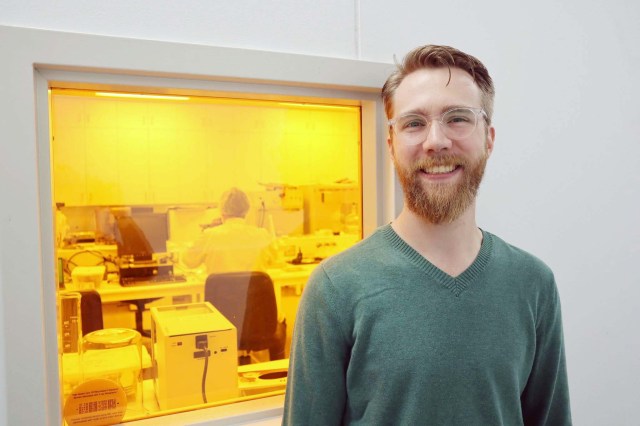 Canadian Light Source's Tyler Morhart runs the SyLMAND laboratory and argues that access, not equipment, is the scarcer resource.
Effort is still needed to make that toolkit reachable. Morhart noted that connections across Canada require travel, professional networks and deliberate relationship-building; geographic separation does not vanish because facilities are complementary. Organizations such as CMC Microsystems help bridge the distance with access to tools and experts — its published national programming includes a five-year, $217 million Strategic Response Initiative funded by the Government of Canada, which is the practical entry point for teams carrying no budget line for beamtime or prototyping.
What are the common mistakes when reading this map?
- Treating a gigawatt announcement as available capacity. The 1.2 GW figure rests on a non-binding agreement; the committed build is the initial 300-MW campus.
- Assuming one province can host the whole flow. Saskatchewan does not run conventional CMOS processing, and no local facility was asked to substitute for nanoFAB or TRIUMF.
- Buying a quantum machine to shorten a product cycle. A nine-qubit system is a research instrument; near-term industrial value sits in scoping studies and staff development.
- Ignoring provincial power market structure. Saskatchewan has no deregulated wholesale electricity market, so developers cannot simply negotiate bilateral power purchase agreements the way they can in Alberta — a legal analysis by MLT Aikins flags this as a siting variable.
- Counting talent as a procurement item. Siemens EDA's Saskatoon story is a decade-long build of university relationships and internal training, not a hiring campaign.
What should operators and buyers do with this?
- Name the physical question before the technology. Degradation, radiation survival, prototyping or compute throughput each route to a different facility.
- Price access and lead time, not headline capacity. Ask for the ready date — first half of 2027 is a dated milestone; 1.2 GW is not.
- Book the test and characterization path early. Beamtime at CLS and an irradiation campaign at TRIUMF are scheduled activities, and they gate qualification more often than design does.
- Use national intermediaries rather than building local relationships from zero. CMC Microsystems exists precisely to connect teams to tools, fabs and experts across Canada.
- Check the power and procurement rules before comparing tariffs. Regulated versus deregulated markets change the contract structure, not just the price.
- Copy the framework, not the facility: one anchor asset, two complementary partners in other provinces, one talent pipeline attached to a university, one intermediary that lowers access friction.
FAQ: questions this comparison raises
Can Saskatchewan host a conventional chip fab today?
No. The provincial SyLMAND work covers advanced materials characterization, non-silicon microdevices and X-ray lithography, not conventional CMOS processing. Conventional processing exists elsewhere in Canada, including nanoFAB in Edmonton, Alberta, so teams plan a second province into the project from day one.
Is the 1.2 GW figure a committed investment?
Treat it as an option. The Bell and Saskatchewan agreement covering another 900 MW is non-binding. The auditable milestone is the initial 300-MW campus, where more than 500 people are working and the first data hall is targeted for the first half of 2027.
What can a nine-qubit quantum computer do for an industrial problem?
Method development and training, not throughput. USask researchers have already used quantum hardware in Quebec on protein networks relevant to vaccine design and modelled northern microgrids combining solar generation and diesel power — problem classes, not production workloads.
How does a company outside Saskatchewan use these facilities?
Through national routes: proposal-based beamtime at CLS, commercial test campaigns at TRIUMF, CMC Microsystems for design tools and prototyping, and DISH for secure collaboration with government and the Canadian Armed Forces.
Sources referenced
- EE Times: Saskatchewan's Semiconductor Strength Is Connecting the Pieces
- BCE newsroom: Bell AI Fabric 300 MW data centre in Saskatchewan
- Data Center Dynamics on the Sherwood campus and anchor customers
- Rigetti investor release on the Novera QPU sale to USask
- TRIUMF proton and neutron irradiation facilities
- Canadian Nuclear Safety Commission profile of TRIUMF
- CMC Microsystems national programing and start-up report
- Canada's Semiconductor Council 2025 talent report
- MLT Aikins on Canadian data-centre power procurement
- University of Alberta nanoFAB