
Memory Supply Tightness Runs to 2028: A Samsung Signal Industrial Buyers Should Price In
Operations and sourcing teams will read this differently from a financial desk. Samsung Electronics used its latest earnings call to tell the market that global memory chip supply tightness cannot be eased in the short term, that pressure may deepen in 2027, and that incremental supply will not become visible before 2028. For any bill of materials that carries DRAM, NAND or high bandwidth memory, that statement effectively defines the planning window for the next several budgeting cycles.
Demand Is Being Reserved Before It Materializes
The mechanism matters more than the headline. As the artificial intelligence build-out expands, demand for high-performance memory keeps climbing, and Samsung has observed customers proactively submitting mid- to long-term demand forecasts in order to reserve future output ahead of time. Requirements that cannot be satisfied this year, the company notes, are very likely to roll into next year, which widens the supply-demand imbalance rather than postponing it.
Jaejune Kim, executive vice president in charge of Samsung's memory business, said that on the basis of customer demand received so far, supply pressure in 2027 is expected to be more severe than in 2026. New wafer fabs and added capacity typically require several years from construction to formal production start-up, which is precisely why the industry is unlikely to see any meaningful release of new supply before 2028.
Case Study: A Fully Booked 2027 HBM Position and the HBM4E Ramp
Samsung's own product plan shows how pre-reservation changes allocation. The company disclosed that its HBM4 high bandwidth memory capacity for 2027 is already sold out in its entirety, with the relevant orders locked in by customers in advance. Its next-generation HBM4E product is scheduled to enter mass production in the first half of 2027, followed by an increase in shipment volume in the second half of that year.
Away from HBM, the pattern repeats. Samsung reports that market demand for high-speed DDR5 memory is equally strong, with server customers showing a particular preference for parts rated at 8000MT/s and above. In NAND flash, the company is accelerating development of products aimed at artificial intelligence applications, including PCIe Gen6 enterprise solid-state drives, high-density QLC SSDs and other storage solutions tied to AI infrastructure.
The Data Behind the Warning
The reported results make the commercial consequence of the imbalance explicit, and they explain why supplier behaviour has shifted toward contract-first allocation.
| Indicator | Reported figure | Relevance for planners |
|---|---|---|
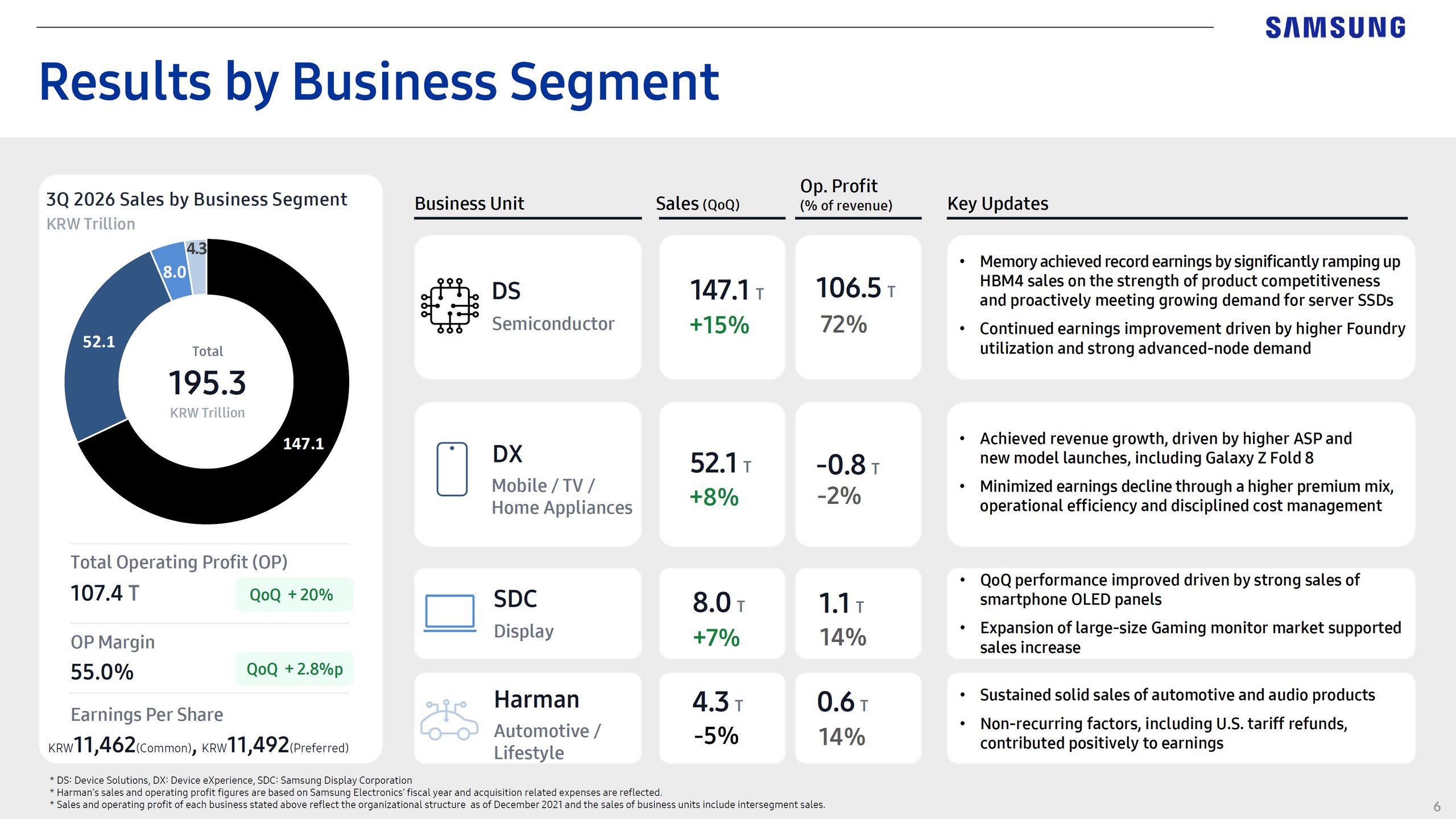
| Revenue, third quarter of 2026 | 195.3 trillion won, up 127% year on year and 14% quarter on quarter | A record quarter driven by the AI server construction boom |
| Operating profit | first global technology company to exceed 100 trillion won, up 783% year on year and 20% quarter on quarter | Peak profitability is a symptom of scarcity, not of its resolution |
| R&D spending | 14.4 trillion won, up 63% year on year | Directed at expanding capacity, developing next-generation memory technology and building new production facilities |
| Samsung DS division (semiconductors) | operating profit up 72%, revenue up 15% | Outperformance pulled by HBM, DRAM and SSD demand |
| Contract structure | about 60% to 70% of capacity | Planned for inclusion in long-term supply agreements, with customers willing to sign multi-year purchase contracts receiving higher-priority supply assurance |
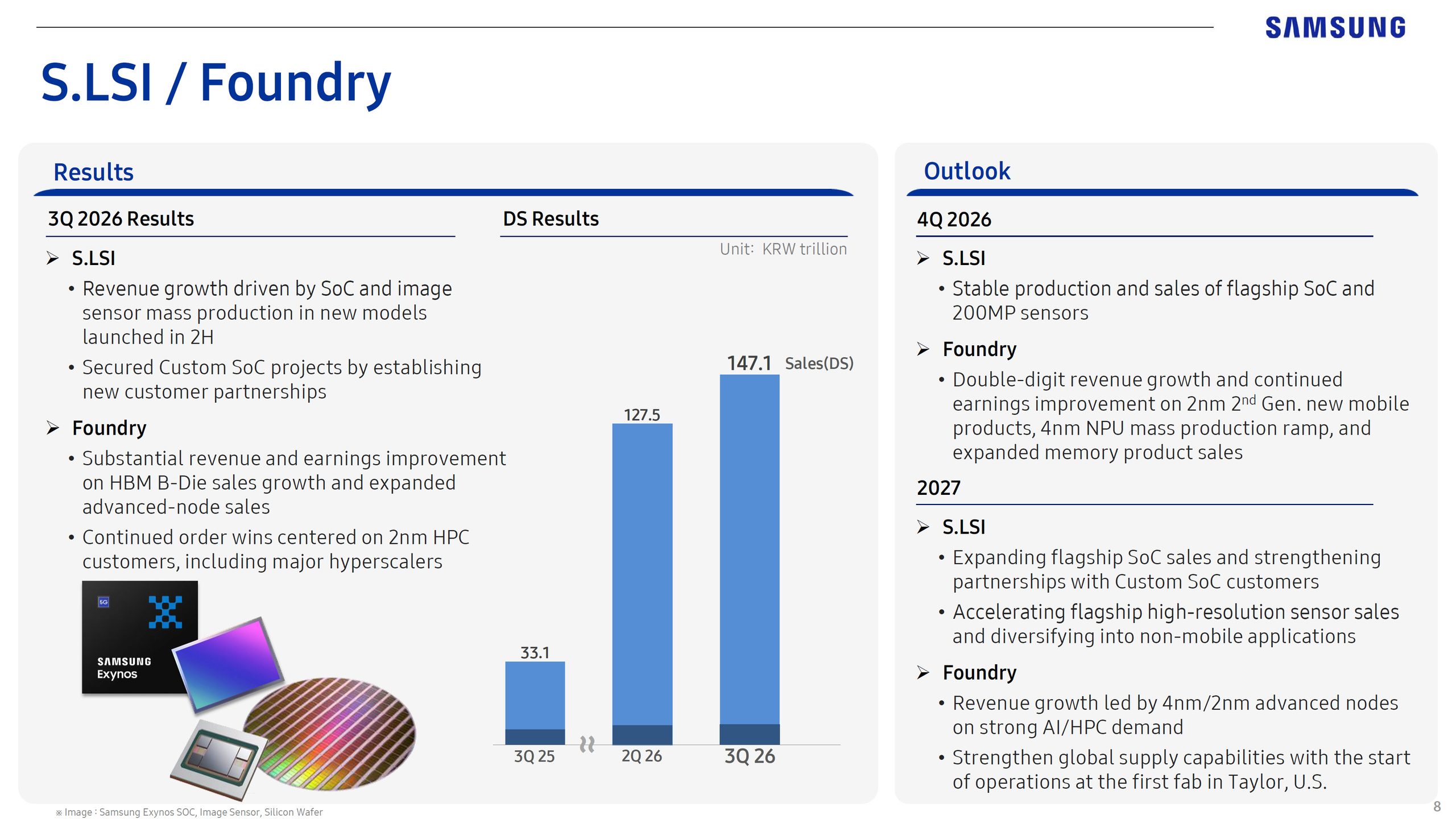
| Wafer foundry | 2nm order volume expected to grow more than twofold this year | Advanced 2nm and 4nm processes are set to keep generating new growth; 4nm has already been adopted by several large US artificial intelligence customers, and main 2nm customer products are planned to enter mass production in the second half of this year |
Where the Wafers Go First
Analysis of the disclosures points to a distributional consequence that industrial buyers cannot plan around indefinitely. It suggests that for the next several years advanced memory products will continue to flow preferentially into the artificial intelligence data center market, while the share of capacity available to consumer electronics may end up comparatively limited. Smartphones, personal computers, graphics cards and consumer-grade storage products alike could therefore remain under sustained cost pressure.
Common Misconceptions Worth Correcting
- Announced capacity equals available capacity. With 2027 HBM4 output already sold out and roughly 60% to 70% of capacity earmarked for long-term agreements, published roadmaps describe commitments rather than open supply.
- Construction announcements shorten the lead time. Samsung's position is that fabs and added lines need several years from building to formal production, so the constraint holds through 2028.
- Record supplier earnings signal a loosening market. The 127% year-on-year revenue jump and the 783% operating-profit increase reflect the tightness of demand, not its easing.
- This is an AI-segment issue only. The company itself flags knock-on effects for phones, PCs, graphics cards and consumer storage.
Action Guidance for Budgeting and Procurement
- Set the planning horizon by 2027, not by the next quarter. Treat 2027 as the year of heaviest supply pressure and assume limited incremental supply before 2028.
- Submit demand visibility early. Customers are already providing mid- to long-term forecasts to reserve future capacity; requests left unmet this year carry into next year, so late forecasts compete for what remains.
- Evaluate multi-year agreements for critical memory content. Samsung states that customers willing to sign long-term purchase contracts receive higher-priority supply assurance.
- Price the consumer-facing side of the bill. Build sustained cost increases for smartphones, PCs, graphics cards and consumer storage into product cost models.
- Watch the advanced-node feed as a second signal. More-than-twofold growth in 2nm orders this year, with 4nm adoption by large US AI customers and main 2nm products entering mass production in the second half of this year, indicates continued competition for scarce wafer output.
FAQ
Q: How long does Samsung expect memory supply to remain constrained?
A: The company says short-term relief is not in view, that 2027 pressure is likely heavier than 2026, and that clear new supply is hard to see before 2028 because fabs take years from construction to production.
Q: Which products are already committed?
A: All 2027 HBM4 capacity is reported sold out. HBM4E is planned for mass production in the first half of 2027 with higher shipments in the second half, while strong DDR5 demand is concentrated at 8000MT/s and above, alongside PCIe Gen6 enterprise SSDs and high-density QLC SSDs for AI workloads.
Q: What does the shift toward long-term contracts mean for buyers without one?
A: With about 60% to 70% of capacity planned for long-term supply agreements and priority given to multi-year contract customers, buyers outside that framework are more exposed to allocation limits and cost increases, particularly in consumer electronics.
Bottom Line for the Plant Floor
Taken together, the guidance describes a market in which the AI wave is still expanding memory demand faster than the industry can build supply, and in which a growing share of what does get built is contractually reserved in advance. For managers and procurement teams, the practical conclusion is a longer commitment horizon: quote validity windows, cost assumptions and supplier agreements made now will be tested by a 2027 that, on the maker's own assessment, may be the tightest year of this cycle.