
Six Languages, One Checkout: What Rochester Electronics' Localized Storefront Change Actually Fixes for Sourcing Teams
Rochester Electronics has moved six regional websites from translated content to a complete buying journey, so customers working in Portuguese (Brazil), Spanish (Mexico), French, German, Italian or Polish can now identify, obtain and pay for authorized semiconductors on their own local site, alongside the existing English, Chinese, Japanese and Korean (South Korea) storefronts. The number that matters is not the language count. It is the number of handoffs deleted between a part number and a purchase order.
On a sourcing desk, cycle time is rarely dominated by finding a part. It is dominated by the gaps between systems: a question written in one language, a quote returned in another currency, a lifecycle answer held by a third team. Each handoff adds a day or two and one more person able to say no.
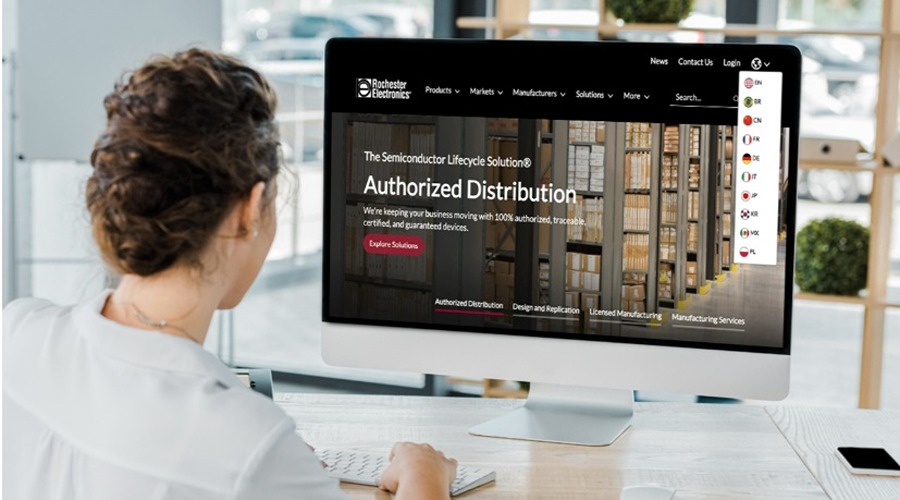
What exactly changed at the regional sites
Conclusion first: the local pages stopped behaving like catalogs and started behaving like tills. The company said these sites previously carried localized product information and content, while the current release supports the full path from search through checkout, including visible regional pricing and inventory that a planner can read without opening a second window.
| Site language set | Before this release | Now |
|---|---|---|
| Portuguese (Brazil), Spanish (Mexico), French, German, Italian, Polish | Localized product information and content only | End-to-end purchasing: search, availability, pricing, order, payment |
| English, Chinese, Japanese, Korean (South Korea) | Full online purchasing already live | Baseline unchanged; same account model across regions |
Because the buy can now close where the request starts, sourcing becomes simpler, throughput rises and processing time shrinks. The regional sites keep a single global experience shape while meeting local requirements for language, content and displayed price.
Why storefront language shows up in sourcing cycle time
Because demand is concentrated, allocation is normal, and allocation is where buyers lose the most hours. In August 2026 the Semiconductor Industry Association reported global chip sales rising 35.1% from the first quarter of 2026 to the second, with CEO John Neuffer stating in the same release that sales are expected to exceed $1.5 trillion for the full year 2026. The World Semiconductor Trade Statistics body put first-half 2026 revenue at 702 billion US dollars, up 102% year over year, and forecasts growth near 90% for the year.
Those figures describe the leading edge, but they set the condition for everything below it. When a market runs that hot, general-purpose and legacy line items get less distributor attention, and buyers shift toward authorized post-market sources. The regional numbers explain which languages were worth building first: Mexico's electronics manufacturing services market is projected to grow from USD 12.81 billion in 2025 to USD 13.46 billion in 2026, and Brazil's production-technology segment is expanding at roughly 20% compound annually, according to the U.S. International Trade Administration's country commercial guide. My read, stated as analysis rather than vendor claim: Portuguese and Spanish storefronts track assembly capacity that has already moved, not reader preference.
Which site functions actually change the work on the floor
- Sourcing and discovery. Advanced product search and filtering, plus recommendations for alternative parts; list-management tools including Bill of Materials (BOM) support, which is where multi-line legacy boards get cheaper to re-buy.
- Inventory and procurement. Visibility of current and future inventory, product availability information and TLS360 lifecycle management. TLS360 — Through Life Support 360, described in Rochester's own product documentation as program-level lifecycle assurance for selected mission-critical semiconductor families — turns obsolescence into a planning input instead of a fire drill.
- Order and account management. Order status and shipment tracking, downloadable invoices and documentation, personalized account settings covering billing, shipping and payment terms, One-click reorder, and secure checkout with major credit cards.
- Reference material. A broadened library of catalogs, white papers and webinar content — useful when a requalification review needs a paper trail rather than a screenshot.
For readers weighing authorized stock against broker supply, our worked example on the 13.6 million authorized STMicroelectronics devices is the closest practical comparison available on this site.
What is the obsolescence math behind an authorized channel
Long-lived systems outlive the parts inside them. Automotive programs typically require around 15 years of service, defence and aerospace platforms stay in the field for 20 to 40 years, while a semiconductor's production life is commonly three to seven years. The component-search platform Sourceability counted 328,000 end-of-life (EOL) notices issued in 2023 alone. Rochester Electronics has been working that gap since 1981, built on licensed manufacturing of discontinued products rather than on surplus trading.
Localization does not alter chain of custody, and that distinction is worth stating plainly. Buyers in Kraków or Campinas still need traceability paperwork, and the standard many quality organizations require of distributors — AS6081, SAE International's specification for avoiding, detecting, mitigating and dispositioning fraudulent or counterfeit electronic parts — remains a documentation exercise, not a translation exercise.
Four mistakes buyers make with a localized checkout
- Reading a translated catalog as proof of an authorized chain of custody. Language and licensing are separate variables.
- Treating displayed local-currency price as landed cost. Duties, tax treatment and freight, especially in Brazilian procurement, still need their own line.
- Accepting an alternative-part recommendation as a qualified substitute. Every swap carries its own requalification and sign-off cost.
- Ignoring future inventory visibility when planning a lifetime buy, then re-qualifying a part nobody can promise in eighteen months.
When local purchasing pays back, and when it does not
Conditions where this pays: boards with many legacy line items, purchasing and planning staff who work outside English, replenishment volumes below the attention threshold of a primary distributor, and programs that need documented lifecycle status before an audit. Conditions where it does not: high-volume leading-edge parts whose price and allocation are settled in supplier agreements long before any storefront, and regulated programs where sign-off demands original manufacturer documentation whichever language the order was placed in.
The same asymmetry shows up across regional component strategy: unit cost and cross-market portability rarely improve together, a point we tested on Honda's sourcing pivot in China. A storefront that shortens a purchase does not automatically shorten a qualification.
A replicable framework for absorbing a new channel in one quarter
- Classify every line item by lifecycle status: active, EOL announced, or already obsolete.
- Assign each class to a channel — primary authorized, authorized post-market, or broker with added inspection — before anyone touches a storefront.
- Write acceptance criteria first: traceability documents required, acceptable currency, payment terms, minimum order quantity, lead-time window.
- Run 90 days and measure four indicators: request for quote (RFQ) turnaround, quote-to-order conversion, first-pass acceptance of documentation, and price variance against the prior period.
- Re-review quarterly; shift volume between channels only on measured indicators, never on a single shortage.
FAQ
Which languages support a full purchase now?
Portuguese (Brazil), Spanish (Mexico), French, German, Italian and Polish support the complete journey from search through checkout. English, Chinese, Japanese and Korean (South Korea) were already operating as full purchasing sites.
What is TLS360?
Through Life Support 360, Rochester's program-level lifecycle assurance offering for selected mission-critical semiconductor families, surfaced on the site as availability and lifecycle status information rather than as a separate sales conversation.
Does a localized price mean a lower price?
No. Regional pricing and local payment terms change how a transaction is executed and recorded. Currency display removes conversion ambiguity, not tariff or freight exposure.
Can a whole BOM be handled in one pass?
List management with BOM support is part of the sourcing toolset, and alternative-part recommendations are exposed alongside it. Whether a line can be substituted remains an engineering decision, not a storefront one.
References
- Rochester Electronics — TLS360 product documentation
- Semiconductor Industry Association — global sales, Q1 to Q2 2026
- World Semiconductor Trade Statistics — 2026 market projection and first-half results
- U.S. International Trade Administration — Brazil production technology overview
- Mexico electronics manufacturing services market outlook 2026
- Sourceability — end-of-life notice volume and obsolescence risk
- ANSI National Accreditation Board — AS6081 counterfeit avoidance scope
- Rochester Electronics localized e-commerce announcement (PDF)