
From Automation to Autonomy: A Component-Level Comparison of Physical AI Build Paths at OktoberTech Silicon Valley 2026
Industrial teams weighing robot and smart-machine programs should compare three variables, not one: where perception runs, where the trust anchor sits, and how much memory a design carries. The supplier messaging at OktoberTech Silicon Valley this year points to a staged build path rather than a single leap, and for plant and product managers the security layer, not the demo, now sets the realistic rollout pace.
What moved to the center of the agenda this year?
Physical AI. At OktoberTech Silicon Valley, held this year in Mountain View, California, physical AI emerged as one of the event's central themes. As AI data centers move into a more mature phase, robotics has become the major use case drawing attention to physical AI, and managers at Infineon described the shift as a journey from automation to autonomy.
The framing matters because it is a migration, not a product category. Physical AI shifts artificial intelligence out of purely digital environments and into machines, factories and logistics networks. These systems can sense, think and act autonomously in real time, opening opportunities across everyday convenience, healthcare, mobility and industrial automation. For an operations or capital-equipment reader, the practical question is which layer of that stack you buy, integrate, or build yourself.
Capital signals reinforce the urgency. Investor-facing coverage of the 2026 robotics startup landscape, citing PitchBook deal data, describes robotics as one of the hottest bets in tech after years of investor reluctance toward hardware, with falling hardware costs, labor shortages and pressure to reshore production named as the drivers (Business Insider). Translation for a purchasing committee: the component supply base is expanding, and the cost of waiting is measured in lost learning, not only lost headcount.

Figure 1: In the reference architecture shown at the event, a robot uses physical AI to perceive its environment, communicate securely, process data locally through edge AI, and act safely and reliably while using energy as efficiently as possible. Source: Infineon
How does autonomy differ from the automation already on the floor?
In short: automation executes a scripted task, autonomy closes the loop between sensing and action. The "journey from automation to autonomy" narrative Infineon used at the event is best read as a set of decision points, because each stage changes a different part of your bill of materials, validation plan and maintenance model.
| Decision variable | Classic automation | Physical AI system |
|---|---|---|
| Where intelligence sits | Central controller program, fixed machine logic | Sensor front end plus edge AI compute, with models deployed down to microcontrollers |
| What it handles | Repeat execution of a known task | Real-time sense, think and act as conditions change |
| Hardware focus | Drives, I/O, safety devices | Sensing, computing, connectivity, motor control and power management as one chain |
| Cost of change | Reprogram and revalidate per variant | Retrain and redeploy models, with a verified boot and update path |
| Strongest fit | High-volume, stable SKUs | Variable inputs, human-adjacent work, mixed-flow and short-run production |
The table is WorldIndustrialWeekly's analytical reading of the supplier narrative from the show floor, not a vendor spec sheet; the useful takeaway is that autonomy moves cost and risk out of the programming step and into the data, memory and trust layers.
Which functional blocks actually decide the outcome?
Five of them. Infineon presented live robots alongside the key functional blocks involved in sensing, computing, connectivity, motor control and power management, while developer booths showed designs that use physical AI for next-generation applications, from industrial automation and home appliances to smart home security. A buyer who evaluates a platform block by block will usually find the bottleneck before the integrator does.
Motor control is the sleeper category. Asked whether physical AI extends beyond robotics, Stephan Zizala, division president of edge systems at Infineon, pointed to motor control. “Several machine learning algorithms are now powering motor control designs.” He also described robotics as the tip of the iceberg for physical AI — a statement with a direct budget consequence: any plant with large installed motor-driven equipment is already inside this market, whether or not it buys a humanoid.
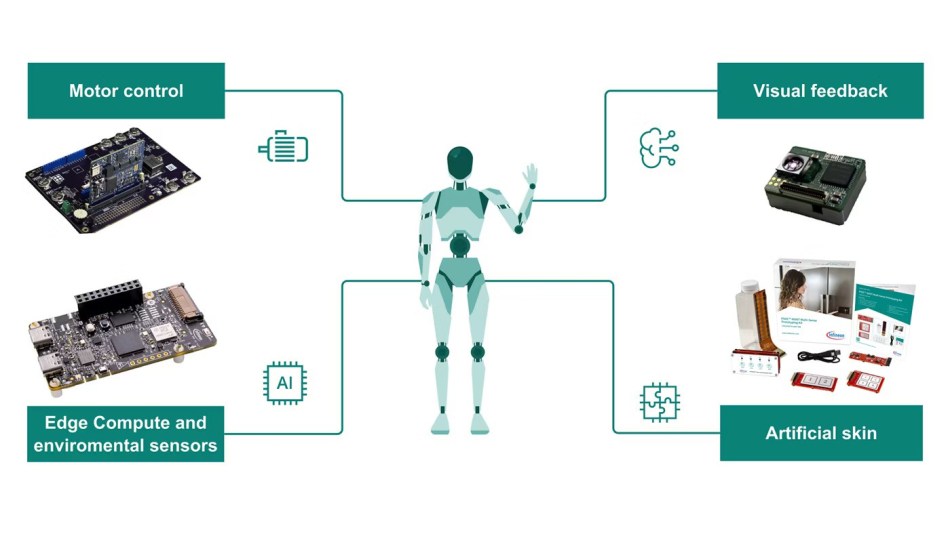
System-level solutions for physical AI were displayed at OktoberTech Silicon Valley 2026. Source: Infineon
Where should the trust anchor live: software, module or silicon?
At the chip level, if the machine physically leaves your site. Discussing the path from generative AI to agentic AI to physical AI, Zizala characterized physical AI as a new era in artificial intelligence. He added that physical AI is already at work, but the larger issue is whether it is ready from a security standpoint. “While physical AI translates perception into precise movement, functional safety and cybersecurity embedded at the hardware level provide an anchor of trust for even the most advanced robots.”
Earlier this year, Infineon introduced the OPTIGA Trusted Platform Module (TPM), SLB 9672, a hardware-based solution that secures the Jetson Thor platform from Nvidia. It stores cryptographic keys securely and verifies system integrity at the chip level, creating a certified, quantum-resilient root of trust for physical AI systems.
The comparison buyers need to run is simpler than it looks:
- Software-only protection. Lowest incremental bill of materials; keys and integrity checks inherit every weakness of the operating system and of field reflash procedures. Workable for a closed bench prototype, weak for a unit that is serviced, networked or resold.
- Hardware root of trust. Adds a component and a provisioning workflow, but binds device identity and verified boot to silicon, so a compromised image does not automatically mean a compromised machine.
Integration teams typically map these requirements onto established automation-security and machine-safety frameworks — IEC 62443 for industrial automation and control systems security, and the ISO 10218 / ISO/TS 15066 robot safety line for industrial and collaborative robots — before they negotiate a chip-level trust anchor. That mapping is our analysis rather than a statement made at the show, but it explains why security is a procurement gate and not an engineering preference: it decides whether a pilot can ever become a validated production asset.
Is the memory wall coming for physical AI designs?
Probably, and it will arrive as a component spec before it shows up as a missed launch date. Zizala outlined a design value chain in which developers take sensor data, train models, and deploy them on microcontrollers. In his keynote, Andreas Urschitz, chief marketing officer at Infineon, referred to these MCUs as foundational MCUs — the MCUs have been reimagined for edge AI and physical AI applications.
Developers at the event were blunt about the constraint: they stressed the need for more memory, and one said the issue comes down to more memory, so more AI models could be used. That is the same limit that throttled accelerator capacity in the cloud, arriving on a smaller die. The “memory wall” story from data centers appears likely to reach physical AI designs sooner or later.
Three build paths compete for that same line item:
- Fully on-device. Best latency and best data-sovereignty posture; paid for in silicon cost, power draw and model-size limits.
- Hybrid edge. Perception and safety loops stay on the MCU and edge module while heavier reasoning offloads periodically — the most common compromise in factory retrofits.
- Connectivity-dependent. Cheapest compute, highest exposure to network jitter and to the security question above.
Which application fits which build path?
Match the path to consequence severity, not to novelty.
| Use case shown at the show | What to check first | Where projects stall |
| Industrial automation cells | Real-time sense-think-act loop, motor control design, safety validation path | Change management when the model, not the ladder logic, behaves differently |
| Home appliances and motor-driven equipment | ML inside motor control, energy efficiency, unit cost at volume | Margin math: memory and security parts must pay for themselves |
| Smart home security devices | Certified root of trust, key provisioning, update integrity | Field service and resale, where software-only trust fails |
| Logistics and mobility systems | Connectivity, local edge processing, fail-safe behavior | Fleet rollout cadence and post-deployment data capture |
What do the 2026 funding and deployment signals say about timing?
Two data points are worth putting into a business case. Market coverage of the 2026 World Physical AI Conference notes that Jensen Huang said at the GTC event in Berlin on 21 October that AI factory deployment cycles had shortened to as fast as 14 days, while Unitree founder Wang Xingxing said the following day that physical AI was already showing signs of a breakthrough, with the window potentially falling in one to two or two to three years — well ahead of his earlier estimate of up to ten years; J.P. Morgan read that compressed timeline as improving the sector's risk-reward and as raising the strategic value of robots already deployed, of developer ecosystems and of real-world data (Sina Finance).
If that timing view holds, the asset you accumulate in a pilot is data, not hardware: machines already in production generate the operating evidence that later models are trained on. That is an inference from these signals rather than a vendor claim, and it argues for smaller, instrumented deployments that create a retrainable data path instead of one flagship robot.
What are the common misconceptions to rule out?
- "Physical AI means humanoid robots." Robotics is, in Zizala's words, the tip of the iceberg; motor control designs already carry machine learning workloads.
- "Autonomy is a software upgrade." The anchor of trust described at the event is embedded at the hardware level, which makes it a BOM and provisioning decision.
- "Edge AI means we can ignore the network." Local processing helps, but hybrid designs still need a deliberate connectivity plan.
- "More memory is a spec detail." On-device model capacity is bounded by memory, so it is a roadmap constraint disguised as a part number.
- "Security arrives at the certification stage." Root-of-trust choices made late are usually paid for in redesign, or in unpatched field exposure.
What should a plant or product team do in the next 90 days?
- Audit installed motor-driven and sensor-bearing equipment to find where ML already fits without buying a robot.
- Score candidate platforms block by block: sensing, computing, connectivity, motor control, power management.
- Require a documented root-of-trust design, and ask explicitly whether keys live in silicon or in software.
- Set a memory and power ceiling per device before a model is chosen, not after.
- Write the data-capture requirement into the pilot contract so deployed machines feed retraining.
- Align validation with IEC 62443 and robot safety documentation from day one.
FAQ: what industrial readers ask next
Is physical AI only relevant to companies building robots?
No. Physical AI covers machines, factories and logistics networks broadly, and motor control designs already run several machine learning algorithms today, which puts most discrete and process manufacturers in scope.
Why is security treated as the gating issue rather than capability?
Because the capability exists — physical AI is already at work — while a machine that senses, decides and moves needs functional safety and cybersecurity anchored in hardware before it can be validated for production use.
What does the memory wall change in component selection?
It turns memory into the pacing item: developers asked for more memory so that more AI models could be used, which means device selection should start from a memory and power budget.
Should we wait for cheaper hardware?
Falling hardware costs are one reason robotics deal activity rebounded in 2026, but the counterweight is that deployed machines generate the real-world data later models need. A small, instrumented pilot usually beats waiting.
Sources
- Infineon materials and executive remarks presented at OktoberTech Silicon Valley 2026, Mountain View, California (Figures 1 and 2, source: Infineon).
- Business Insider, "25 Robotics Startups to Watch in 2026, According to Investors" — PitchBook deal data, hardware costs, labor shortages, reshoring: businessinsider.com.
- Sina Finance, 30 October 2026 coverage of 2026 physical AI remarks by Jensen Huang, Wang Xingxing and J.P. Morgan's read on deployment timelines: finance.sina.cn.
Written by the WorldIndustrialWeekly editorial desk for the General channel. Author: Michael Torres. For corrections or questions on this comparison, contact news@industrialweekly.com.