
WorldIndustrialWeekly Industry Brief: Renesas RX74M and RX74N Bring Embedded MRAM to the 32-bit Industrial MCU Conversation
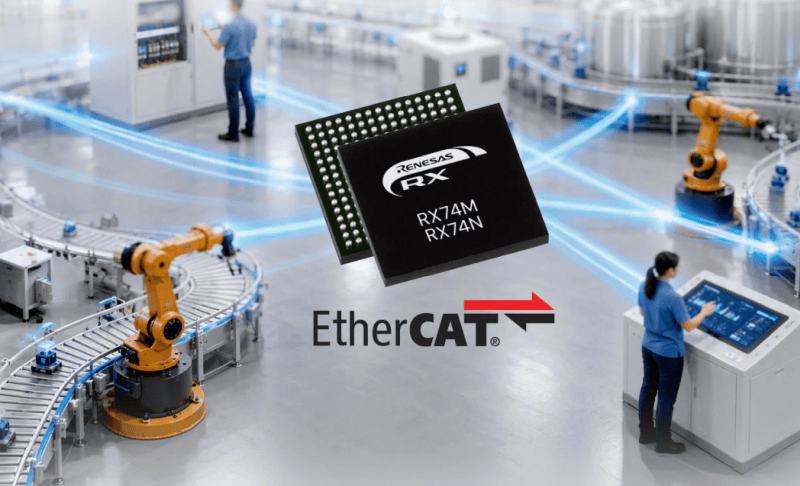
For industrial teams comparing controller generations, the practical question is which constraint is being relaxed. The latest RX family devices from Renesas Electronics answer that question for the RX74M and RX74N: a 22-nm process node, a 600-MHz RXv3e core and embedded MRAM arrive together in the first 32-bit members of that line using this combination, with corresponding evaluation boards also available.
Why This MCU Update Matters for Industrial Design Teams
The value of the RX74M and RX74N is not a single specification point. It is the way the specifications are aligned. A 600-MHz RXv3e core provides processing bandwidth for control loops, communication stacks and calculation tasks. The memory layout is designed to keep time-critical code and data predictable: 1 MB of code MRAM, 256 KB of zero-wait-state tightly coupled memory (TCM) RAM and 1.5 MB of SRAM. For industrial applications, that combination matters because latency and update behavior can be as important as raw clock frequency.
The embedded MRAM angle is especially relevant. Unlike embedded flash, MRAM can be written without a prior erase operation. That difference can make code and data updates faster and reduce programming time. For equipment that needs frequent parameter updates, configuration persistence or staged firmware changes, a memory architecture that avoids the erase-before-write model gives embedded developers a clearer implementation path.
Performance Baseline: From 240-MHz Legacy Parts to 600-MHz Core Speed
The predecessor comparison gives a direct signal about the shift. The RX74M and RX74N are positioned as delivering more than twice the performance of the 240-MHz RX72M and RX72N. That is a useful reference point for migration planning. In many industrial platforms, higher core frequency is not an end in itself; it becomes useful when it allows the same controller to absorb more task scheduling, more communication overhead or more control-loop complexity without requiring a larger product category.
The 22-nm process node is also not only a manufacturing detail. In embedded industrial silicon, process advances can create space for higher frequencies and richer on-chip subsystems while preserving reliability expectations. The announced combination of 22-nm, 600-MHz RXv3e, MRAM and TCM suggests the devices are intended to serve as a high-performance option within the broader RX family.
Application Split: RX74M for Automation, RX74N for Metering, Power and Environmental Control
The family architecture separates the two variants by target system class. The RX74M is aimed at industrial automation equipment such as AC drives, industrial robots and PLCs. The RX74N targets smart meters, power conditioners and HVAC systems. Both integrate Gigabit Ethernet and CAN FD, covering many industrial fieldbus and Ethernet control patterns. The RX74M adds a TSN-capable Ethernet switch and an EtherCAT slave controller for industrial networking, strengthening its fit for time-sensitive automation topologies.
That split gives design teams a simple selection logic. If the dominant requirement is deterministic motion, drive control, PLC communication and network synchronization inside a factory machine, the RX74M is the more direct choice. If the requirement is metering, power conversion, environmental control and communication over Ethernet and CAN FD without the added EtherCAT slave and TSN switch, the RX74N remains the more application-shaped option.
| Decision dimension | RX74M | RX74N |
|---|---|---|
| Primary application focus | AC drives, industrial robots, PLCs | Smart meters, power conditioners, HVAC systems |
| Shared connectivity | Gigabit Ethernet, CAN FD | Gigabit Ethernet, CAN FD |
| Additional industrial networking | TSN-capable Ethernet switch, EtherCAT slave controller | Not listed as a differentiating addition |
| Common compute platform | 600-MHz RXv3e core | 600-MHz RXv3e core |
| Common memory architecture | 1 MB code MRAM, 256 KB TCM RAM, 1.5 MB SRAM | 1 MB code MRAM, 256 KB TCM RAM, 1.5 MB SRAM |
Illustrative Design Cases Built from the Stated Applications
For a machine-builder project centered on an AC drive, the relevant question is whether the controller can maintain current-loop responsiveness while also managing communication tasks. The stated RX74M use case, together with the 600-MHz RXv3e core, 256 KB TCM RAM and industrial Ethernet and CAN FD integration, points to a design that can place time-critical control code close to predictable memory resources while still handling connectivity overhead. The addition of EtherCAT slave support and a TSN-capable Ethernet switch further aligns the part with automation equipment that expects synchronized data movement.
For a smart meter or power conditioner platform, the trade-off may focus more on update behavior, persistence and communication stability than on motion control. Here the embedded MRAM narrative is central: if code and data can be written without the erase-before-write step associated with embedded flash, the device can support faster parameter or configuration updates. The 1.5 MB SRAM gives room for application buffering and communication stacks, while Gigabit Ethernet and CAN FD provide the interface foundation used in many power and metering systems.
For HVAC systems, the pattern is similar to building-adjacent control. The system must manage sensing, actuator logic, local user or supervisory communication and perhaps networked status reporting. The RX74N target, combined with the shared 1 MB code MRAM, 256 KB zero-wait-state TCM RAM and 1.5 MB SRAM, suggests a controller architecture that can keep operational logic and temporary state responsive, without requiring the added EtherCAT slave or TSN switch focus that defines the RX74M variant.
Common Misconceptions in Industrial MCU Selection
- Clock frequency alone does not solve latency. In embedded control, 600-MHz compute is useful, but real response depends on memory behavior, interrupt paths, software architecture and network timing. The presence of 256 KB zero-wait-state TCM RAM matters because it addresses predictable access, not just speed.
- MRAM is not simply another label for nonvolatile storage. The operational distinction is that embedded flash typically requires erase before write, while MRAM can be written without that prior erase. That changes update flow and programming-time expectations.
- Industrial Ethernet is not interchangeable with any Ethernet. Gigabit Ethernet, CAN FD, TSN-capable switching and EtherCAT slave support are different tools for different timing and topology requirements. The RX74M versus RX74N split shows why networking features should be mapped to application class.
- A new process node does not automatically make migration easy. A 22-nm part from the same RX family may reduce conceptual distance, but firmware, peripheral mapping, validation and board-level testing still require structured porting work.
Action Recommendations for Engineering and Product Teams
- Map the controller task list first. Separate hard-real-time loops, communication tasks, data logging and supervisory functions before choosing between RX74M and RX74N.
- Model memory use explicitly. Compare code size against 1 MB of code MRAM, interrupt and control buffers against 256 KB TCM RAM, and runtime data structures against 1.5 MB SRAM.
- Decide whether network timing is a differentiator. If EtherCAT slave behavior or TSN-capable switching is required, treat RX74M as the baseline. If those features are not needed, RX74N may reduce unnecessary complexity.
- Build an update strategy around MRAM. Test parameter writes, configuration persistence and code or data update flows with the no-prior-erase behavior in mind, not only the erase cycle model used for embedded flash.
- Start with evaluation boards. Since the parts are available and corresponding evaluation boards are also available, use them to validate real-time behavior, peripheral interaction and network topology assumptions before committing to a final hardware design.
FAQ
Are the RX74M and RX74N part of the same 32-bit platform family?
Yes. They are described as entries in the RX family, built on a common 600-MHz RXv3e core and using a 22-nm process with embedded MRAM.
What performance claim should teams compare before selecting these parts?
The direct comparison in the source information is the move from 240-MHz RX72M and RX72N parts to the new devices, with more than twice the performance stated for the RX74M and RX74N.
Which memory blocks are most important for real-time control planning?
The 1 MB code MRAM, 256 KB zero-wait-state TCM RAM and 1.5 MB SRAM are the key architecture points. The TCM RAM is particularly relevant when the application needs predictable access to tightly coupled memory.
What differentiates the two variants?
The RX74M is aimed at automation equipment such as AC drives, industrial robots and PLCs, and adds a TSN-capable Ethernet switch and an EtherCAT slave controller. The RX74N targets smart meters, power conditioners and HVAC systems while retaining Gigabit Ethernet and CAN FD integration.
What is the availability status?
The parts are currently available, and matching evaluation boards are also available.
For WorldIndustrialWeekly readers, the takeaway is practical rather than promotional: the RX74M and RX74N give the RX family a new performance, memory and networking template for industrial 32-bit designs. Teams should read that template as a set of selection questions — compute headroom, MRAM-based update behavior, TCM RAM predictability and whether time-sensitive Ethernet features are truly needed — before translating the announcement into a production platform roadmap.