
Renesas RL78/G21 and a Wider RL78/G23 Lineup Reset the 16-bit Budget for Appliance Control
Renesas has extended the RL78 family with the RL78/G21, a 16-bit microcontroller specified at 34.4 µA/MHz — half the operating current of the leading RL78/G13 — while new R7F104G devices lift RL78/G23 capacitive-touch channels to 24 in the 44-pin version and 25 in the 48-pin version. For appliance and industrial-equipment makers, the news is not a new part number. It is a lower floor for the always-on control layer that quietly consumes the standby-power budget of every product line.
What actually changed in the RL78 family?
Two moves land together. First, the RL78/G21 joins the lineup as an ultra-low-power device aimed squarely at system control in air conditioners, refrigerators, washing machines and microwave ovens. Second, the RL78/G23 range broadens with devices that add touch channels for human-machine interfaces, taking the front-panel role further than the earlier generation could.
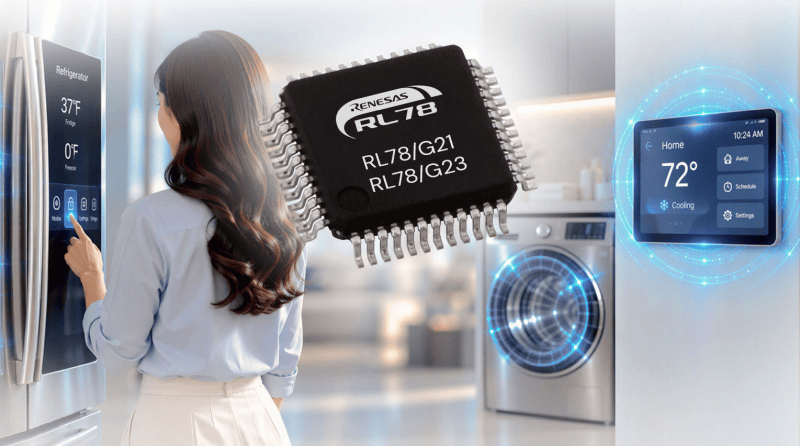
Read in isolation, both look like incremental refreshes. Read against the family's history, they look like a deliberate role split. Renesas introduced the RL78 family in November 2010 as the first microcontroller line developed on an integrated platform after the company's consolidation, built on a 130 nm flash process and positioned as the successor to the 78K0R line. The 16-bit general-purpose RL78/G23 arrived in April 2021, with an RL78 core running at 32 MHz. The current additions therefore do not create a new family; they separate two jobs inside an existing one — efficient control, and integrated touch HMI — so that design teams can pick a lane instead of compromising on one part.
Both groups are now available from Renesas Electronics, with starting prices of $0.56 for the RL78/G21 and $0.77 for the new RL78/G23 devices.
Why is operating current the headline rather than memory or packaging?
Because the regulatory ceiling has moved underneath it. Commission Regulation (EU) 2023/826, adopted on 17 April 2023 and applicable from 9 May 2025, cuts the off-mode allowance from 0.50 W to 0.30 W, holds standby without an information display at 0.50 W, and caps networked standby at 2 W for most connected equipment and 8 W for high-performance networked appliances; a further tightening step is planned from 9 May 2027, according to national guidance implementing the rule.
That is a shrinking envelope for components that never truly switch off. The International Energy Agency's standing analysis of the problem is blunt: "Standby power consumption can be reduced by an average of 75 per cent with cost-effective design changes and technological improvements," the agency says in its report on phantom loads. Older IEA-flagged estimates also projected that by 2030, 15% of appliance electricity consumption in Europe could come from standby functions alone.
The arithmetic matters because of volume. IDC's Worldwide Quarterly Smart Home Device Tracker counted 892.3 million units shipped in 2024 and forecast a rebound to 931.1 million in 2025 (up 4.4%), reaching about 1.1 billion by 2028 on a 5.6% compound growth path. Multiply that install-base growth by even a tenth of a watt per device and the delta is measured in gigawatts of no-load demand — which is why a controller's running current has become a compliance variable, not just a datasheet footnote.
For equipment makers the practical implication is a re-ordering of the power budget. The compressor, the heater and the inverter stage are dominated by physics and duty cycle. The part that is genuinely free to optimise is the electronics that sit idle for hours: the supervising MCU, the touch scanner, the wake source. Independent analyst coverage of this launch frames the low-current device as an "always-on control layer" for vibration monitoring, audio triggers and appliance state detection — a use pattern that extends well past white goods into motors, pumps and compressors where condition monitoring must run continuously without adding measurable parasitic load.
How do the published specs translate on a production line?
The stated values are useful only if each is mapped to a decision the factory or the qualification team has to make.
| Published specification | Stated value | What operations should read into it |
|---|---|---|
| Operating current, RL78/G21 | 34.4 µA/MHz, half the RL78/G13 level | More headroom inside standby and off-mode ceilings; longer run-time for battery-backed sensors |
| ESD tolerance | ±4-kV HBM | Fewer handling losses during SMT insertion, panel assembly and field service events |
| Expansion interface | UARTA | A reserved serial path for connectivity modules, diagnostics or a co-processor without re-spinning the board |
| Code flash options | 128 KB or 256 KB | Room for protocol stacks, multilingual UI text and field-updatable control logic on one part number |
| Data flash | 4 KB | Non-volatile storage for cycle counts, error logs and user settings — the raw material for warranty analytics |
| High-speed on-chip oscillator | ±1.0% accuracy | External crystal can be dropped from the BOM, with consequences for cost, board area and EMC |
| Legacy compatibility | Pin- and function-compatible with RL78/G13 and RL78/G23 | Upgrade path with minimal redesign; layout reuse across product generations |
| Touch channels, RL78/G23 | 24 on 44-pin, 25 on 48-pin, versus the existing R7F100G devices | Glass-front panels with sliders, knobs and key clusters can drop a discrete touch controller |
| Starting price | $0.56 (RL78/G21) and $0.77 (new RL78/G23) | A $0.21 spread that must be justified by the parts it removes, not by the chip alone |
Where does the touch-channel expansion actually help?
Compared with the existing RL78/G23 (R7F100G), the R7F104G devices raise the channel count to 24 in the 44-pin version and to 25 in the 48-pin version. On its own that is a modest-sounding increment. In a front panel it is the difference between a compromise layout and a clean one.
Consider a typical washing-machine or built-in oven interface: a rotary selector with a scan ring, a horizontal programme slider, a dozen direct keys, an approach gesture and indicator LEDs routed behind the same overlay. A channel budget near 16 forces designers to multiplex, to shrink the slider, or to add a second touch front-end device with its own supply, firmware and reflow profile. At 24 and 25 channels, the panel can be routed directly into the supervising MCU, which removes components, shortens the signal chain and frees board area for the connectivity module.
Two caveats belong in the same paragraph. Channel count is package-dependent, so the 44-pin and 48-pin options are not interchangeable at layout. And the ±4-kV HBM figure is a device-level rating: a finished glass or membrane panel still has to clear system-level immunity testing under IEC 61000-4-2, where the overlay, the ground plane and the discharge path decide the result, not the MCU pin.
Should the two parts be seen as competitors or as a pair?
The most economical way to read the launch is as a two-chip architecture option rather than a one-chip choice. One device handles the efficient system-control task — motor sequencing, defrost logic, temperature loops, safety interlocks. The other absorbs the HMI and touch scanning. Renesas positions the RL78/G21 for system control and the RL78/G23 group for touch integration; because the parts share pin and function compatibility with each other and with the RL78/G13, a single footprint strategy can span both roles in the same product family.
For procurement, the relevant test is whether the more expensive device pays for itself. At $0.77 against $0.56, the per-unit difference is $0.21 — roughly $210,000 across a one-million-unit programme. That number is only meaningful if it replaces a discrete touch controller, a second supply chain, additional reflow steps and requalification work. If it does not, the cheaper lane plus a separate front end may well win. This is analysis rather than vendor guidance, and every platform team should run it on its own volumes.
Which misconceptions misprice this transition?
- "A lower µA/MHz figure automatically lowers the appliance's standby draw." It does not. The rating is normalised per running megahertz; the real consumption depends on how often the core wakes, how long the touch scan runs, the regulator topology and leakage in the rest of the rail. Duty cycle dominates.
- "16-bit is a legacy class that 32-bit is about to absorb." Cost, memory footprint and mixed-signal integration still keep this class competitive for fixed-function control, and general-purpose 32-bit devices draw more current once peripherals are enabled — a trade-off documented across MCU-selection guides and echoed in the durability of the RL78 line since 2010.
- "Pin compatibility means no redesign." It means minimal redesign, not zero. New silicon revisions still demand revalidation of EMC, timing margins and, for regulated products, safety functions.
- "ESD robustness is a reliability nice-to-have." At appliance assembly scale, handle-level ESD losses show up as field returns and line scrap, which is why the ±4-kV HBM tolerance is a yield argument as much as a datasheet number.
- "The oscillator accuracy spec is a detail." A ±1.0% on-chip option changes the bill of materials, the crystal-supplier exposure and the EMC signature of a panel that ships in the hundreds of thousands.
What should engineering and operations teams do next?
- Re-baseline the standby budget before selecting silicon. Allocate the 0.30 W off-mode and 0.50 W standby envelopes across the whole board, then see whether a control-layer reduction of this order closes the gap to the next regulatory step.
- Model the always-on path explicitly. Separate peak, average and quiescent currents for the supervising MCU and the touch scan; assume the connectivity module is the largest consumer, not the controller.
- Map the upgrade path from legacy RL78 designs. Because the new parts are pin- and function-compatible with the RL78/G13 and RL78/G23, existing platforms can absorb the change with layout reuse — but plan the requalification window, not just the part swap.
- Decide the HMI architecture first, then the part. Panel channel count drives package selection between the 44-pin and 48-pin options; sketch the glass overlay before committing to a footprint.
- Lock the clock strategy early. Confirm whether the on-chip oscillator at ±1.0% meets timing for your touch and communication functions before deleting a crystal from the BOM.
- Run a dual-line price sensitivity check. Compare $0.56 and $0.77 across your own volumes, including the cost of the components each choice removes.
- Extend the logic beyond white goods. Vibration, acoustic and state-detection monitoring on industrial assets needs the same always-on behaviour at negligible load — a reasonable second market for the same component strategy.
Frequently asked questions
Is the RL78/G21 a replacement for the RL78/G13?
No. Renesas quotes 34.4 µA/MHz, half the operating current of the leading RL78/G13 devices, and keeps pin and function compatibility with the RL78/G13 and RL78/G23. That makes it an upgrade path for designs that need lower running current, not a forced migration for everyone already on the older part.
What does the 34.4 µA/MHz figure translate to in milliamps?
It is a normalised running-current figure, so it scales with clock frequency and with the share of time the core is actually awake. Using the 32 MHz class RL78 core that Renesas described when it launched the 16-bit RL78/G23, continuous execution would imply roughly one milliamp — which is precisely why duty-cycling and peripheral design, not the headline number, decide the final consumption.
Do the new RL78/G23 devices replace the existing ones?
They sit alongside them. The R7F104G parts expand the R7F100G-based lineup by raising touch channels to 24 in the 44-pin package and 25 in the 48-pin package, targeting panels that need more sensor inputs on a single chip.
Where do the parts stand on availability and cost?
Both the RL78/G21 and the new RL78/G23 devices are available now from Renesas Electronics, with starting prices of $0.56 and $0.77 respectively.
Is this only an appliance story?
Not entirely. The same ultra-low-power control layer that reduces standby draw in air conditioners, refrigerators, washing machines and microwave ovens maps onto continuous condition monitoring, gateway endpoints and any assembly that must sense, wake and report without measurable idle cost.
References
- European Commission, Energy Efficient Products — standby, networked standby and off mode requirements: https://energy-efficient-products.ec.europa.eu/product-list/standby-networked-standby-and-mode_en
- UL, "EU Regulation 2023/826: New Energy Efficiency Requirements" — networked standby limits of 2 W and 8 W: https://www.ul.com/news/eu-regulation-2023826-new-energy-efficiency-requirements
- International Energy Agency, "Things that go Blip in the Night" — standby reduction potential of about 75% through cost-effective design changes: https://www.iea.org/reports/things-that-go-blip-in-the-night
- Renesas newsroom, RL78 family introduction, November 2010: https://www.renesas.com/en/about/newsroom/renesas-electronics-introduces-new-rl78-microcontroller-family-deliver-solutions-next-generation-8
- Renesas press room, 16-bit general-purpose RL78/G23 launch, April 2021: https://www.renesas.com/en/about/press-room/renesas-strengthens-rl78-family-low-power-mcus-16-bit-general-purpose-rl78g23
- IDC Worldwide Quarterly Smart Home Device Tracker figures as reported by 199IT (892.3 million units in 2024; 931.1 million forecast for 2025; about 1.1 billion by 2028): https://www.199it.com/archives/1720859.html
- TMC Net insight on the launch — always-on control layer for vibration monitoring, audio triggers and state detection: https://insight.tmcnet.com/insight/renesas-adds-rl78-g21-and-extends-rl78-g23-touch-control-mvtuptn1
- Renesas RL78 family product page: https://www.renesas.com/en/products/microcontrollers-microprocessors/rl78-low-power-8-16-bit-mcus
Written by Michael Torres for WorldIndustrialWeekly. Questions or corrections: news@industrialweekly.com.