
From Solar Carports to BMS Replacement: A Cambridge Net Zero Case Study in Industrial Facilities
For plant, property, and engineering leaders, net zero is useful only when it can be audited. The Cambridge update from Raspberry Pi Ltd illustrates how a facilities decarbonisation plan becomes a stream of measurable decisions: generation output, load control, transport charging, and phased fuel switching. The 2025 baseline named four ambitions, and this follow-up uses those ambitions as an operations checklist rather than a promotional narrative.
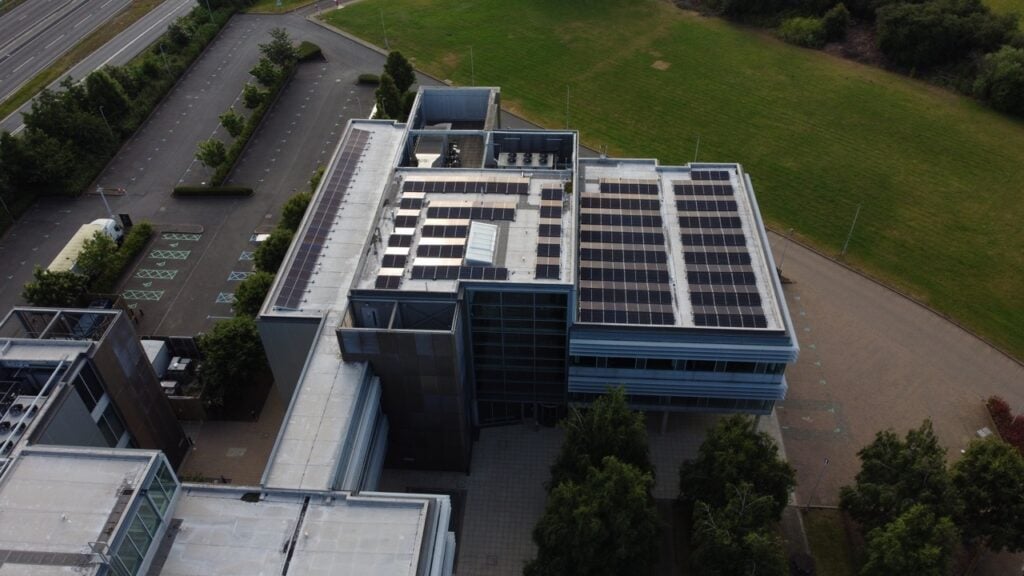 Pi Towers roof-mounted 85.5kW array captured in a site view.
Case framing: why the Cambridge site matters to industrial operators
The site is not unusual because its ambitions are exotic; it is useful because it links production load, office energy use, and control-system spending. Raspberry Pi Ltd uses Raspberry Pi hardware inside the building, but the broader lesson is a data-first method: measure first, control second, and replace capital assets only when an open architecture can reduce risk.
Data citation: generation, investment horizon, and summer coverage
- June 2024: the 85.5kW solar PV array went live.
- 192,000kWh generated across 26 months.
- Full return on investment reported around 2.7 years.
- A 219kW carport is being added with support from landlord agents Stanhope, lifting site capacity to 304kW.
- The combined 304kW array covers 63% of predicted summer electricity demand.
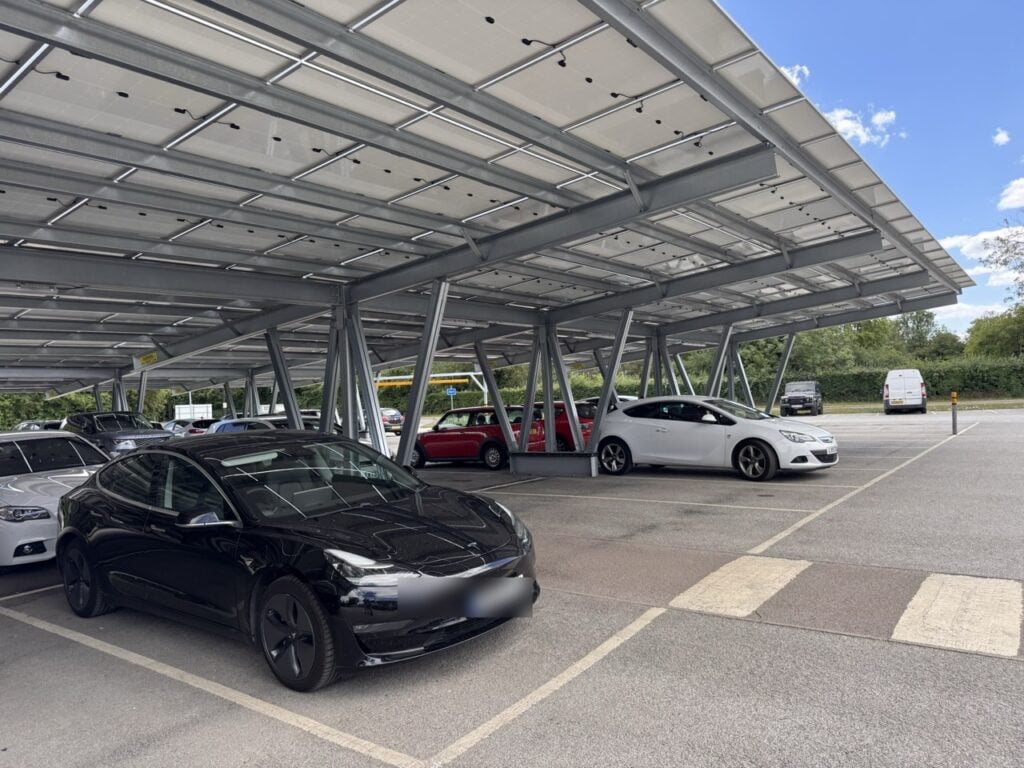 The proposed 219kW carport combines parking structure and generation above the vehicle deck.
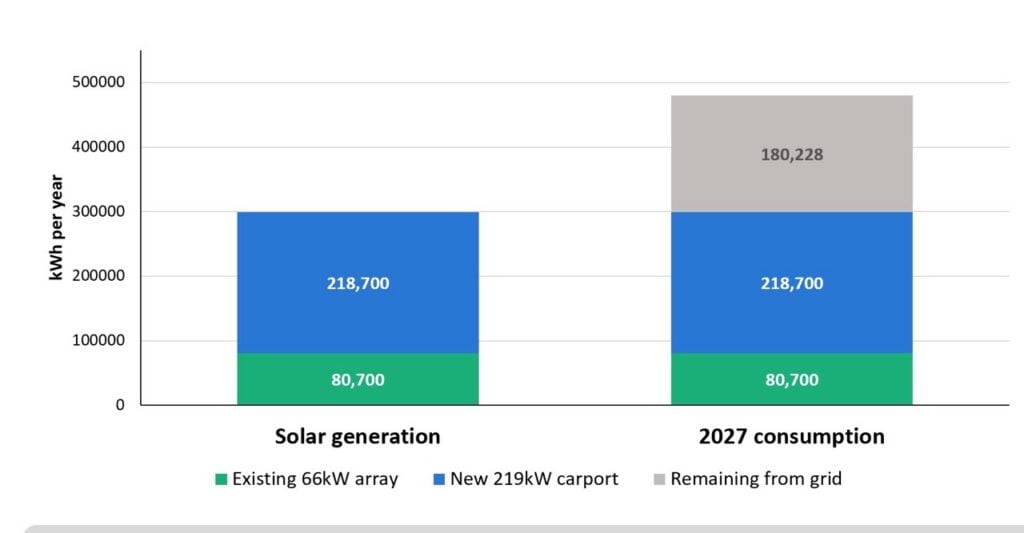 Generation versus forecast demand, showing 63% summer coverage from 304kW.
But what about the shortfall? The answer is procurement rather than overbuilding. Raspberry Pi Ltd states a partnership with Granular Energy to source 100% renewable electricity, using enhanced certificate traceability to address residual Scope 2 exposure.
Mobility infrastructure: EV charging uptake in numbers
August 2024 saw 24 Easee chargers installed, followed by a salary-sacrifice EV scheme. An earlier count showed 11 EVs; the current update reports nearly 60 passes issued and 20 vehicles charging at the time of writing. A second bank of 24 is planned as demand grows.
Base-load control: measurement before equipment replacement
The site found that electrifying a building does not by itself lower base load. Raspberry Pi 4 and 5 boards, Home Assistant, and Emporia clamping technology were used to clamp every breaker and main high-level supplies, creating circuit-level snapshots of every kWh consumed.
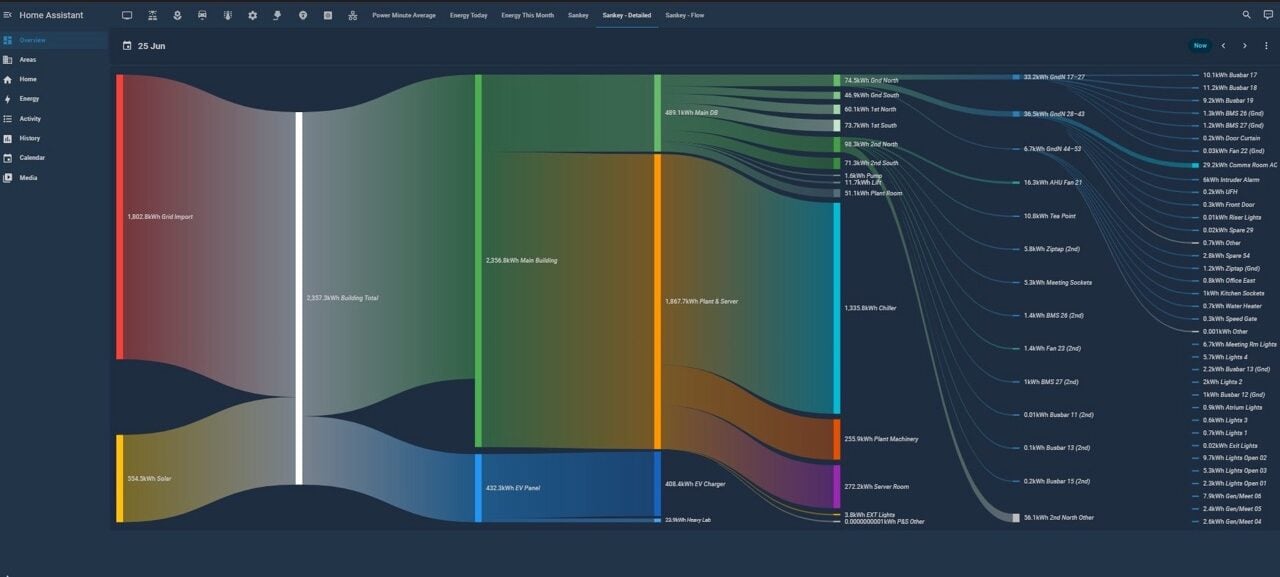 Live flow view across circuits on 25 June 2026.
Quick wins included switching off unnecessary lighting circuits and automating selected equipment. Because process and comfort loads remain material, the larger benefit came from visibility and control.
BMS trade-off: proprietary replacement versus open BACnet architecture
The old Trend 963 BMS interface failed in early 2026. At 17 years old and proprietary, a like-for-like replacement would have run into six figures. The chosen path used Contemporary Controls' BASview and BASpi, an open source BACnet system running on Raspberry Pi hardware, with weather compensation, CO2-based ventilation control, solar integration, and finer temperature, air-quality, and energy visibility.
| Option | Reported cost |
|---|---|
| Like-for-like BMS replacement | ~£150,000 |
| Raspberry Pi based system | £7,800 |
Gas phase-out: milestones, limitations, and staged controls
At Pi Towers, the two Potterton boilers were switched off on 25 June 2026. The heat pump supporting domestic hot water became operational in late 2025 and can also carry some underfloor heating demand. July and August 2026 became the first fully gas-free months on record.
- 25 June 2026: gas supply stopped for the office.
- Late 2025: heat pump took over domestic hot water.
- July and August 2026: first fully gas-free months.
The winter reality is different. As temperatures fall, the boilers may be restarted to heat the building. Rather than discard the existing plant and move immediately to an all-electric system, Raspberry Pi Ltd is adapting incrementally and aiming to remove gas year-round.
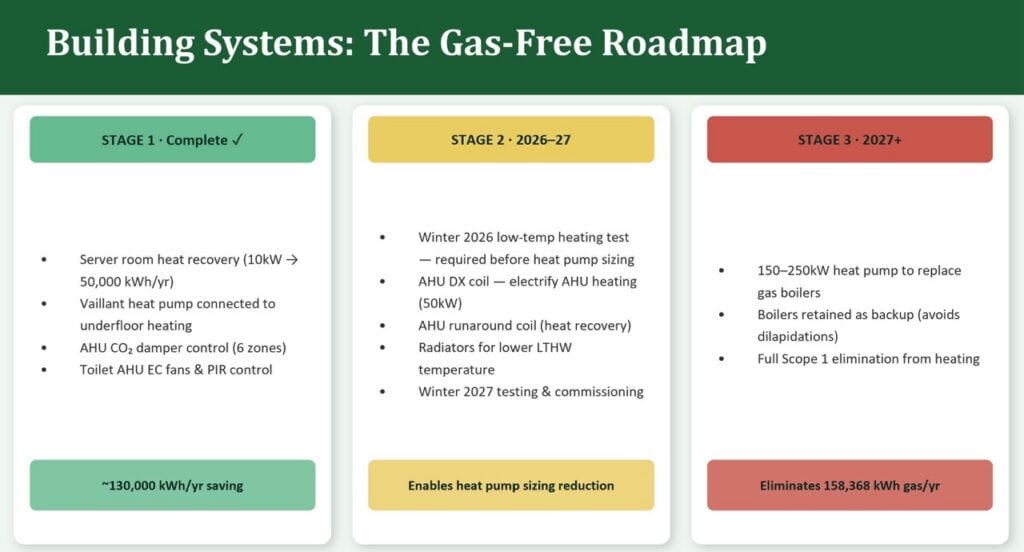 Staged roadmap: completed first phase, active second phase, and 2027 target.
Stage 2 load-reduction measures
Heat recovery from air-conditioning condensers serving the server room was routed through a condenser under the atrium staircase, sending warm air into occupied space in winter. Toilet and shower extractor fans were upgraded to PIR operation so they run only when occupied. Floor-level AHU ventilation damper controls were installed to manage delivered air and reduce strain on chillers and boilers. The combined saving is around 130,000kWh a year.
What remains for 2027
The final phase involves three additions: an AHU DX coil for electrified fresh-air heating, a bypass damper to recycle treated air, and heat pumps to replace boilers. Expected annual heating demand is approximately 300,000kWh, with required output estimated at 150–250kW. Separately, a new warehouse will be fully electric, and the Raspberry Pi Store in Grand Arcade, Cambridge, is already fully electric. The stated endpoint is net zero in 2027.
Common mistakes industrial teams make when copying this playbook
- Assuming electrification automatically lowers base load. Raspberry Pi Ltd found circuit-level data was still needed.
- Defaulting to like-for-like BMS replacement. The failed Trend 963 BMS case shows how a proprietary path could justify six figures, while the open BACnet path was £7,800.
- Buying generation without managing residual Scope 2. The 63% summer coverage figure still required 100% renewable procurement through Granular Energy.
- Treating a summer gas-free window as a completed net zero outcome. Heating loads can bring the Potterton boilers back before the system is truly year-round.
Action advice for facilities and engineering managers
- Start with an energy ledger, not an equipment list: use Raspberry Pi 4 and 5, Home Assistant, and Emporia clamping to make every breaker and supply visible.
- Model the full-year load before replacing generation or boilers. The 304kW and 63% figures only describe summer coverage, while 150–250kW and approximately 300,000kWh frame annual heating need.
- Use staged controls: weather compensation, CO2-based ventilation, damper controls, and PIR fans can deliver around 130,000kWh a year in the case described.
- Plan capital replacement against data ownership. The Cambridge route selected Contemporary Controls BASview and BASpi on Raspberry Pi hardware to keep BACnet visibility and reduce sunk replacement cost.
FAQ
What is the core claim being updated?
Raspberry Pi Ltd is updating progress on its net zero plan in Cambridge against the four ambitions published in 2025: solar and reduced electricity use, EV transport, gas removal, and base-load reduction.
How much solar is involved?
The existing array is 85.5kW, installed in June 2024 and generating 192,000kWh over 26 months, with a reported payback around 2.7 years. A 219kW carport would bring the site to 304kW and cover 63% of predicted summer demand.
What is the hardest remaining barrier?
Year-round gas removal. The two Potterton boilers were switched off on 25 June 2026, and July and August 2026 were fully gas-free months, but winter heating may require them until heat pumps and AHU electrification complete the final phase.