
WorldIndustrialWeekly General Guide: Engineering procurement after today’s memory-driven 2GB board pricing shift
By Michael Torres, Industrial Weekly | Contact: news@industrialweekly.com
Why the pricing signal matters beyond a single board line
Industrial teams rarely change a board specification without consequences in firmware, testing, inventory, and customer quotations. The current update therefore deserves attention because it connects a small component-class change to procurement rhythm. Memory costs have climbed over the past two years, and pressure continued after an April review that held lower-density options steady. Effective today, the 2GB price delta is $12.50, moving the affected Raspberry Pi 4 target to $67.50 and the affected Raspberry Pi 5 target to $77.50. For manufacturing, automation, and embedded program managers, the practical lesson is to revisit whether the memory being purchased is actually required by the application.
A fit-for-purpose case from the original guidance
The source advice is written as a fit check, not simply as a price notice. It asks buyers to compare what the project truly needs against what they are about to pay for. The point is that an older but widely liked design path can still be the better commercial answer. Specifically, Raspberry Pi 3B, 3A+, or 3B+ may provide the performance required while costing less, while 1GB variants may still be sufficient where the software stack is lean. This is a useful model for engineering organizations: convert a price change into a requirements review, then use board-level examples to avoid capacity that will never be used.
Data citation table: affected and unchanged price points
| Product or configuration | Change status | Key value |
|---|---|---|
| 2GB Raspberry Pi 4 | increase of $12.50, effective today | $67.50 |
| 2GB Raspberry Pi 5 | increase of $12.50, effective today | $77.50 |
| 1GB Raspberry Pi 4 | unchanged | listed as unchanged |
| 1GB Raspberry Pi 5 | unchanged | listed as unchanged |
| 2GB Compute Module 4 | unchanged | listed as unchanged |
| 2GB Compute Module 5 | unchanged | listed as unchanged |
The table compresses the essential numbers into a procurement review format. The two changed single-board targets carry the same $12.50 delta, but the resulting prices differ: $67.50 and $77.50. The unchanged categories are equally important for teams that have already validated a smaller memory requirement or that are using module-based designs rather than single-board units.
Industry background: sequential adjustment, not a one-off event
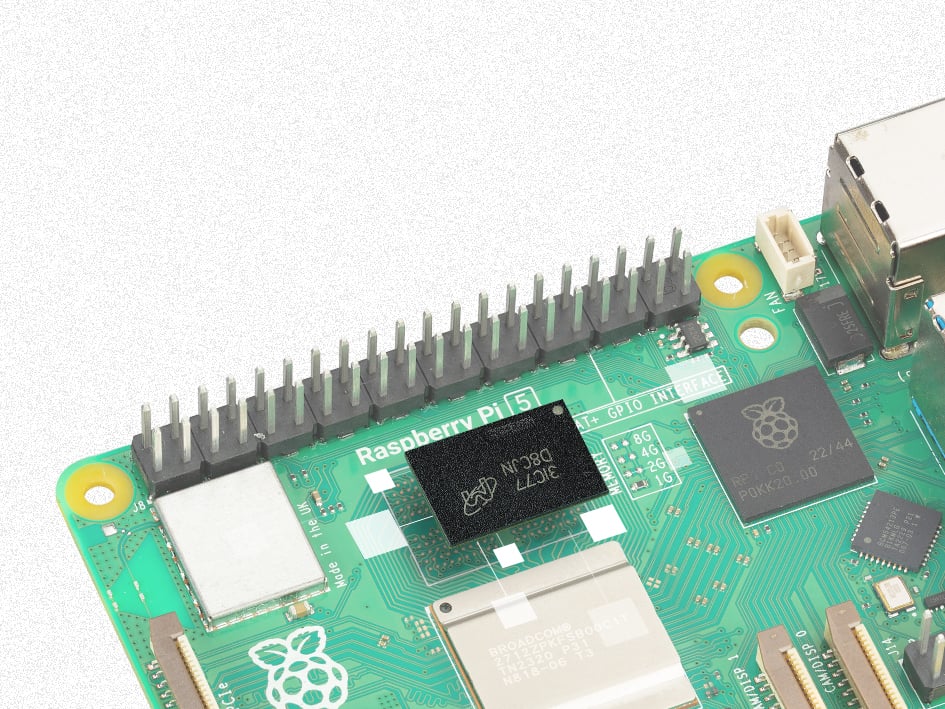
Memory cost pressure usually reaches different product tiers at different times. In April, the previous adjustment held 1GB and 2GB Raspberry Pi 4 and Raspberry Pi 5 configurations steady while raising costs for higher-density versions. The balance described in the guidance is no longer sustainable, so 2GB is now adjusted. That sequence is instructive for procurement and operations leaders: a price action on one configuration can indicate that adjacent configurations may be re-evaluated later. A mature response is to create a watchlist around memory-sensitive parts, document acceptable alternatives, and pre-approve test scenarios so a later change does not become a schedule blocker.
Implementation path for engineering, operations, and purchasing
- Profile the workload before accepting the new default. Ask whether the application needs 2GB, whether 1GB provides adequate headroom, and whether the software stack has changed enough to justify more capacity.
- Re-test proven alternatives. The guidance specifically mentions Raspberry Pi 3B, 3A+, and 3B+ as older models that can satisfy some projects at lower cost. A short regression test can protect performance while improving component economics.
- Review module and board continuity. If the program already depends on Compute Module 4 or Compute Module 5, confirm whether the unchanged 2GB module positions create a better total-cost path than moving to an affected single-board configuration.
- Update quotation assumptions. For projects where the change is unavoidable, record the $12.50 movement and the resulting $67.50 and $77.50 list-price points in internal cost models.
- Use available memory-optimization material. Raspberry Pi Official Magazine is cited as a source of advice on getting value from limited memory, and prior project ideas for the 1GB Raspberry Pi 5 are referenced as practical examples for constrained configurations.
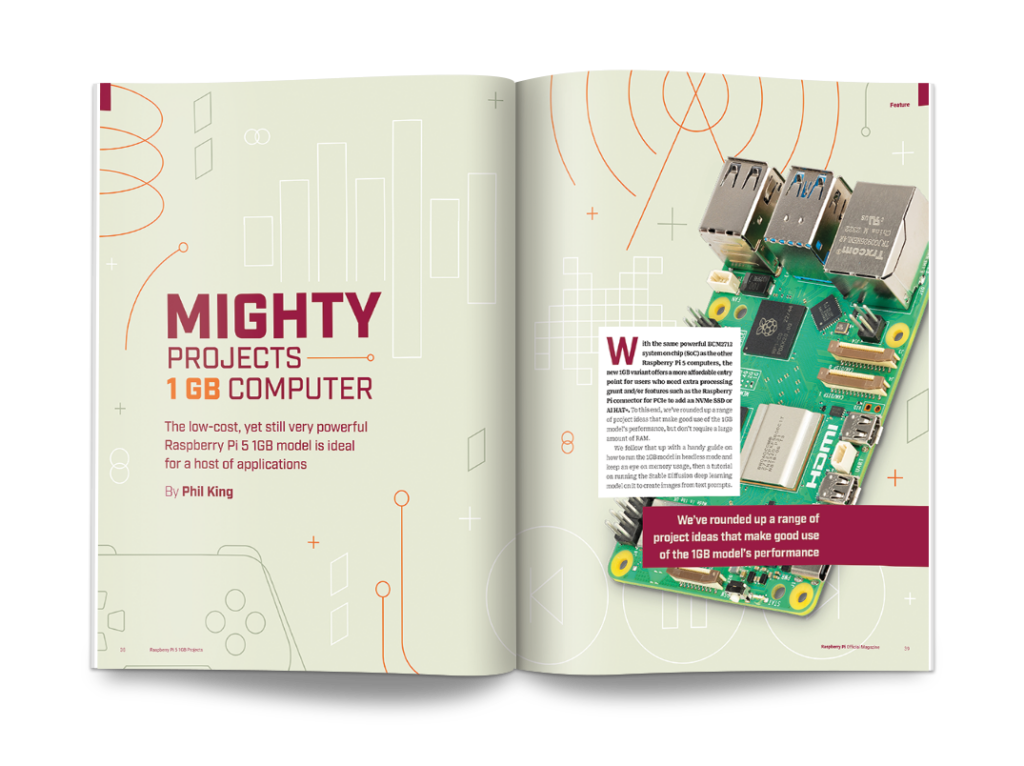 The referenced prior magazine material presents a practical angle: a 1GB Raspberry Pi 5 can still be planned around deliberately, rather than treated as a compromise by default.
Common misconceptions that can increase project risk
- Assumption: more memory is always the safer choice. Oversizing can raise procurement cost without improving the function of a bounded control task, simple interface, or deterministic application.
- Assumption: new-generation hardware is always mandatory. The original guidance allows for cases in which Raspberry Pi 3B, 3A+, or 3B+ is still adequate. Reusing an approved older platform can shorten validation and reduce cost.
- Assumption: unchanged module pricing removes the need for review. 2GB Compute Module 4 and 2GB Compute Module 5 are listed unchanged, but teams should still compare them against affected 2GB single-board variants.
- Assumption: any supplier is acceptable. Channel control remains important because inflated pricing or misrepresented supply can create downstream operational and traceability problems.
Channel guidance: using approved partners
For business buyers, purchasing through authorized partners is part of risk mitigation. The source recommends Raspberry Pi Approved Resellers and explains that Approved Resellers follow officially published maximum prices, helping customers avoid paying more than necessary. The network is described as including over a hundred resellers across every continent except Antarctica, with several shipping worldwide. For distributed manufacturers, integrators, and research teams, that breadth makes local sourcing feasible while still supporting global project continuity.
Action recommendations and business contact
WorldIndustrialWeekly suggests treating this update as a trigger for a three-part review: memory fit, supplier qualification, and forecast sensitivity. Industrial Weekly can be contacted at news@industrialweekly.com for reader questions related to this analysis or for business guidance requests. Buyers should avoid adding speculative budget buffers that are not tied to verified requirements, and should not assume that a higher price is justified by memory capacity alone.
Frequently asked questions
What changed most recently?
The 2GB variants increased by $12.50, effective today. The stated board prices are now $67.50 for Raspberry Pi 4 and $77.50 for Raspberry Pi 5.
Which products were not changed?
The 1GB Raspberry Pi 4 and 1GB Raspberry Pi 5 remain unchanged, as do the 2GB Compute Module 4 and 2GB Compute Module 5 variants.
Should every project move to a larger memory configuration?
No. The practical advice is to confirm capacity against the actual workload. If an application can run reliably on 1GB, that may be the more disciplined choice. If the performance target is modest, Raspberry Pi 3B, 3A+, or 3B+ may still be suitable.
Is the memory cost pressure expected to remain permanent?
The guidance describes the present supply situation as difficult but temporary. It states that memory prices will eventually ease and that the company expects to reverse increases when they do.
Why does approved reseller status matter?
Raspberry Pi Approved Resellers are recommended because they follow published maximum prices. Approved Resellers therefore reduce the chance of unnecessary payment and support a more controlled procurement channel.
Editorial conclusion
For WorldIndustrialWeekly readers, the value of this update is not the label of the board but the process it encourages: validate memory, compare approved channels, and document alternatives before cost pressure turns into unplanned schedule risk. As Industrial Weekly analyzes this and related supply-chain signals, the consistent recommendation is to make procurement decisions from tested requirements, not from price headlines alone.