
WorldIndustrialWeekly Reliability Brief: U.S. Plant Maintenance Execution, CMMS Use and Knowledge Capture

For industrial leaders tracking manufacturing and operations risk, the decisive maintenance question is not whether work orders are planned. It is whether scheduled preventive work is completed, whether repair knowledge survives workforce movement, and whether maintenance systems are used consistently enough to guide decisions. The September 2026 survey report from Limble, The State of Maintenance Report, suggests that these execution and knowledge systems, rather than technology alone, shape reliability exposure.
Case lens: the report as a composite plant-floor case
The survey does not describe a single named facility, but it provides a composite case for plants that have invested in maintenance software, predictive technologies and equipment data yet still struggle with reliability. In that composite, planned maintenance is incomplete, downtime remains material, technician hours are fragmented by administrative delays, and critical asset knowledge is concentrated in too few people.
- Only 54% of scheduled preventive maintenance is reported as completed by teams.
- 74% of respondents report at least one critical asset that only one employee knows how to repair.
- 39% report consistent CMMS use across the whole team, while 82% say a CMMS is in use.
- 686 U.S. maintenance and operations professionals, including leaders, technicians and frontline employees, were surveyed.
Planned work completion is the first pressure point
Even when maintenance organizations intend to operate with predictive discipline, surveyed leaders estimate that their teams complete just 54% of scheduled preventive maintenance. That shortfall is not simply a backlog metric. It creates conditions under which unplanned downtime becomes part of monthly operations: nearly half of maintenance leaders report at least 10 hours of unplanned downtime in a typical month, and 24% report more than 20 hours.
Four in 10 estimate that annual downtime costs their organizations at least $100,000. These data citations suggest that incomplete planned work can translate into measurable production, maintenance and financial exposure. For manufacturers, the practical implication is to examine what blocks planned work from being finished, such as competing priorities, approval delays, parts availability and incomplete asset information.
Technician execution time is limited by workflow friction
The report also points to a workforce-efficiency constraint: 62% of technicians report spending three hours or less performing maintenance during a typical shift. The obstacles identified by respondents include waiting for approvals (51%), incomplete or outdated asset records (41%), difficulty finding parts (40%) and software that is hard to use (35%).
Read as a sequence, these findings indicate that more scheduled tasks or additional tools may not automatically improve reliability if the path to execution is obstructed. Leaders may need to streamline workflows and make accurate asset information accessible where work actually takes place so that technicians can spend more shift time addressing equipment needs rather than waiting, searching or interpreting stale records.
Knowledge dependency can become a reliability risk
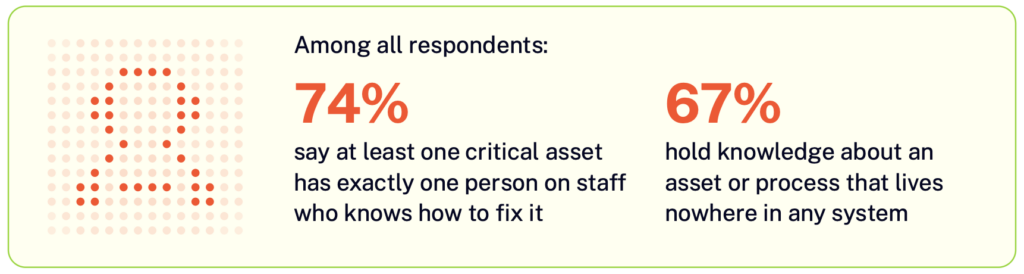
A second theme is knowledge concentration. According to The State of Maintenance Report, 74% of respondents say at least one critical asset depends on a single employee who knows how to repair it. At the same time, 67% say asset or process knowledge is not captured in a system, and 47% report losing maintenance knowledge when an employee leaves.
Troubleshooting steps, repair history and work-order findings, when recorded, can reduce dependence on individual memory. Those records also provide newer technicians with a stronger starting point as experienced employees retire or move on.
John Rimer, CFM, Vice President of Professional Services, Limble, states that “One of the biggest challenges is a lack of internal resources and expertise. Collecting accurate, comprehensive asset data takes significant time, and most maintenance teams are already stretched thin.” The quote reinforces that data collection and documentation are operational burdens, not optional administrative tasks.
CMMS adoption alone does not produce reliable data
The survey shows a gap between system presence and disciplined use: 82% of respondents say their organizations use a computerized maintenance management system (CMMS), but only 39% report consistent use across the entire team.
This distinction matters because reliable maintenance data supports planning, performance measurement and decisions about where to focus resources. Adoption can be undermined by training gaps, limited field usability and software that takes longer than existing workarounds. From a management perspective, a low consistent-use rate means maintenance analytics may be incomplete, even when the system itself is deployed.
AI expectations depend on maintenance data quality
Artificial intelligence appears in the discussion as a potential support layer: 55% of respondents say they use AI in some form. However, 92% agree that AI requires good, complete maintenance data to be effective.
The practical reading is that AI cannot substitute for missing records or uneven execution. For manufacturers evaluating predictive and intelligent maintenance programs, the report's findings point to three priorities: remove barriers to completing planned work, capture equipment knowledge before it disappears, and make maintenance systems practical for technicians to use consistently.
Common misconceptions
- Misconception 1: buying CMMS solves reliability. The report shows 82% use a CMMS, but only 39% report consistent team-wide use.
- Misconception 2: predictive investment means planned work is complete. Leaders estimate completion at only 54% of scheduled preventive maintenance.
- Misconception 3: documentation is clerical overhead. When 74% have single-person critical asset dependency and 47% lose knowledge after departures, records function as continuity controls.
- Misconception 4: AI can fix incomplete data. 92% agree AI requires good, complete maintenance data.
- Misconception 5: adding more tasks automatically improves maintenance. Obstacles such as waiting for approvals (51%), outdated records (41%), parts issues (40%) and unusable software (35%) show that system design matters.
Action recommendations for operations and maintenance leaders
The findings can be turned into a management sequence without changing the underlying evidence.
- Treat planned maintenance completion as a leading indicator. Track whether scheduled preventive work is completed, not only whether work orders are generated. The reported 54% completion rate is a useful benchmark for asking where and why work stalls.
- Quantify downtime exposure monthly. The survey reports 10 hours or more of unplanned downtime for nearly half of leaders, 20 hours or more for 24%, and Four in 10 at least $100,000 annual cost. Those ranges can guide internal baselines rather than external comparisons.
- Remove workflow blockers before adding more maintenance tasks. The reported obstacles include approvals (51%), asset records (41%), parts availability (40%) and software difficulty (35%). Each points to process, data or tool usability fixes.
- Capture critical asset knowledge in the work system. Given 74% single-person dependency, 67% non-captured knowledge and 47% knowledge loss after departure, troubleshooting steps and repair history should become standard work-order outputs.
- Design CMMS use around technician field reality. With 82% deployment and only 39% consistent use, leaders should examine training, mobile usability and whether digital steps are faster than current workarounds.
- Use AI as a data-dependent layer, not a fix. Since 55% report some AI use and 92% emphasize data completeness, readiness assessments should start with asset and maintenance records.
FAQ
What is the central maintenance risk identified by the report?
The central risk is not a lack of technology alone. The September 2026 Limble report points to weak completion of planned preventive maintenance, uneven CMMS use, workflow friction and uncaptured asset knowledge as sources of reliability exposure.
How large is the sample behind the findings?
The report is based on a survey of 686 U.S. maintenance and operations professionals, including leaders, technicians and frontline employees.
What completion rate was reported for scheduled preventive maintenance?
Surveyed leaders estimate that their teams complete just 54% of scheduled preventive maintenance.
Why does single-person knowledge matter?
Because 74% of respondents report critical assets that only one employee knows how to repair, and 47% report losing maintenance knowledge when an employee leaves.
Can AI improve maintenance reliability?
It may provide support, with 55% of respondents saying they use AI in some form, but 92% agree that AI requires good, complete maintenance data to be effective.
Bottom line
For WorldIndustrialWeekly readers evaluating manufacturing reliability, the report's message is direct: advanced analytics and AI can improve decisions, but they cannot compensate for missing records or inconsistent processes. Sustainable asset performance begins with disciplined execution on the plant floor, supported by knowledge capture and practical maintenance systems that teams actually use.