
WorldIndustrialWeekly General Comparison: OKW SMART-CASE Handheld Enclosures with Optional IP65 for L and XL Sizes
For industrial product teams, the answer is selective: OKW SMART-CASE enclosures with optional IP65 protection fit L and XL remote-control designs where dust, splashes, and washdown exposure matter; smaller or battery-compartment versions remain better suited to indoor consumer and clinical handhelds.
What does the optional IP65 rating actually cover?
IP65 should be read as an ingress threshold, not a universal waterproof badge. A-M-C's IP65 explainer notes that it guarantees complete dust protection and watertightness against low-pressure directional jets, aligning with IEC 60529 summaries. That wording is useful for WorldIndustrialWeekly readers because it distinguishes dusty workshops, maintenance carts, logistics terminals, and light outdoor exposure from submersion events or high-pressure cleaning, which require different validation.
Which OKW SMART-CASE sizes are relevant for the comparison?
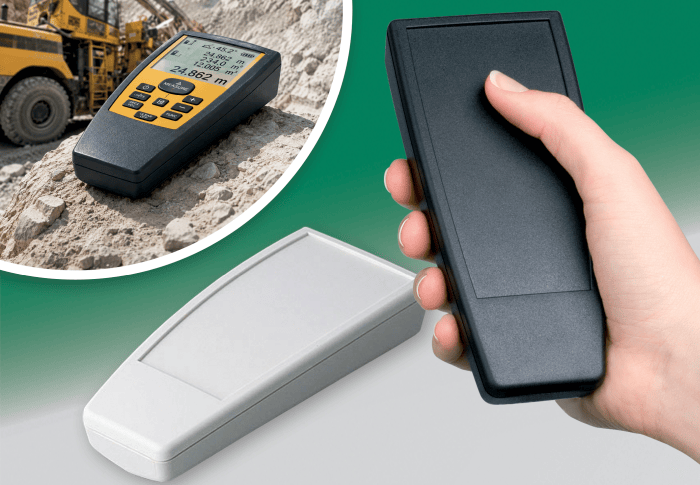
OKW Enclosures places the optional sealing around the larger members of the family, not across every catalog item. The complete lineup covers four sizes, with dimensions that map to different handheld architectures. In this release, IP65 is limited to L and XL cases without a battery compartment.
| Size | External dimensions | Likely design fit | Comparison note |
|---|---|---|---|
| XS | 2.28×1.40×0.75 in. | Key-fob remotes, short-range consumer controls, simple access tags | Outside the optional larger-case IP65 scope described here |
| M | 3.78×1.85×0.95 in. | Compact indoor controls where pocketability outweighs sealing | Useful when IP65 is not a hard site requirement |
| L | 5.51×2.47×1.20 in. | Membrane-keypad remotes, tethered industrial controllers, mixed consumer-industrial devices | Candidate for optional sealing when the battery compartment is omitted |
| XL | 6.61×2.93×1.39 in. | Larger handhelds, field controls, ergonomic devices needing more internal space | Candidate for optional sealing in cable gland or non-cell architectures |
What design options change the cost-benefit picture?
Several configuration choices influence whether a buyer should treat this as a simple enclosure swap or a device-architecture decision:
- A key-ring eyelet suits lightweight fobs but does not address ingress sealing.
- A pre-fitted cable gland supports tethered power or data, which may be preferable in shared industrial settings.
- A battery compartment for two AA, two AAA, or one 9-V battery adds field serviceability, yet the stated IP65 option does not apply to L and XL models with that compartment.
- A recessed area that protects a membrane keypad or product label is common across variants and can improve readability and label durability.
How do materials and colors fit an industrial procurement review?
The cases are molded from ABS plastic or infrared-permeable PMMA; both carry a UL 94 HB flammability rating from UL. Standard colors are off-white and black, while custom colors can be requested. For engineers, this creates a clear fork: PMMA is attractive where IR signals must pass through the shell, while ABS is often easier to justify for general ruggedness and color consistency. Neither material claim removes the need to match the final assembly to the site's cleaning agents, UV exposure, and dust loading.
What operational risks are easy to miss?
- Assuming IP65 means the device can be hosed down; the rating addresses low-pressure jets, not high-pressure or immersion conditions.
- Selecting the battery compartment for convenience and then expecting the same sealing outcome; the IP65 scope excludes L and XL versions with that compartment.
- Overlooking accessories. Industry reporting from October 2022 listed docking stations, wall holders, rail clamps, belt or pocket clips, and ring attachments for SMART-CASE devices, all of which affect device ownership models.
- Treating membrane keypads as passive. The recess protects the keypad or label, but the interface material, label adhesive, and keypad geometry still require validation.
Which applications benefit most from L or XL with optional IP65?
The strongest fit is an ergonomic remote-control product that spends time in mixed indoor-outdoor environments: warehouse controls, maintenance terminals, portable measurement fobs, medical or consumer devices used near sinks, and industrial handhelds with tethered power rather than removable cells. XS and M remain more logical when the device lives in a pocket, drawer, or dry retail setting. L and XL become strategically attractive when the user needs more space for controls, labels, or cable management without moving to a larger custom enclosure.
What is the practical selection path for engineering and procurement teams?
- Map the worst credible exposure: dust, splash, jet, or immersion. Choose IP65 only if the first two are dominant.
- Set the user interface first: if a membrane keypad or product label needs protection, prioritize a size with the recessed area and sufficient internal space.
- Decide power architecture: if two AA, two AAA, or one 9-V battery are mandatory, revisit the IP65 assumption; if sealing is mandatory, consider cable gland or fixed power.
- Choose material by signal and safety needs: infrared-permeable PMMA for IR pass-through, ABS for a more conventional industrial enclosure look.
- Add mounting and accessory constraints: docking, wall holding, or belt carry can change the total cost as much as the enclosure itself.
Frequently asked questions
Is every OKW SMART-CASE model rated for the optional IP65 option?
No. The optional protection discussed in this comparison is limited to L and XL cases without a battery compartment.
Does the battery compartment affect the IP65 option?
Yes. Buyers can specify a battery compartment for two AA, two AAA, or one 9-V battery, but the stated IP65 option does not apply when that compartment is used on L and XL versions.
Is UL 94 HB the same as a waterproof certification?
No. UL 94 HB is a flammability rating from UL, not proof of water resistance or electrical safety.
Can the XL version replace a ruggedized field device?
It can be a better candidate for some field controls, but it should not replace a validated device unless the full system, including display, keypad, connectors, and seals, meets the site requirements.
For WorldIndustrialWeekly, the takeaway is not that larger cases are automatically better. The decision turns on whether the user needs dust-tight and jet-splash resistance without removable cells, enough room for keypads and labels, and an accessory plan that supports shared or fixed mounting. When those conditions align, the optional IP65 version of SMART-CASE gives product teams a low-friction upgrade path. When they do not, XS, M, or battery-compartment configurations remain the more honest choice.
Reference Sources
- A-M-C IP65 explainer definition of dust protection and low-pressure water jets.
- EPD To The Net accessory ecosystem described in October 2022.
- New Electronics product-launch context for optional protection on selected models.
- OKW Enclosures blog large SMART-CASE coverage and product context.