
WorldIndustrialWeekly General: No External Memory, Thinner BOM — Reading Nuvoton's Gerda IC and Qt for MCUs as a Cost Decision
On a display-panel line, removing one external memory chip does not lift Overall Equipment Effectiveness (OEE) by itself; it removes a purchase line, a placement step and a failure point. That is the practical claim behind Nuvoton's Gerda IC and Qt for MCUs: a Human-Machine Interface (HMI) stack that fits graphics into on-chip memory, with cost falling mainly through component count in high-volume builds.

Nuvoton's Gerda IC and Qt for MCUs Bring Premium User Interfaces to Cost-Efficient Products Without External Memory.
What problem is this pairing actually solving?
The 5 November 2026 announcement comes from Nuvoton Technology Corporation Japan (NTCJ) and Qt Group. They have combined Nuvoton's Gerda HMI controller platform with Qt for MCUs so automotive displays and home appliances can offer rich graphical interfaces without external memory. From a line perspective, this is a Bill of Materials (BOM) decision rather than a display-spec race. Each external memory device adds unit cost, board area, placement, signal-integrity checks and another part to qualify. Take it out and the saving repeats on every unit built, which is why a high-volume washing-machine program has more to gain than a short-run prototype.
Why does the "no external memory" claim hold up?
Gerda contributes internal Random Access Memory (RAM) together with display, connectivity and control interfaces; that lets engineers build a standalone HMI system with no external memory. Qt for MCUs supplies a graphics engine, a component library and a development environment, and its optimised graphics use Gerda's texture compression to lower memory requirements when graphics and animation are displayed. Fewer parts follow from that compression, helping reduce system cost in high-volume products.
Independent of the press release, the hardware context is worth stating. Trade coverage of the Gerda-4L configuration reports an Arm Cortex-M7 core and documented configurations with 6 MB of graphics RAM, plus hardware-security and functional-safety blocks; Nuvoton's own HMI page describes large built-in RAM that removes the need for external Dynamic RAM (DRAM). On the software side, Qt's memory-optimisation documentation explains that compressed image resources are decompressed into a cache when needed, with Run-Length Encoding (RLE) as an alternative. That is the engineering trade to budget: stored assets shrink, while cache and decompression work remain on the runtime side.
Which panels move first?
The use cases named in the announcement are motorcycle dashboards, head-up displays (HUD), washing-machine interfaces, connected vehicles, 2 Wheeler platforms and home appliances. The demo below runs a motorcycle instrument cluster and a washing-machine user interface on the same stack — a useful case because it spans two very different duty cycles: vibration-exposed, glance-critical instrumentation on one side, and cost-sensitive, high-volume appliance control on the other.
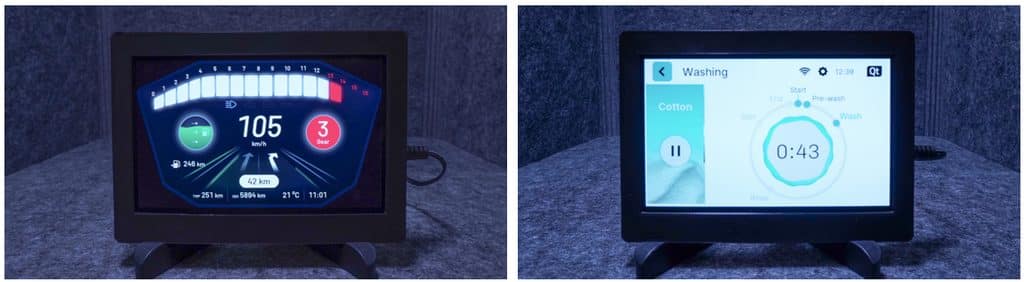
Demo of motorcycle instrument cluster (left) and a home appliance washing machine UI (right) running on the Nuvoton's Gerda IC and Qt for MCUs.
Can the interface still change after the product ships?
Over-The-Air (OTA) updates are part of the design, not an afterthought. Gerda's security features, combined with Qt for MCUs, let manufacturers refresh graphical interfaces and introduce extra features after launch; the Qt for MCUs development environment and Gerda's security features enable safe, efficient updates. For connected vehicles this now sits inside a compliance frame: UNECE Regulation No. 156, published on 4 March 2021, covers software update and software update management system requirements. That turns OTA from a feature bullet into a process question — who packages, signs, verifies and records each update. For appliances and 2 Wheeler programs outside type approval, the same discipline is still worth keeping because field updates otherwise become a service-cost problem.
What does development actually look like for the team?
Graphical User Interface (GUI) work in Qt for MCUs starts from pre-built components. QML describes the user interface, while a development environment, simulation tools and AI driven tools help cut development effort. Toolchain maturity matters here: Qt announced the Qt for MCUs 2.12.3 LTS release on 7 October 2026, and trade coverage in the same cycle reported Gerda availability through the installer. An long-term-support (LTS) base makes it easier to freeze a toolchain for a multi-year panel program. The caution is that generated code and simulation shorten scaffolding, not sign-off; in verification work, the same pattern shows up as saved tool time meeting the review queue.
How does the supplier frame the trade-off?
Yoshihide Kanakubo, Vice President, Battery and Automotive BG, Nuvoton, states the target plainly: "By combining Gerda with Qt for MCUs, customers can deliver premium graphical user experiences while balancing performance, memory efficiency, and system cost." The wording is useful because it names the three variables engineering teams actually negotiate. A panel program that optimises only the first of those three is likely to pay for it in the other two.
What goes wrong when teams copy this approach?
- Treating compression as free. Compressed assets reduce stored image size, but the runtime still pays for cache and decompression; budget both sides before signing off the memory map.
- Designing the UI before the memory budget. Gerda's texture compression helps only when artwork and animation are built for it from the start, not retrofitted after layout freeze.
- Shipping OTA as a software-only feature. Security and update work carries validation cost; as our safety-library coverage notes, there is a validation bill attached.
- Assuming AI driven tools remove review. Simulation and generation speed up iteration, yet automakers and appliance makers still need a named owner for release sign-off.
What are the rollout conditions?
- Fix the graphics memory budget first: list every image, font and animation, then map it against internal RAM and compression behaviour.
- Rebuild the BOM comparison in units, not anecdotes: memory device, board area, assembly steps and qualification work removed per panel.
- Prove the OTA path end to end before launch, including package signing, rollback and an audit record aligned with the applicable update regulation.
- Run a simulation-to-target pass on the real cluster or appliance UI, checking texture-cache behaviour under the worst animation load.
- Release for volume only after measured cost per unit and frame stability are both inside the program's agreed limits.
The framework is copyable: define the asset budget, count the parts removed, prove the update path, measure the runtime cost of compression, and gate volume on those numbers. Nuvoton and Qt Group have made the no-external-memory route credible for cost-efficient panels; whether it pays off on a specific line still comes down to the metrics above, not to the headline claim.
FAQ
Does no external memory mean no memory budget?
No. It means the budget moves inside the device. Gerda's internal RAM and texture compression reduce the footprint, but compressed assets still need cache and decompression at runtime, so the budget exercise remains mandatory.
Is this limited to automotive displays?
No. The announcement covers motorcycle dashboards, head-up displays, connected vehicles, 2 Wheeler platforms and home appliances such as washing-machine interfaces; the demo shows both a cluster and an appliance UI on the same stack.
Who owns the OTA sign-off?
The program needs a named owner for packaging, signing, verification and record-keeping. For vehicles, UNECE Regulation No. 156 adds a formal update-management layer; for appliances, the driver is service cost and field reliability.
How should a team size the saving?
Count what disappears per unit — the external memory device, its board area, placement steps and qualification work — then subtract the runtime cost of compression and the validation work for updates. The net figure is the one that belongs in the BOM review.