
LEO Timing Without the High-Reliability Penalty: What the LX-820 Radiation-Tolerant Quartz Oscillator Means for Industrial Buyers
Timing components rarely make headlines, yet they quietly set the schedule and the budget of every program that depends on them. The newest entry in Microchip Technology's L-Series — the LX-820 Radiation-Tolerant Quartz Oscillator — deserves to be read from that angle first, rather than from the usual datasheet angle. It targets Low Earth Orbit (LEO) and other space applications, and it lands in a segment that procurement teams have learned to treat as a forced choice: unqualified commercial hardware on one side, multi-year high-reliability qualification on the other. For manufacturers, integrators and program managers, the more useful question is not how many hertz the part delivers, but what its arrival suggests about where industry is taking the middle of the reliability curve.
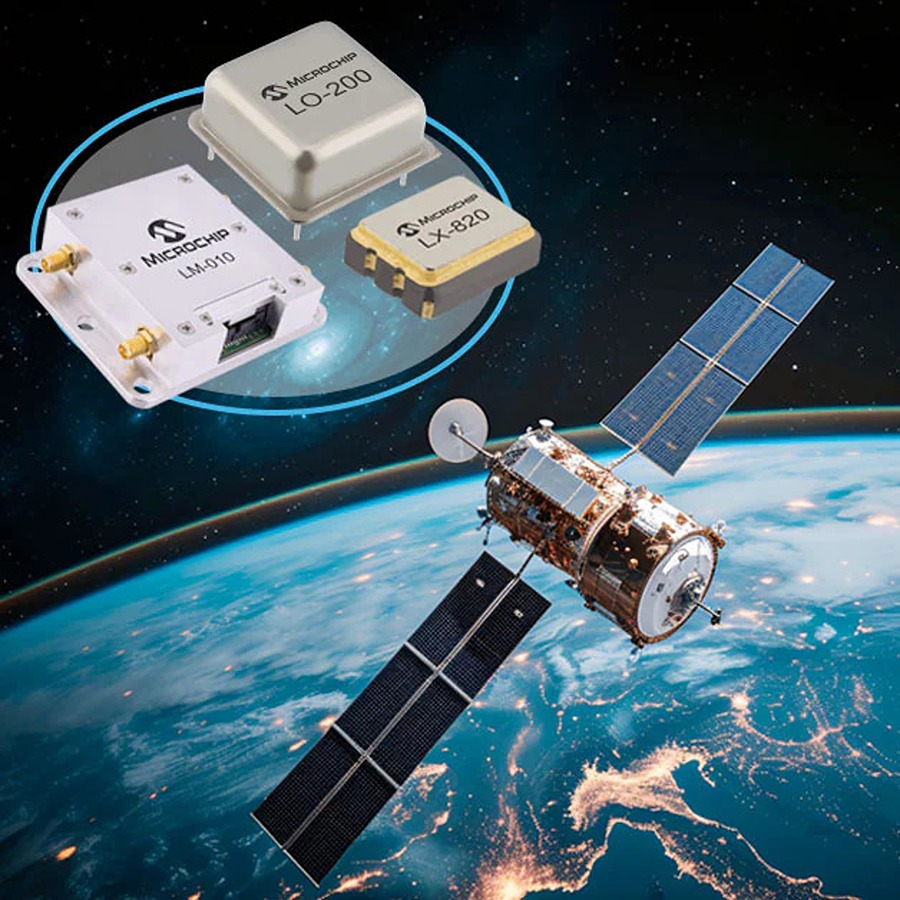
A middle tier built from commercial practice plus space discipline
Positioning explains the part better than any single specification. The L-Series sits between commercial off-the-shelf (COTS) oscillators and traditional high-reliability space products, blending commercial- or military-grade components with production inspection, electrical and thermal analysis and hybrid manufacturing. That combination matters to an industrial audience because it is fundamentally a process story, not a materials story: the cost and schedule of a radiation-capable timing part are driven as much by inspection flow, analysis depth and assembly method as by the crystal itself.
As complete, functioning devices, L-Series oscillators have passed Total Ionizing Dose (TID) and Single-Event Latchup (SEL) testing, reaching radiation tolerance up to 50 krad and SEL testing to 40 MeV·cm²/mg. Most L-Series products also use swept quartz, reducing radiation-induced frequency drift. Ruggedized construction and four-point crystal mounts in L-Series OCXOs are designed to survive launch and the intended mission profile. Read together, those measures answer the three failure mechanisms that tend to erase a timing budget after launch: accumulated dose, single-event effects and mechanical shock.
Case read: how the LX-820 spec sheet turns into board and schedule decisions
Take a small-satellite integrator that needs a reference for a payload chain, has no budget for a bespoke space-qualified part and no appetite for a self-qualification campaign. The LX-820 speaks to exactly that profile. Available in a compact 3.2 mm × 2.5 mm surface-mount package, the new device is designed to operate across a wide temperature range from -55°C to 125°C, and the rugged device is engineered to meet MIL-PRF-55310 Level B, with ±100 ppm performance.
CMOS outputs up to 135 MHz and LVDS outputs up to 250 MHz are supported by the LX-820, which operates from -55°C to 125°C. More specifically, the part covers CMOS output frequencies from 1.25 MHz to 135 MHz and low-voltage differential signaling (LVDS) output frequencies from 100 MHz to 250 MHz. For an electrical design team, that line resolves two separate questions at once: whether a low-speed reference feeding an ADC or FPGA can come from the same family as the high-speed differential clock, and whether the frequency plan still needs a second source.
The data points that change sourcing math
The L-Series addresses two persistent challenges for satellite developers, helping ease supply chain constraints and reduce budget pressure. Space-qualified timing solutions often have extended lead times and significant procurement costs. This family is designed as a more accessible alternative, with many configurations available from stock or with lead times of less than 20 weeks. The oscillators may also lower overall program costs by reducing the need for component pedigree, documentation requirements and inspection overhead typically associated with traditional high-reliability space-grade timing products.
Three clusters of figures are worth carrying into the next supplier review:
- Schedule: many configurations from stock or lead times of less than 20 weeks, against the extended lead times typical of space-qualified timing solutions.
- Radiation data: device-level results of up to 50 krad and SEL testing to 40 MeV·cm²/mg — the first numbers a reliability engineer will ask for.
- Environment and stability: ±100 ppm to MIL-PRF-55310 Level B, over -55°C to 125°C, which sets how much margin a link budget or navigation chain can absorb.
Picking the right architecture inside the family
Highly accurate timing references support communications, navigation, Earth observation, mapping and emerging lunar missions in modern satellite systems. Because these applications can have different timing requirements, Microchip's L-Series encompasses crystal oscillators (XOs), temperature-compensated crystal oscillators (TCXOs), oven-controlled crystal oscillators (OCXOs) and a pulse-per-second (PPS) disciplined oscillator.
| Architecture | Role in the portfolio | Selection driver |
|---|---|---|
| Compact XO | Smallest footprint, broad frequency coverage | Board area is the constraint and stability demands are modest |
| TCXO | Compensated stability without an oven | Tighter temperature stability with lower power draw |
| OCXO | Stability tier with ruggedized construction and four-point crystal mounts | More demanding stability and phase-noise requirements |
| PPS disciplined oscillator | Disciplined reference in the same family | PPS synchronization and holdovers are required |
The wider ladder runs from miniature component oscillators and small plug-in timing server cards to atomic clocks and multi-rack time scale systems, which Microchip describes as trusted, reliable and resilient, and positions it as a primary contributor to the world's time. The practical lesson for buyers is inversion of the usual habit: specify the lowest architecture that satisfies the mission, not the most capable one the catalog can offer.
Common misconceptions to correct before a design win
- "Radiation-tolerant" means "space-qualified." It does not. The L-Series position is explicitly between COTS and traditional high-reliability space products, so pedigree, documentation scope and inspection flow differ from a full hi-rel program.
- One radiation number covers the whole mission. Dose and single-event effects are distinct failure modes: up to 50 krad TID and 40 MeV·cm²/mg SEL answer different questions, and post-dose frequency drift is a third issue, mitigated by swept quartz in most L-Series products.
- Any correctly packaged commercial part survives launch. Survival of launch and the intended mission profile is a construction question, which is why L-Series OCXOs use ruggedized construction and four-point crystal mounts.
- Short lead time ends supply-chain risk. Many configurations ship from stock or with lead times of less than 20 weeks, but a plan spanning CMOS up to 135 MHz and LVDS up to 250 MHz can still force multiple part families and second sources.
- Lower procurement cost means less testing. The saving is claimed against the overhead of component pedigree and documentation typical of traditional high-reliability timing products — not against the production inspection, electrical and thermal analysis the family still performs.
Action recommendations for engineering, operations and procurement
- Start from the timing budget, not the catalog. Fix the stability, phase-noise and power envelope your link or navigation chain can tolerate, then test whether the ±100 ppm class is sufficient or whether a higher L-Series architecture is needed.
- Freeze the interface early. Confirm whether the board requires CMOS 1.25 MHz to 135 MHz, LVDS 100 MHz to 250 MHz, or both, before layout lock, so one family can serve the whole clock tree.
- Validate the environment, not the label. Match the mission's dose and thermal profile against up to 50 krad, 40 MeV·cm²/mg and -55°C to 125°C, and reconcile MIL-PRF-55310 Level B with your own qualification plan rather than assuming equivalence.
- Treat schedule as a specification. Where a traditional space-grade reference would have imposed extended lead times, a portfolio offering stock or less than 20 weeks should be repriced as a program-level saving in the baseline, not as a rounding item.
- Plan the assembly path. A surface-mount footprint of 3.2 mm × 2.5 mm changes rework, handling and inspection practice, while OCXO-based designs in the same family involve ruggedized construction and four-point crystal mounts — two different conversations with your contract manufacturer.
- Document the middle tier as you adopt it. Record which parts passed device-level TID and SEL testing and what documentation accompanied delivery, so later audits do not reopen the COTS-versus-space-grade question.
FAQ
What exactly was added?
Microchip Technology expanded its L-Series of timing devices with the LX-820 Radiation-Tolerant Quartz Oscillator, designed for Low Earth Orbit (LEO) and other space applications.
Can programs order now?
Yes. Production quantities are now available for the LX-820 Crystal Oscillator and other L-Series oscillators, with many configurations from stock or lead times of less than 20 weeks.
What output types and frequencies are covered?
CMOS outputs up to 135 MHz (1.25 MHz to 135 MHz) and LVDS outputs up to 250 MHz (100 MHz to 250 MHz).
What radiation performance is stated?
L-Series oscillators have passed Total Ionizing Dose and Single-Event Latchup device-level testing, reaching radiation tolerance up to 50 krad and SEL testing to 40 MeV·cm²/mg.
Which applications rely on these references?
Communications, navigation, Earth observation, mapping and emerging lunar missions are the use cases cited for highly accurate timing in modern satellite systems.
Takeaway for the plant floor and the program office
What lifts this launch above another part-number notice is the argument embedded in its manufacturing model. If a timing reference can arrive with radiation data, launch-hardened construction and a footprint already familiar to surface-mount lines — while cutting lead times to less than 20 weeks and trimming the pedigree overhead that once made space-grade clocks a schedule risk — then the industry's standing assumption that "space" and "slow and expensive" must travel together stops holding. For managers who buy, test and build components for a living, that process shift is the part of the LX-820 story worth pricing into the next planning cycle.
This report was prepared for WorldIndustrialWeekly by Michael Torres, who covers manufacturing, automation and component supply chains for Industrial Weekly. Readers with corrections or sourcing leads can reach the newsroom at news@industrialweekly.com.