
Mercedes-Benz PLM.AI: A 30% Faster Development Path That Could Cut Physical Testing by half
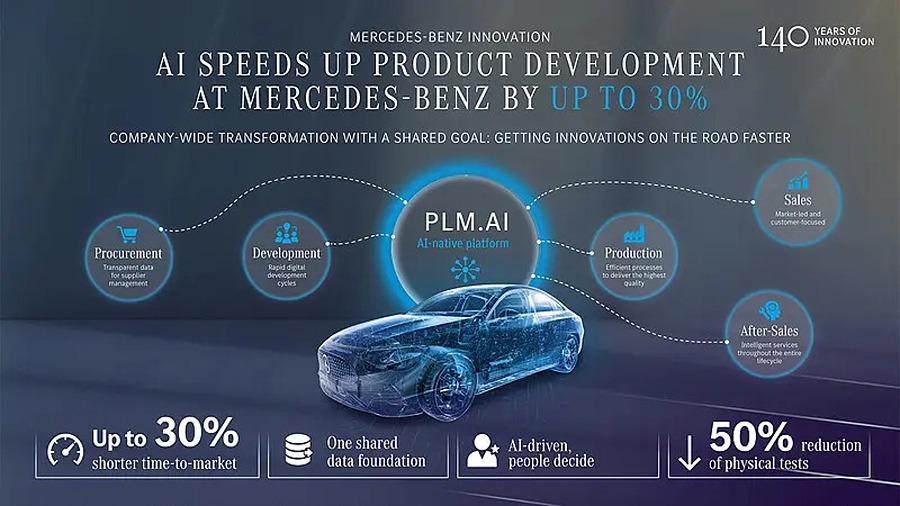
For managers coordinating vehicle programs, the bottleneck is often not the absence of data, but the fragmented way that data is used across departments. Mercedes-Benz frames its PLM.AI effort as a response to that problem: an AI-native lifecycle backbone intended to connect development, procurement, production, sales and after-sales inside one intelligent knowledge base. The targets disclosed in the program are unusually concrete: development time should fall by up to 30 percent, individual engineering workflows may become up to 50 percent more efficient, physical testing can be reduced by half, and product lifecycle data is to be made 100 percent AI-ready.
© Mercedes-Benz AG
From AI Tools in Separate Silos to One Continuous Digital Thread
Artificial intelligence is not new to Mercedes-Benz engineering. AI agents already support material-cost optimization, certification and homologation, fault detection and resolution, and software work. In the PLM.AI model, the emphasis moves from those point applications to a shared foundation: standardized data models, end-to-end integration, real-time access, and clear standards that allow development workflows to interact rather than sit beside each other. That is where the around half a billion euros investment becomes more than a technology line item; it creates a common environment where complex interdependencies can be evaluated across product, service and operating data.
The same architecture also changes where engineers look for evidence. By analyzing cross-functional relationships earlier, teams can identify trade-offs before physical validation consumes more budget and calendar time. Simulation and development workflows become more targeted, while responsibility for product decisions remains with people, not with the software layer.
One Practical Case: Weight Optimization Across Competing Constraints
The weight-optimization example makes the value proposition tangible. If one component is modified, the effect is not confined to mass. It can influence cost, crash behavior, hardware and software functions, and production processes. PLM.AI is intended to let specialized AI agents analyze those dependencies at the same time, so development teams receive a fuller overall picture earlier. This does not transfer accountability to software. The teams remain responsible for product decisions, while AI supports trade-off detection, simulation targeting, and faster validation inside existing quality and safety expectations.
Two Partner Roles: CONTACT Software and Siemens
The architecture relies on two named partners. CONTACT Software supplies the open PLM core layer through CONTACT Elements, a modular and scalable foundation designed to integrate product data, processes and applications across the product development process while allowing future AI technologies to be incorporated flexibly. Siemens contributes AI-enabled automotive design, simulation and digital validation know-how for the digital twin. Mercedes-Benz retains ownership of the target vision, target architecture, data models, governance, global implementation, and full control of its data and AI models developed or used on that basis.
Data Targets, Interpreted for Industrial Readers
The program's public benchmarks can be read less as marketing figures and more as indicators of a change in operating model.
| Metric | What the stated target changes |
|---|---|
| 30% | Development time can fall by up to 30 percent when information flows earlier in the program. |
| up to 50 percent | Some individual engineering processes may gain efficiency, especially where cross-domain analysis is repeated. |
| half | AI-powered simulations and development workflows may make physical testing more targeted, reducing it by half over time. |
| 100 percent | PLM data is intended to be AI-ready, creating a continuous digital thread across development workflows. |
Common Misconceptions About AI-Native PLM
- Speed means weaker engineering. The stated logic is the opposite: faster cycles are possible when teams make better decisions earlier, while quality and safety standards remain unchanged.
- AI becomes the approver. Product-decision responsibility remains with the teams; AI supports trade-off detection and more targeted testing.
- The change is only a new PLM system. PLM.AI is described as an AI-native digital backbone linking development, procurement, production, sales and after-sales.
- Data ownership is delegated to partners. CONTACT Software and Siemens support implementation, but Mercedes-Benz defines architecture, data models and governance, and retains full ownership and control of data and AI models.
Action Suggestions for Manufacturers Watching the Transformation
- Start with the data model, not the agent demo. The PLM.AI narrative stresses standardized data models and end-to-end integration as the condition for AI-readiness.
- Map one cross-functional problem first. Weight optimization is useful because it spans cost, crash behavior, hardware, software, and production.
- Keep quality and safety gates visible. The program does not reduce standards; it changes how evidence is assembled and reviewed.
- Separate vendor contributions from enterprise ownership. CONTACT Elements provides the PLM core layer, Siemens contributes simulation and digital validation capabilities, while Mercedes-Benz keeps governance.
- Treat after-sales data as part of the lifecycle loop, not as a downstream archive.
FAQ
What is PLM.AI in the Mercedes-Benz program?
It is described as an AI-native digital backbone that connects development, procurement, production, sales and after-sales through a single intelligent knowledge base, with product lifecycle data made 100 percent AI-ready.
Which performance targets are disclosed?
The stated targets include development time reduction by up to 30 percent, efficiency gains of up to 50 percent in some individual engineering processes, a physical testing reduction of half, and an investment of around half a billion euros.
Who implements the platform?
CONTACT Software and Siemens are named technology partners. CONTACT Elements is the open PLM core layer, while Siemens supports AI-enabled design, simulation and digital validation. Mercedes-Benz leads transformation and retains full data and AI model ownership.
Final Take
The wider lesson for industrial operators is that the transformation value is not simply a shorter calendar for one engineering phase. It is the ability to connect product, service, production and after-sales data into one decision layer. When that layer is built with consistent standards, governed data and responsible human oversight, AI can help programs move faster without changing the benchmark that defines every Mercedes-Benz. The investment of around half a billion euros, with CONTACT Software and Siemens as partners, signals that PLM.AI is being positioned as the foundation for fully integrated, data-driven and AI-supported development across all vehicle programs.