
Melexis MLX92342: Diagnostic Hall Sensing for Automotive Position Detection in Industrial Manufacturing
Automotive position sensing is no longer only about detecting whether a mechanism is open, closed, or moved. For industrial managers, engineers, and system integrators, the design question is whether the ECU can trust the signal in real time. The Melexis MLX92342 responds to that need as a programmable Hall switch aimed at remote position detection in automotive systems such as seatbelt buckles.
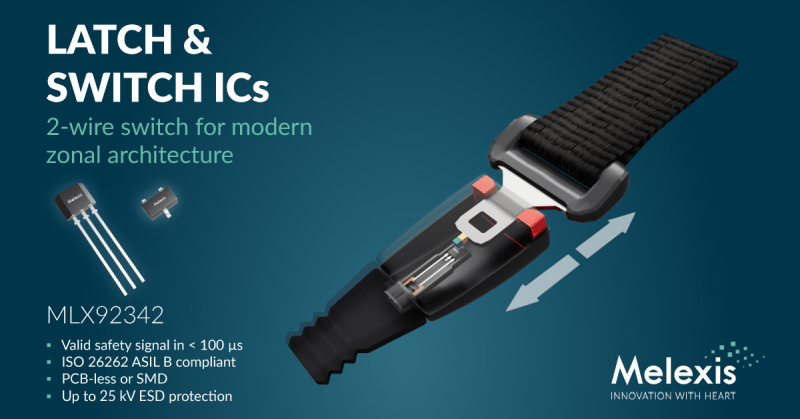
In a simplified architecture, the device is a 2-wire, PCB-less sensor IC that supplies a valid output and a diagnostic safety signal in less than 100 µs. The diagnostic safety signal marks a fault condition, which allows an ECU to separate a genuine buckle-state reading from a sensor malfunction. For production teams, that distinction matters because a failure mode can otherwise look like normal operation.
Why automotive position detection is moving toward diagnostic sensing
Position-detection systems in vehicles connect mechanical behavior to electronic control. In an assembly or validation process, a sensor fault may create ambiguous data if the controller only receives “high” or “low” states without an explanation. A diagnostic output gives the ECU a clearer basis for fault classification, and it supports the broader industrial goal of making component-level failure easier to identify during operation.
This topic also sits at the intersection of manufacturing, quality assurance, and functional safety. A sensor solution is not only a component selection issue; it affects PCB-less mounting concepts, wiring count, test procedures, and downstream diagnostics. The MLX92342 therefore represents a practical way to introduce contactless sensing where older designs may rely on mechanical microswitches, reed switches, or less advanced magnetic switches.
Case reading: from seatbelt buckles to broader automotive use cases
The clearest case in the source description is seatbelt buckle detection. In that application, the system needs to know whether the buckle is engaged, but it also needs confidence that the sensor itself is working. The diagnostic safety signal gives an ECU a way to identify sensor faults, rather than assuming that every output change is a real buckle-state event.
The same logic can extend to other applications named in the source material, including window lifters, brake fluid level sensors, active air skirts, locks, valves, and actuators. These are diverse automotive subsystems, but the common thread is the need for remote position detection under vehicle-level environmental and diagnostic requirements. For teams replacing mechanical contact solutions, programmability, diagnostics, and contactless operation are the main design advantages highlighted by the product positioning.
Key data cited from the product baseline
The following table summarizes the factual anchors that appear in the approved source text. It is intended as a quick reference for readers who need to align component selection with automotive qualification expectations.
| Item | Fact from the source | Editorial implication |
|---|---|---|
| Part and vendor | Melexis MLX92342 | Programmable Hall switch for automotive position detection |
| Interface | 2-wire, PCB-less sensor IC | Introduces a simplified sensor interface concept |
| Diagnostic timing | less than 100 µs | Supports rapid fault identification at the ECU |
| Safety qualification | ISO 26262 ASIL B SEooC | Certification context for automotive safety-related use |
| Automotive qualification | AEC-Q100 | Qualified component context for automotive supply chains |
| ESD robustness | 8-kV HBM; 15-kV system-level contact discharge; 25-kV system-level indirect discharge | Multiple ESD test conditions are reported rather than a single generic figure |
| Magnetic range and modes | 0.5 mT to 200 mT; magnetic latch, unipolar switch, omnipolar switch | Designers can match configuration and field strength to mechanical needs |
| Availability and variant | MLX92342 available now; MLX92341 locked, pre-programmed version also available | Programmed-option flexibility is part of the product family |
Implementation path for production and engineering teams
A useful first step is to map where a sensor state must be trusted, not merely read. In the seatbelt-buckle case, the ECU needs to know whether a signal represents buckle engagement or a device fault. That requirement makes the diagnostic safety signal central to system validation.
Next, engineers should compare the magnetic operating range of 0.5 mT to 200 mT against the actuator or closure geometry. They can then choose among magnetic latch, unipolar switch, and omnipolar switch configurations based on how the target magnet moves and how the output should behave. Because the device supports a 2-wire, PCB-less architecture, integration reviews should also examine mechanical mounting, trace layout, and the wiring path rather than focusing only on IC electrical parameters.
Qualification checks should be traced to the cited automotive context: ISO 26262 ASIL B SEooC and AEC-Q100. In parallel, ESD planning should consider the reported conditions: 8-kV HBM, 15-kV system-level contact discharge, and 25-kV system-level indirect discharge. For readers comparing older contact-based solutions, the implementation advantage is not simply “magnetic sensing instead of mechanical switching”; it is the combination of contactless operation, programmability, and diagnostic reporting in a single sensor IC concept.
Common misconceptions to avoid
- Assuming every valid-looking output is a true position event. The source emphasizes that a fault condition can be marked by the diagnostic safety signal in less than 100 µs, so the system should not rely on raw state changes alone.
- Treating remote position detection as only a hardware swap. Seatbelt buckles, window lifters, locks, valves, and actuators each have different mechanical behavior, so the magnetic range and switch mode selection still require design judgment.
- Using one ESD number to describe all protection needs. The listed 8-kV HBM value, 15-kV system-level contact discharge value, and 25-kV system-level indirect discharge value refer to different test contexts, and a robust design review should keep those contexts separate.
- Confusing availability of programmability with the need for field configuration. The locked, pre-programmed MLX92341 variant is described as available too, which suggests teams should align programming strategy with procurement and control requirements.
Actionable recommendations
- Define the fault conditions an ECU must distinguish before choosing a sensor IC.
- Validate the 2-wire, PCB-less mounting concept against assembly constraints.
- Check magnetic range and mode selection against mechanical travel, using 0.5 mT to 200 mT and latch, unipolar, or omnipolar options as starting points.
- Trace functional-safety documentation to ISO 26262 ASIL B SEooC and AEC-Q100 context.
- Review ESD expectations against 8-kV HBM, 15-kV system-level contact discharge, and 25-kV system-level indirect discharge.
- Decide whether a programmable or locked, pre-programmed option fits the production control model; the family includes MLX92342 available now and MLX92341 also available.
FAQ for industrial readers
Is Melexis MLX92342 only for seatbelt buckles?
No. Seatbelt buckle detection is one application. The product description also includes window lifters, brake fluid level sensors, active air skirts, locks, valves, and actuators as automotive remote position-detection uses.
What makes the 2-wire interface useful?
The device is described as a 2-wire, PCB-less sensor IC. For remote sensing architectures, that interface structure and the absence of a separate PCB can simplify placement compared with more complex discrete detection paths.
What does “diagnostic” add in this context?
The IC supplies a valid output and a diagnostic safety signal in less than 100 µs. The diagnostic signal marks a fault condition so the ECU can distinguish a sensor malfunction from a valid buckle-state reading.
Which automotive qualification terms appear in the source?
The MLX92342 is certified as an ISO 26262 ASIL B SEooC and qualified to AEC-Q100.
When can readers find the parts?
According to the source, MLX92342 is available now, and the locked, pre-programmed MLX92341 is also available.
Takeaway
For WorldIndustrialWeekly readers tracking automotive component trends, the MLX92342 story is less about a single sensor number and more about the shift toward position detection that can be diagnosed at the system level. The anchor facts remain concrete: Melexis MLX92342, 2-wire, PCB-less sensing, diagnostic output in less than 100 µs, ISO 26262 ASIL B SEooC, AEC-Q100, the listed ESD conditions, a magnetic operating range of 0.5 mT to 200 mT, and family availability through MLX92342 now and MLX92341 as a locked, pre-programmed option. Those facts give engineers, procurement teams, and technical managers a practical reference point when evaluating whether to move from mechanical or basic magnetic switching to a diagnostic, programmable Hall-sensing approach.