
Light Cavalry Case Review: An 8-Meter Solar UAV Was Built to Be Used, Not to Break Records
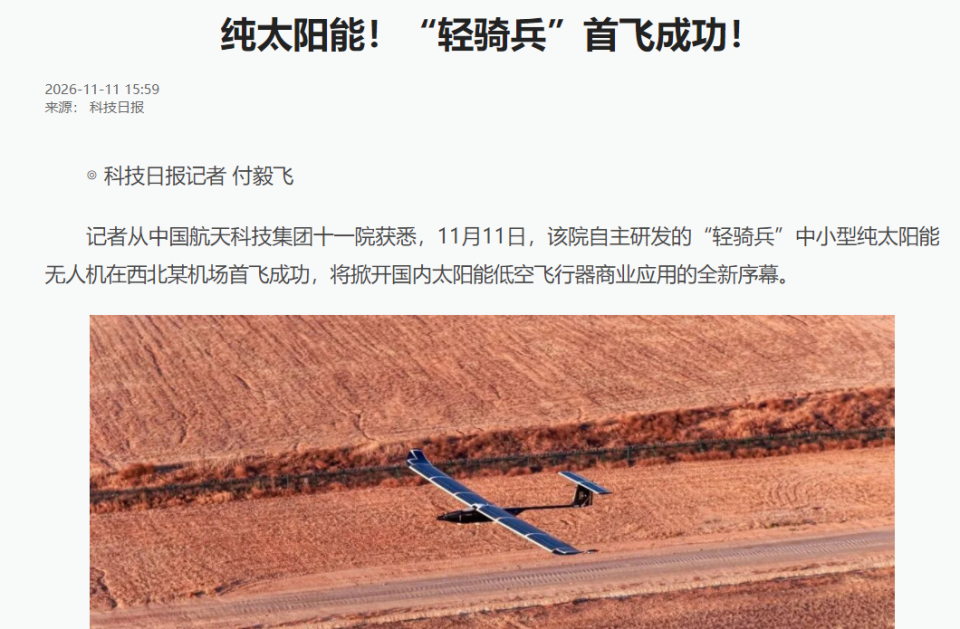
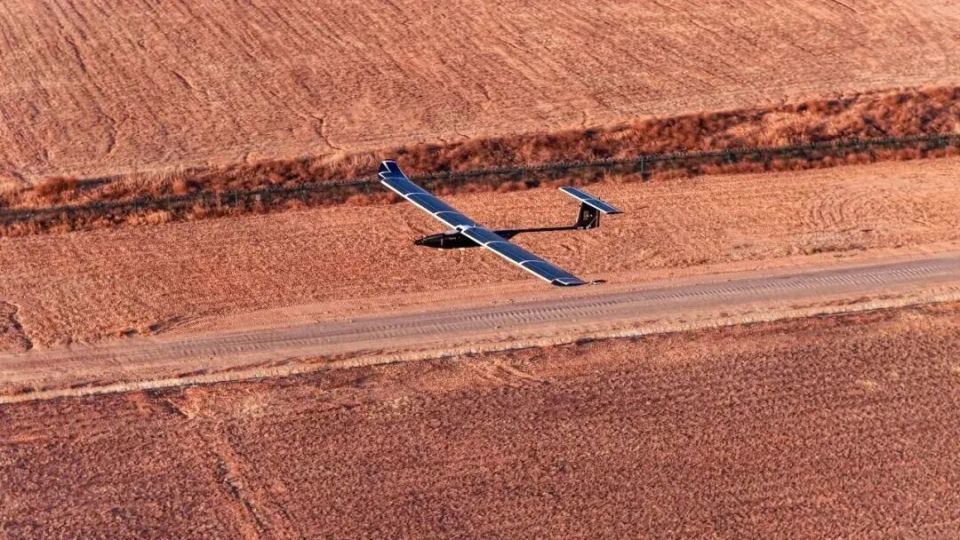
The recovery-and-relaunch interval is the number I watched: a pickup truck, a catapult rail, twenty minutes from park to launch. A 45-kilogram, 8-meter-wingspan solar UAV that can cycle that fast changes the inspection economics more than any single endurance figure does. That is the core of the case I want to review — the "Light Cavalry" (Qingqibing) from the Academy 11 of the China Aerospace Science and Technology Corporation (CASC), which completed its maiden flight at a northwest airport on November 11, 2026, and which the developer bills as China's first commercial-grade small-to-medium pure-solar UAV. Instead of chasing the two-month, near-space records of the previous two decades, the design cut the wingspan to 8 meters, capped endurance at a designed 30 hours, and aimed every choice at jobs a ground crew can actually schedule.
Why the big-wing solar aircraft keep crashing
The failure list is the best evidence for the design choice. US NASA's "Helios" flew with a wingspan wider than a Boeing 747 — about 75 meters — and had set an altitude record near 29.5 kilometers in August 2001 before low-altitude turbulence broke the fragile wing apart in flight over the Pacific in June 2003, ending the program. Google and Meta spent hundreds of millions of dollars on their own high-altitude solar aircraft: Google's UAV broke its wing four minutes into its first flight, and Meta's Aquila snapped its right wing when a light breeze hit it on landing, after which both companies shelved the projects.
The physics behind these failures is documented in NASA's own accident investigation: the huge, flexible wing was optimized for minimizing structural weight, and flying qualities degraded to the point that turbulence at low altitude exceeded the control authority. In plain terms — the same engineering trade that bought those record-setting wingspans made the airframe unable to survive the disorderly air near the ground.
The record holders still flying stay inside carefully controlled windows. Airbus' "Zephyr" is the world record holder at 25 meters wingspan and logged a 67-day continuous flight above 20,000 meters at the stratospheric ceiling. British BAE Systems' PHASA-35, at 35 meters, is still positioned as a stratospheric experiment. These platforms are formidable, but they demand long runways, large support crews, and stable weather — three things no pipeline patrol crew has.
How Academy 11 broke the weight-power spiral
The case gets interesting when you look at who built this machine. Academy 11 of CASC is the "Rainbow" (Caihong) drone national team; in 2017, the same academy flew a 45-meter-wingspan solar UAV above 20,000 meters. The near-space route is not a blind spot — it is a path the team deliberately declined this time. When the designer of record-holders decides the next aircraft should shrink, that decision is the strongest data point in the case.
The key engineering spiral is cell energy density. Daytime power cannot carry through the night; adding battery mass drives up wing area, which drives up fragility and cost. My own conclusion, drawn from this case, is that the way out is not a better battery but a revised requirement: accept 30 hours — one full day-night cycle — instead of two months. That single change allows the wingspan to shrink to 8 meters and the mass to a pickup-compatible 45 kilograms, breaking the spiral on the requirements side instead of the chemistry side. Public research on solar aircraft points in the same direction: a Harvard analysis of solar stratospheric flight identifies 500 Wh/kg as the battery threshold above which month-scale endurance becomes practical — a figure today's production cells still fall short of. The "Light Cavalry" sidesteps that chemistry bottleneck entirely by aiming at one night at a time, not one season.
Next, the details. The wing carries domestically produced flexible thin-film photovoltaic cells; the fuselage holds lightweight energy-storage batteries; the carbon-fiber structure is built to take the shock of a truck-mounted catapult launch. The whole supply chain is domestic — not a single imported screw. This matters commercially, not just symbolically: the platform leans on China's fully mature photovoltaic, lithium-battery, carbon-fiber and drone supply chains, all validated at civilian-market scale, which is precisely what turns a laboratory aircraft into a priced product.
The route also has academic precedent. Zhou Zhou's "Phantom" (Meiying) team at Northwestern Polytechnical University set a domestic record of 27.6 hours in 2019 with a low-altitude civil solar UAV; the university's own news release logs the flight at 27 hours 37 minutes. Small-scale, practical solar flight has deep domestic roots — the "Light Cavalry" is a commercialization step on a well-trodden path, not a sudden inspiration. On the high-altitude side, Zhu Shengli of the Aviation Industry Corporation of China (AVIC) First Aircraft Institute led the "Qimingxing 50" (Venus) large solar UAV program on the stratospheric track. Two routes running in parallel — high-altitude records and low-altitude service — indicate a layered technology network, not a single bet.
What the numbers look like in inspection work
The maiden flight covered standard items: motor start, taxi, acceleration, climb to preset altitude, a circuit of the field, and landing, with flight control, avionics, energy storage and handling qualities all verified. The specifications now public: 3.2 meters fuselage length, 8 meters wingspan, 45-kilogram takeoff mass, designed ceiling of 7,000 meters, maximum designed endurance of 30 hours, and mission payloads above 5 kilograms, with solar power as the only energy source. The crucial claim about deployment: vehicle-mounted launch with no runway, about twenty minutes of ground preparation, and rapid deployment from wilderness, mountain or coastal terrain with no airfield.
On the jobs themselves — long-distance pipeline patrol, reservoir and embankment inspection, early wildfire detection, rapid post-flood area reporting — the alternative costs were brutal. Manned helicopter patrol runs in the tens of thousands of yuan per hour, and battery-powered multirotors cover a few miles per sortie and need round trips for battery swaps. Public estimates put conventional drone patrol around $200–300 per mile versus more than $1,200 per mile for helicopters — a gap that long-endurance solar flight should widen further, since one airframe covering 30 uninterrupted hours replaces the battery-drone relay crews that have to shuttle spares and swap packs. The "Light Cavalry" compresses that economic equation to what a single ground crew can actually schedule: one pickup, one aircraft, twenty minutes of preparation, thirty hours of continuous coverage.
Adoption conditions, risks, and common mistakes
Worth flagging clearly: the figures above are design values — the first flight was a single circuit of the field. Procurement teams treating 30 hours as a guaranteed service metric are repeating the same mistake as treating one good OEE week as proof of a stable line.
- Weather envelope. The 30-hour figure depends on sunshine. Overcast, rain, or smoke plumes that reduce photovoltaic input will compress endurance; missions should be planned to the worst-case irradiance season, not the best.
- Zone restrictions. A 7,000-meter designed ceiling does not mean open skies everywhere. Controlled airspace and flight approval procedures still apply — the drone's runway independence solves the ground infrastructure problem, not the regulatory one.
- Payload-versus-endurance trade. The 5-kilogram margin is a budget, not a fixed menu; heavier sensors or communication relays eat directly into endurance margin, and teams should spec payload with endurance in the same sentence.
- Residual operational risk. Catapult launching still requires a trained crew and site selection, not just "any empty field."
The biggest common mistake is procurement teams benchmarking this platform against the stratospheric record holders. The two categories share almost nothing operationally — the near-space aircraft needs long runways and weeks of planning; this one needs a pickup truck. Treat them as separate procurement lines, not as competitors.
A copyable framework for any organization weighing a low-altitude long-endurance platform: first, define the mission's maximum useful sortie length — if a full day-night cycle covers the task, the 30-hour class is the right bracket; second, audit the launch site availability along your routes; third, cost the mission end-to-end across crew, fuel, approvals and downtime, not just per-flight fuel; fourth, score against the ceiling of 7,000 meters, the payload budget above 5 kilograms, and the requirement of roughly twenty minutes of ground preparation — if the mission fits those brackets, a solar platform deserves a slot in the fleet plan.
The case point that closes the argument: the "Light Cavalry" does not break a single record. It moves the technology from the "can it fly" era into the "is it worth using" era — the transition every monitoring team actually waits for.
Related coverage on our site: a separate solar platform — ApusNeo, which reached 47,600 feet in a 29-hour high-altitude test — is taking the opposite bet, staying high and big.
FAQ
What does "commercial-grade" mean here in practice?
It means the platform is positioned as a priced product for scheduled inspection work, rather than a research demonstrator — a shift from the "can it fly" stage into the "is it worth using" stage, with the developer calling it China's first commercial-grade small-to-medium pure-solar UAV.
Is the 30-hour endurance a guaranteed service figure?
No. It is a maximum designed endurance. The maiden flight was a single circuit, and actual sortie length will depend on sunshine, payload weight and the weather window. Plan missions on design values, not service guarantees.
Can it replace helicopters for pipeline patrol?
For long, linear, repetitive patrol routes, the economics point that way — helicopter patrol has run in the tens of thousands of yuan per hour, while conventional drone patrol is estimated at $200–300 per mile versus more than $1,200 per mile for helicopters. For one-off, high-detail or emergency-landing-sensitive missions, manned assets still hold advantages.
Why is 20 minutes of ground preparation significant?
Because responsiveness drives utilization. Vehicle-mounted, no-runway launch with roughly twenty minutes of preparation means a crew can fly from wilderness, mountain or coastal sites without an airfield — deployment friction, not airframe capability, is usually what limits how often inspection aircraft fly.
Sources
Xinhua News Agency, "China's first commercial-grade small-to-medium pure-solar UAV completes maiden flight," November 11, 2026 — https://k.sina.cn/article_5953740931_162dee0830670455se.html
pv magazine, "CASC completes maiden flight of solar-powered UAV in China," November 11, 2026 — https://www.pv-magazine.com/2026/11/11/casc-completes-maiden-flight-of-solar-powered-uav-in-china/
NASA Engineering and Safety Center, "Helios Prototype Aircraft Mishap Investigation Report" (Noll et al., 2007) — https://ntrs.nasa.gov/api/citations/20070022260/downloads/20070022260.pdf
Wikipedia, "Airbus Zephyr" — https://en.wikipedia.org/wiki/Airbus_Zephyr
Northwestern Polytechnical University News, "'Phantom' solar UAV sets another record," July 28, 2019 — https://news.nwpu.edu.cn/info/1002/64544.htm
Harvard SEAS, "Powering Solar-Powered Flight" (500 Wh/kg battery threshold), October 2026 — https://seas.harvard.edu/news/powering-solar-powered-flight
Phoenix Drone Pros, "Drone vs Manned Aircraft for Pipeline Inspection" ($200–300/mile vs $1,200+/mile), November 2026 — https://blog.phoenixdronepros.com/drone-vs-manned-aircraft-pipeline-inspection
Additional reporting by WorldIndustrialWeekly: ApusNeo solar UAV 100-hour test coverage