
When the Ramp Meets the Quality Gate: The Unsettled iPhone Duo Inner-Screen Claims
For production and operations leaders, the useful part of this story is not the crack itself. It is the open question bolted onto it: how much shipment pressure a first-generation foldable line can absorb before its inspection thresholds become a matter of public argument. Apple's foldable smartphone, the iPhone Duo, went on sale on October 23 with a starting price of $1,999 in the United States, and reports of cracked inner panels and display abnormalities close to the hinge surfaced almost immediately.

Two supply-chain accounts, neither of them closed out
A Jiemian News report quoted a Foxconn employee describing heavy output pressure on the iPhone Duo line and stating that Apple had eased certain yield inspection requirements during the opening weeks of mass production so that units could keep shipping. Read literally, that account describes a specific factory outcome: hardware that would previously have been screened out at an inspection station reached the market instead, and with it a higher chance that a customer receives a device carrying a latent defect.
A second person familiar with the supply chain offered the opposite version, telling Chinese media that Apple had not adjusted its internal yield standards. So far no document and no official statement allows an outside reader to verify either side. The allegation that "Apple lowered its quality inspection standards" therefore has to be recorded where it belongs: as an unverified supply-chain claim, not as established fact.
The engineering thread: a hinge model, not a confirmed root cause
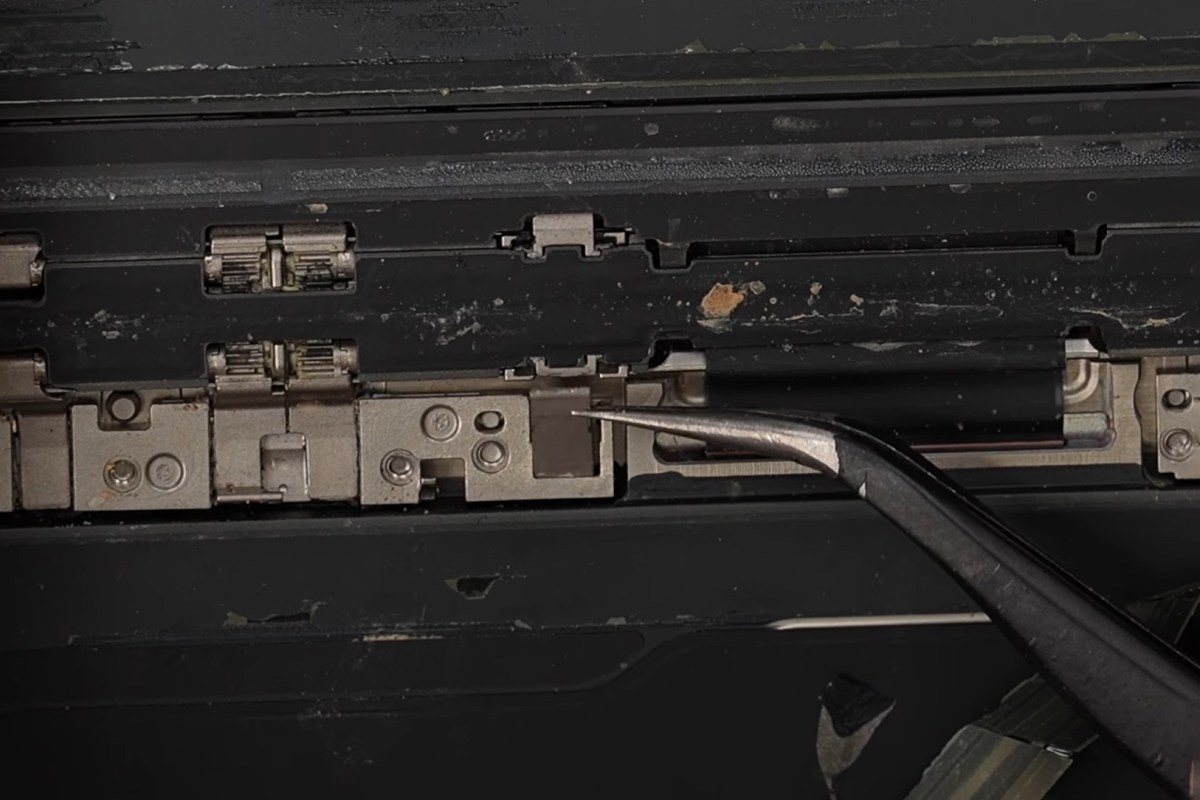
The Foxconn account also touched on possible structural contributors to the inner-screen failures, in terms broadly close to the analysis previously published by teardown specialist iFixit. Drawing on teardown documentation, related patents and CT scans, iFixit assembled a model of the hinge structure and argued that a central support bar near the display may not move out of the way quickly enough as the device folds, placing excessive mechanical stress on a localized region of the inner screen. Relative positioning between the hinge rails and the surrounding structure was flagged as a second variable bearing on screen survival.
Field feedback describes cracks or abnormal bright lines adjacent to the hinge, with some failures appearing shortly after the device reached customers. On October 26, Apple acknowledged that a small number of iPhone Duo units exhibit inner-screen problems and directed affected owners to AppleCare for replacement. The company has not published a confirmed failure mechanism, has not announced a full recall, and has not opened a repair program covering all units.
Ramp arithmetic: the figures behind the friction
| Reported data point | Figure | Attribution and caveat |
|---|---|---|
| Retail start date | October 23 | Launch timing referenced in the reporting |
| Entry price | $1,999 | United States starting price |
| Manufacturer acknowledgment | October 26 | A small number of units with inner-screen problems; no cause confirmed |
| Planned output this year | About 7.5 million units | Estimate from related China supply-chain sources |
| Final assembly yield, mid-September | Only slightly above 60% | Earlier supply-chain statement on Foxconn-related lines |
| Time to line maturity | Six months to one year | Same earlier account, given Apple's strict quality demands |
| Panel and hinge readiness | Yield shortfalls and delivery delays reported | Samsung Display foldable OLED panels and hinge-related parts |
Taken together, those numbers explain why this category behaves differently from a conventional slab phone. The complexity of the foldable panel and the hinge mechanism, combined with supply and yield problems on certain critical parts, makes whole-device mass production materially harder than the volume curves suggest. Early order demand and tight supply sharpened the pressure to scale deliveries quickly, yet a rising line output does not automatically mean a rising count of qualified units.
The same Foxconn employee said the line had already swapped in an emergency batch of components, while current production and stocking plans had not visibly changed. That combination is common on troubled ramps: a containment action at the station, with the shipment commitment left where it was.
Common misconceptions
- Confusing throughput with good output. Units leaving the line and units passing the gate are two different counts; on a low-yield ramp the gap between them is the real risk exposure.
- Treating any single insider quote as confirmed policy. Two contradicting supply-chain accounts are circulating and neither has been independently validated, so "Apple lowered its quality inspection standards" is still a claim.
- Assuming an emergency parts swap closes the root-cause question. A component change tells you what the line touched, not which mechanism produced the failure.
- Reading "a small number of units" as a small problem. On a first-generation product, the acknowledged population is also the population that carries the reputational weight of the whole category entry.
- Filing supplier yield and delivery slips under procurement detail. When foldable OLED panels and hinge parts lag, the time available for process adjustment and equipment optimization shrinks with them.
Action recommendations for manufacturing and supply-chain teams
- State the yield threshold as a fixed constraint in the ramp plan, and require a documented, data-backed change authority before any inspection limit is altered mid-program.
- Keep confirmed statements and unverified allegations in separate columns of the risk log. "A small number of devices show inner-screen issues" and "the customer relaxed inspection" carry different consequences and different evidence burdens.
- Track the highest-complexity subassembly as the schedule driver. For foldable hardware, hinge geometry and panel qualification status belong on the ramp review agenda, not only the supplier scorecard.
- Price any gate relaxation as total cost rather than shipment relief: replacement handling through the service channel plus first-product reputation is the bill that arrives later.
- Build a verification window into the launch. A six months to one year maturity estimate for a final assembly line means early-quarter units and steady-state units should not be judged by the same failure profile.
FAQ: separating what is confirmed from what is alleged
Has Apple confirmed that inspection standards were relaxed?
No. A Jiemian News report cited a Foxconn employee saying some yield inspection requirements had been eased early in production, while another person familiar with the supply chain told Chinese media that internal standards were unchanged. No independently verifiable document or official statement has settled the dispute.
What has the manufacturer actually said?
On October 26, Apple acknowledged that a small number of iPhone Duo units have inner-screen problems and told affected users to contact AppleCare for replacement. No failure cause, recall or universal repair program has been announced.
What mechanical explanation is circulating?
iFixit's hinge model, built from teardown data, patents and CT scans, suggests a central support bar near the screen may not clear in time during folding, overloading part of the inner panel; hinge rail positioning relative to neighboring structure is described as a further factor.
Are volumes being adjusted?
Reporting says a batch of parts was urgently replaced on the line without a visible change to production or stocking plans. China supply-chain estimates put this year's iPhone Duo production target at about 7.5 million units.
Why does the yield history matter to the argument?
Because the earlier reported figures — final assembly yield at Foxconn-related lines only slightly above 60% as of mid-September, six months to one year to reach maturity, plus yield and delivery problems on Samsung Display panels and hinge parts — describe exactly the conditions under which shipment pressure and quality gates collide.
The boundary that has to hold
What survives the noise is narrow and checkable: a launch on October 23 at $1,999 in the United States, acknowledged inner-screen defects in a limited number of iPhone Duo units on October 26, and a service route through AppleCare. Whether the customer requirement behind those defects was ever softened is a separate claim that still needs evidence. For anyone running a ramp, that distinction is the point worth carrying forward: shipment pressure can change schedules, but it should never be allowed to silently rewrite a specification.
Editorial questions about this report can be sent to news@industrialweekly.com.