
From Four 3-Mpixel Cameras to NVIDIA Jetson Orin Nano: A Practical Read on the Innodisk GMSL2 camera starter kit
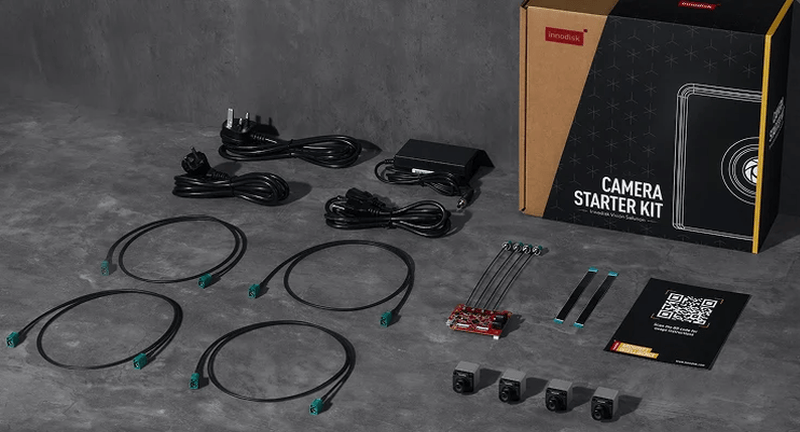
When engineers assess edge AI vision, the first practical question is often whether a multi-camera chain can be observed, powered, and driven as a single test system before it is forced into a larger product. That question is the reason a bundled platform can be useful: it places cameras, capture hardware, cabling, power, and sample software in one evaluation frame. The Innodisk GMSL2 camera starter kit is presented as that frame: four 3-Mpixel camera modules, a MIPI CSI-2-to-GMSL2 capture card, accessories, and supporting source code aimed at the NVIDIA Jetson Orin Nano Super Developer Kit.
What the kit puts on the bench
The core of the platform is a set of four fixed-focus GMSL2 camera modules paired with a MIPI CSI-2-to-GMSL2 capture card. That combination addresses a common architecture gap in embedded vision: cameras or interfaces may use one signal path, while the compute platform expects another. The capture card provides the bridge, and the four-camera layout allows developers to observe how a system behaves when several video sources are present rather than a single isolated stream.
The package also includes four 1-meter GMSL2 FAKRA cables, a power adapter, and power cords. These items matter because validation is not only about code; it is about creating a repeatable bench setup. A known cable length, a defined power source, and an organized capture path make it easier to isolate whether a failure is coming from the camera, the link, the driver layer, the platform, or the surrounding harness.
Why GMSL2 and 6 Gbps appear in the specification conversation
GMSL2 is described as a high-speed serial link for real-time video transmission, and the starter kit is linked to forward-channel data rates that can reach up to 6 Gbps. In an evaluation context, that number is not a promise about every camera, every frame rate, or every system setting; it is a capacity reference for the link class being tested. Teams should treat it as a boundary condition in planning: the link can support a high-speed forward path, but the application still needs to confirm how its chosen camera modules, resolution, and driver configuration behave inside that envelope.
The presence of a MIPI CSI-2-to-GMSL2 capture card adds another layer to that interpretation. MIPI CSI-2 and GMSL2 serve different transport roles in many embedded vision chains. The card’s role, as presented, is to connect the camera-side link to the compute-side interface path. This is useful for teams comparing a modular camera approach with a direct-attach design, because the kit lets them test the bridge as part of a pre-integrated chain rather than building the bridge from individual components first.
Data points worth citing in an internal evaluation memo
| Evidence in the kit | Why it can be cited | Limited conclusion |
|---|---|---|
| four 3-Mpixel cameras | Establishes that the platform is built around a multi-camera, mid-resolution evaluation rather than a single-camera demo. | The kit supports four-camera testing; it does not, by itself, define the final frame rate or processing load. |
| GMSL2 camera starter kit | Positions the product as an entry platform for testing, not just a component list. | It is a starter validation package tied to the stated target applications. |
| MIPI CSI-2-to-GMSL2 capture card | Shows the interface translation element needed to make the chain work with the named platform. | Teams should still verify host integration in their own software image. |
| up to 6 Gbps | Gives a high-speed serial-link reference for the forward channel. | It is a capacity reference, not an application-specific throughput guarantee. |
| NVIDIA Jetson Orin Nano Super Developer Kit | Identifies the platform used to run the sample source code and system validation path. | Source-code availability is tied to this named platform. |
| 1-meter FAKRA cables | Fixes a baseline harness length for bench comparison. | Longer or different routing needs separate validation. |
How the sample software path reduces setup friction
The kit is bundled with camera source code for the NVIDIA Jetson Orin Nano Super Developer Kit, the platform named for running the system. That is the practical shortcut: the hardware and software are pre-integrated so component sourcing, complex system-level integration, driver debugging, and tuning become less necessary during the first phase of evaluation. For a small team, the value is not merely receiving cameras; it is receiving a defined starting point where camera acquisition, capture translation, platform runtime, and sample code are already aligned.
For a larger organization, the same structure can reduce hand-off ambiguity. Instead of separate groups owning camera selection, board support, capture-card drivers, and application middleware, a single reference chain can be used to establish a baseline. Once that baseline is visible, later discussions become easier: are changes needed in optics, harness routing, power quality, platform thermal policy, or application logic? The original package, as described, targets the pre-integrated state, not every downstream custom integration.
Case framing: where the stated target applications enter the story
The described target applications are blind spot detection and advanced driver assistance systems for heavy-duty vehicles, plus object recognition and environmental perception for humanoid robots and autonomous mobile robots. Those cases are useful because they stress different parts of the same validation chain. A heavy-duty vehicle scenario emphasizes a durable video path and camera placement around blind areas. A robot or autonomous mobile robot scenario emphasizes scene understanding from multiple views, where several cameras may need to be observed together.
Within that framing, the four 3-Mpixel modules can be used to ask questions such as: how does the capture chain behave when four streams are active; how stable is the link over a 1-meter FAKRA harness; how does the software path on the NVIDIA Jetson Orin Nano Super Developer Kit present the images to the developer; and what still has to be adapted before the evaluation chain becomes a product chain? Those are evaluation questions rather than final deployment conclusions, which is appropriate for a starter kit.
Common misconceptions to avoid
Assuming four cameras means a complete multi-view product design
The kit provides four fixed-focus GMSL2 camera modules, which is enough to test a four-camera architecture, but it does not replace mounting geometry, lens placement, field-of-view analysis, lighting behavior, or mechanical validation for a final application.
Reading 6 Gbps as an application throughput
The stated up to 6 Gbps figure belongs to the GMSL2 forward-channel data-rate discussion. It should not be treated as the effective bandwidth after all application overhead, encoding, capture configuration, or software processing has been considered.
Treating MIPI CSI-2-to-GMSL2 as a software-only issue
The MIPI CSI-2-to-GMSL2 capture card is part of the hardware chain. Interface translation affects power, cabling, timing, driver expectations, and platform compatibility. A development plan that only focuses on camera selection may miss the bridge layer.
Thinking a starter kit skips validation
The kit reduces some work by bundling hardware, accessories, source code, and a named compute platform. It does not eliminate validation. Initial testing still has to confirm image behavior, link stability, driver interaction, and application fit for the intended use.
Action recommendations for industrial teams
Use the kit as a baseline, not as a finished deployment
The most reliable way to use the Innodisk GMSL2 camera starter kit is as a reference chain. Confirm that all four 3-Mpixel cameras appear through the MIPI CSI-2-to-GMSL2 capture card, that the power adapter and power cords create a stable bench condition, and that the 1-meter FAKRA cables are managed without unnecessary strain or routing variables.
Start with the NVIDIA Jetson Orin Nano Super Developer Kit path
Because the camera source code is described for the NVIDIA Jetson Orin Nano Super Developer Kit, teams should begin evaluation on that platform before attempting other hosts. This keeps software and hardware conditions aligned with the documented starter configuration.
Define what must be customized after the first proof
Once the baseline is working, separate remaining gaps by category: optical or mechanical changes, harness changes, driver or runtime changes, platform changes, or application changes. The package description notes that Innodisk provides customization services ranging from hardware fine-tuning to application deployment in edge environments after initial validation.
Document the evaluation assumptions
Every result should be recorded with the assumptions behind it: four cameras, fixed focus, 3-Mpixel module class, GMSL2 link, 1-meter FAKRA cabling, named developer kit, and pre-integrated source code. That documentation prevents a bench result from being over-explained when it is presented to a wider design review.
FAQ: quick answers for engineers and decision-makers
What is the Innodisk GMSL2 camera starter kit?
It is a bundled evaluation platform for edge AI vision that includes four 3-Mpixel GMSL2 camera modules, a MIPI CSI-2-to-GMSL2 capture card, and accessories, with product designation EKIT-B14-001.
Which compute platform is tied to the included source code?
The source code is described for the NVIDIA Jetson Orin Nano Super Developer Kit, the platform used to run the system in the starter-kit configuration.
What link speed is referenced?
The kit is associated with GMSL2, a high-speed serial link for real-time video transmission, with forward-channel data rates that can reach up to 6 Gbps.
Which application areas are named?
The stated targets are blind spot detection and advanced driver assistance systems for heavy-duty vehicles, plus object recognition and environmental perception for humanoid robots and autonomous mobile robots.
Does the package include cabling and power?
Yes. The described package includes four 1-meter GMSL2 FAKRA cables, a power adapter, and power cords in addition to the cameras and capture card.
What should teams do after initial validation?
Teams should treat the result as a baseline, then identify whether further work is needed in hardware fine-tuning, application deployment, or edge-environment integration; the vendor’s described follow-on services cover those directions.
A concluding view for operations and engineering managers
For decision-makers, the practical value of this kind of package is risk visibility before a project commits to deeper custom work. A four-camera edge vision chain has many failure surfaces: camera choice, capture translation, driver behavior, power stability, harness length, platform compatibility, and application interpretation. By placing those surfaces inside one starter configuration, the GMSL2 camera starter kit makes it easier to separate “known baseline” from “project-specific unknown” when the team moves from testing to deployment.