
WorldIndustrialWeekly Briefing: Edge AI, Software-Defined Vehicles and 800 VDC Take Center Stage at the 10th annual OktoberTech
By Michael Torres | WorldIndustrialWeekly
For production, facilities, vehicle-platform and infrastructure teams, the practical question is not which concept gets the loudest headlines, but which electrical and compute changes will reach factory floors, charging networks and equipment rooms first. The 10th annual OktoberTech discussion at Computer History Museum in Mountain View, California, on Oct. 22 framed that question around semiconductor supply, local intelligence, software architecture and rack-level power.
Event context: waves of innovation meet industrial constraints
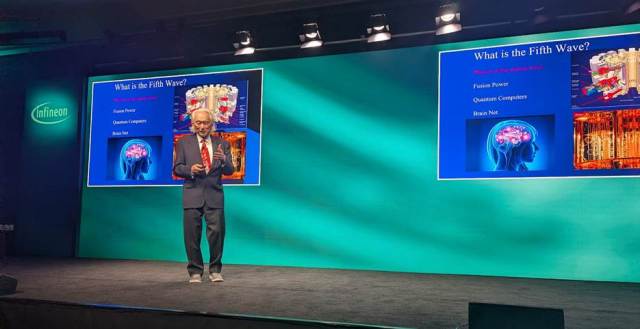 Figure 1: Michio Kaku at OktoberTech 2026 discusses waves of technological innovation; photo by Aalyia Shaukat, Computer History Museum, Mountain View, California.
The agenda moved between executive briefings and keynotes. Michio Kaku, a theoretical physicist at City College of New York, linked the present AI transition to earlier technology waves. The framing echoes Joseph Schumpeter’s creative-destruction argument that newer inventions displace older systems.
Kaku’s historical line began with steam power during the Industrial Revolution, passed through the transistor and the Information Age, and arrived at AI systems now being deployed in physical environments. He also pointed to quantum computing and brain-computer interfaces (BCIs) as possible sources of future industries. For an industrial audience, the value was less the spectacle than the reminder: capacity, standards and local compute readiness determine whether a technology wave becomes routine engineering practice.
Case point: edge AI answers a different problem than early IoT hype
Before the edge-AI sessions, reporters questioned whether IoT had been an overhyped wave that never scaled. One journalist recalled that billions of connected devices were once promised across cellular, Wi-Fi and low-power networks, yet did not appear; conferences in Silicon Valley that once attracted 12,000 to 14,000 participants also disappeared. That history raised a natural challenge: why should edge AI avoid the same fate?
Stefan Zizala, division president of edge systems at Infineon, answered that IoT was “an unfulfilled promise” rather than a failed idea. His distinction is architectural: modern microcontrollers offer enough capability and memory to execute models locally. In his words, “Not every piece of information needs to be fed back to the cloud.” He continued, “I think that’s the big difference…they are processed with AI right at the edge…and the results are then sent back to the cloud…So, it’s a conceptual change.”
Zizala connected the point to machines plant managers already know—power tools and home appliances—and noted that machine-learning algorithms are used in electric motor control for predictive maintenance. Other reasons to keep processing local, he said, include cloud-token cost, absent or limited connectivity, latency and data protection. The shift is therefore not a promise of universal streaming, but a change in where useful analysis happens.
Semiconductors and manufacturing: the quiet constraint
The OktoberTech sessions also kept returning to semiconductors. Automotive chips, power electronics and embedded processing formed the bridge between physical AI claims and deliverable hardware. Speakers emphasized that AI infrastructure raises requirements for semiconductor technology, manufacturing capacity and supply-chain visibility—not only for cloud racks, but for the devices that sense, control and move.
Software-defined vehicles: adoption, platform debt and central computing
Peter Schiefer, president and CEO of the Automotive Division at Infineon, set the automotive scene with a share estimate: only about 10% of vehicles have a software-defined architecture today, while roughly 90% do not. He expects the software-defined share to rise to around 40%, a change that alters supplier relationships, integration work and lifecycle maintenance.
During discussion, audience members noted that newer entrants, particularly in China, may benefit from designing vehicles on a clean sheet of paper, without carrying legacy electronic architectures. Schiefer agreed that greenfield companies can move more easily. He added a second constraint for Western OEMs: many software-defined vehicle launches were tied to new electric-vehicle platforms, so canceled platforms delayed the vehicle software rollouts as well. In China, by contrast, EV penetration reached about 50%, giving those manufacturers an advantage in building newer computing stacks.
For legacy automakers, the practical issue is complexity. Schiefer described the need to consolidate roughly 100 distributed control boxes, each with its own software, into a central computer. He stated, “That’s the only way traditional OEMs can survive. And I think meanwhile they recognize it, and they need to catch up.” The implication for procurement and program managers is that vehicle architecture, supplier software boundaries and platform cancellation risk are now the same discussion.
Data-center power: October announcements, Dresden capacity and the 800 VDC question
Although much of the event addressed physical AI, the power-systems briefing turned toward data-center requirements. In October, Infineon’s announced package included a 27 kW three-phase PSU reference design; an 800 VDC and ±400 V digital hot-swap controller; the first 900-V GaN bidirectional switch (BDS) to be used in Enphase’s IQ solid-state transformer (SST); and an 800 V to 50 V, 12 V, 6 V GaN intermediate bus converter (IBC) collaboration with Nvidia.
Manufacturing capacity behind the roadmap
The same build-out logic extends into factories. In July, Infineon opened the €5 billion (~$5.58 billion) Smart Power Fab in Dresden, a 300-mm facility for power and analog/mixed-signal devices. Adam White, president of Infineon’s Power and Sensor Systems division, described it as available capacity for AI infrastructure demand, even though its rooms were not yet filled at opening: “This facility is at the moment empty, okay? But I promise you now, with the demand that we’re seeing, that facility will be ramped.” He said the fab is “open there for the industry.” Full production is set to ramp up in late 2026.
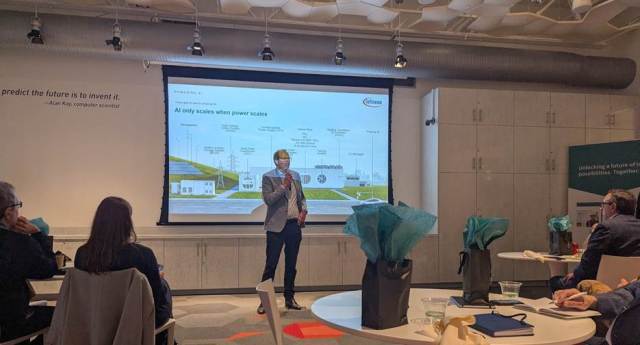 Figure 2: Adam White, president of Power and Sensor Systems division, presents a grid-to-core view of AI data-center power at OktoberTech 2026; photo by Aalyia Shaukat, Computer History Museum, Mountain View, California.
From AC sidecar designs to 800 VDC facilities
Asked when 800 VDC would reach the market, White said, “We may start seeing some of the first, whether they’re prototypes or mass productions, definitely in ‘28.” He placed that milestone inside a longer migration: single-phase systems, three-phase systems and then higher-voltage DC paths at facility level. He called the endpoint “the holy grail to get to the 1 MW rack.” This differs from today’s sidecar method, in which local conversion creates 800 V from three-phase AC. White also warned that safety and certification hurdles remain, including the need to maintain UL certification from the beginning.
IBC table and voltage conversion limits
On intermediate bus converters, Infineon released 800-to-50 V and 800-to-12 V IBCs in March 2026; both reference designs use 650-V CoolGaN on the primary side. The October work also indicates active development of 800-to-6 V conversion. That path draws 800 VDC from the sidecar and places conversion closer to the processor, possibly leaving downstream converters to take 6 V toward sub-1V core voltages, though engineering trade-offs remain.
| Product | Configuration | Rated power | Efficiency | Footprint | Power Density | Devices |
|---|---|---|---|---|---|---|
| HV IBC: 800 V to 50 V | ISOP, planar PCB-integrated transformer | 6 kW TDP (up to 10.8 kW for 400 µs) | >98% full load | 60 × 60 × 11 mm | 2.5 kW/in³ | 650 V CoolGaN primary+ multiple synchronous rectifier stages |
| HV IBC: 800 V to 12 V | ISOP LLC, matrix transformer | 6 kW TDP (up to 10.8 kW for 400 µs) | 98.2% peak, 97.1% full load | 130 × 40 × 8 mm | >2.3 kW/in³ | 650 V CoolGaN + 40 V OptiMOS 7 |
Table 1: Infineon’s 800 V-to-50 V and 800 V-to-12 V CoolGaN IBC reference-design specifications.
The October release reinforces GaN’s place in IBC work, an area also pursued by Renesas, TI, ST, Navitas and other power vendors. The physics argument is straightforward: I²R losses become dominant when voltage drops and current rises. The 20 kW-class 800-to-6 V converters shown at GTC 2026 illustrate the scale; in the GTC setting, 20 kW / 6 V ≈ 3,300 A, meaning outputs move more than 3,000 A. As voltage nears the core level, the electrical path to the xPU must shorten, which has encouraged vertical power delivery (VPD) on AI processors such as GPUs.
Workload mix moves power toward CPUs in some racks
A panel discussed how power delivery changes across xPU types, including GPUs, CPUs and TPUs. One point was that lateral power delivery (LPD) may still apply to CPU-heavy agentic racks. Training workloads often favor the GPU in an 8:1 GPU-CPU ratio, while inference moves toward ~4:1 and agentic workloads can approach ~1:1. White noted, “From the customer interactions that we’re having, there are clear commitments I see from some of the bigger companies to go down to a ratio of 1:1,” then added, “Of course, that’s a dramatic change from 8:1 ratios that were there previously.”
Case summary: what operators can infer from the sessions
| Industrial topic | Signal discussed | Decision implication |
|---|---|---|
| Edge AI | More capable microcontrollers can run models locally | Review connectivity, latency and data-protection constraints before assuming cloud streaming |
| Software-defined vehicles | Low current SDV adoption versus forecast growth | Track platform cancellations and consolidation of control boxes into central computing |
| Data-center power | Dresden capacity and 800 VDC roadmap timing | Align equipment planning with ramp dates, certification needs and rack power targets |
Common misconceptions
- IoT was not simply “a failed wave”; the event framing was that it remained “an unfulfilled promise,” while edge AI changes where inference occurs.
- More connected devices are not automatically the goal. Local AI processing can matter more when cloud-token cost, latency, connectivity gaps or data protection dominate.
- Newcomer advantage does not erase architecture burden. Legacy OEMs face the problem of roughly 100 distributed control boxes and must control software centrally.
- 800 VDC is not just a product launch. It sits on a longer migration from AC sidecar approaches toward higher-voltage DC facility paths, with UL certification and safety prerequisites.
Action recommendations for industrial readers
- Separate “local processing” from “full cloud dependency”: ask whether equipment can run AI models on microcontrollers and send only results, consistent with Stefan Zizala’s “Not every piece of information needs to be fed back to the cloud” framing.
- For vehicle or machine programs, inventory software boundaries: how many distributed control boxes exist, how many can be consolidated, and which suppliers retain unique embedded code.
- Watch manufacturing readiness, not only product announcements: the Dresden Smart Power Fab, opened in July, is expected to ramp toward full production in late 2026 and may indicate capacity timing.
- Treat 800 VDC as an infrastructure path with certification risk: evaluate whether your rack design needs 800 V from today’s sidecar conversion or should plan for prototypes or mass production around ‘28.
- Read voltage-conversion data through loss physics: check whether your power chain is constrained by I²R heating, current, path length and the transition from 6 V to sub-1V core delivery.
FAQ
Q: Why did speakers say edge AI differs from the early IoT wave?
A: Because more capable microcontrollers can process data at the edge and send selected results to the cloud, rather than assuming billions of connected devices must stream all monitoring data centrally.
Q: What share of vehicles today is software-defined?
A: Schiefer said only about 10% of vehicles have a software-defined architecture, leaving roughly 90% without one, and forecast growth to around 40%.
Q: When does White expect 800 VDC products to appear?
A: He said, “We may start seeing some of the first, whether they’re prototypes or mass productions, definitely in ‘28.”
Q: What power-system changes were announced in October?
A: The package included 27 kW, 800 VDC, ±400 V, 900-V GaN for Enphase, and Nvidia collaboration for 800 V to 50 V, 12 V, 6 V IBCs.
Data citation and sources
- Omdia, Power Semiconductor Market Share Database, 1H26 (2025 Base Year), May 2026. Cited in Infineon Technologies AG, Q3 FY2026 Company Presentation, August 2026. https://www.infineon.com/assets/row/public/documents/corporate/company/fy2026-q3-web-en.pdf
- S. Bowerman and G. Ableidinger, “The CPU is back: Rethinking the CPU-GPU split for LLM inference,” Red Hat Blog, August 6, 2026. https://www.redhat.com/en/blog/cpu-back-rethinking-cpu-gpu-split-llm-inference