Industrial IoT Reliability Is Built on the Test Bench: Inside Goodram's Validation Regime in Poland
By Michael Torres | WorldIndustrialWeekly
What caps Overall Equipment Effectiveness (OEE) on a running line is frequently the least visible part in the cabinet: the DRAM module or the SSD inside the industrial computer doing the control work. When that part gives up, the bill is written as production downtime, on-site maintenance and, in the worst case, the loss of critical data — a total that sits far above the component price. Read that way, Total Cost of Ownership (TCO) is settled before integration, in how memory and storage are screened at the factory. Following the regime Goodram operates at its manufacturing site in Łaziska Górne, Poland, shows exactly what industrial buyers and system integrators should be asking suppliers to prove.
Why a Pass/Fail Snapshot Does Not Prove a Memory Batch
Contract-manufactured boards usually ship with electrical test records behind them. For an OEM system integrator that record is a floor, not a ceiling: latent defects tend to announce themselves under prolonged stress rather than during a short functional check. The specifier's requirement is two-sided — predictable behaviour under extreme operating conditions and identical parameters from one production batch to the next — and a single pass/fail moment cannot evidence either one.
Goodram, a Polish manufacturer of DRAM modules and SSDs, responded with a multi-stage functional, thermal and environmental validation system built into its facility in Łaziska Górne, Poland: thermal burn-in at 80°C, more than 400 diagnostic platforms, and a dedicated climatic chamber for environmental qualification.
Four Misconceptions That Quietly Raise Industrial Storage TCO
- "Run every unit longer and the risk disappears." Extending test duration across the whole assembly line is economically inefficient — and for flash it is actively harmful, because over-testing wears NAND cells before the product ever reaches the customer.
- "One test recipe covers DRAM and SSD." The physical failure mechanisms differ, so the screening methodology has to differ as well.
- "Standard electrical testing already covers it." It may not reveal defects that emerge only under prolonged stress.
- "A part number stays the same for the life of the design." An uncontrolled controller revision or memory die process change can introduce compatibility issues — the failure mode real-time systems, where deterministic behaviour and predictable response times are critical, can least afford.
Case in Point: Splitting the Screening Line by Failure Mechanism
The Polish program starts with early-life failures — the "infant mortality" phase of the bathtub curve that reliability engineering exists to remove from the field. Instead of one universal soak, Goodram runs two distinct methodologies matched to each technology.
DRAM: Heat Used as a Diagnostic Instrument
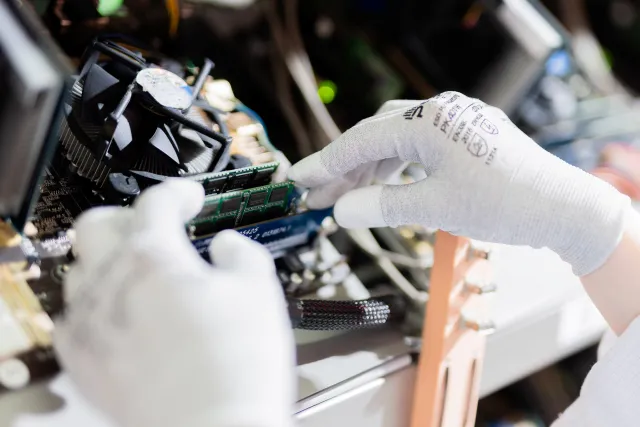
Thermal acceleration is the primary screen. Higher temperature increases charge leakage in memory cells, which drags data retention anomalies and marginal timing characteristics to the surface quickly. Modules are held under full load at 80°C, with temperature measured directly on the component surfaces, and depending on the procedure the dwell lasts between 30 and 180 minutes.
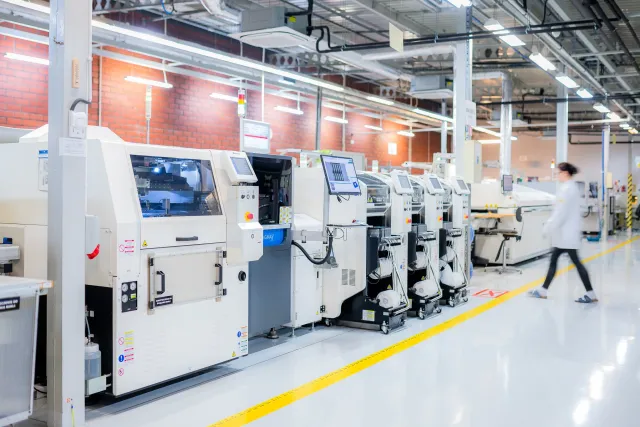
Coverage forms the second axis. Dedicated infrastructure of more than 400 computer platforms based on Intel and AMD architectures allows compatibility and functional verification against the memory controllers that actually exist in the field, across DRAM generations and including ECC and Registered DIMM configurations.
The workloads come from inside the house: Goodram's in-house R&D team writes low-level algorithms in assembly language, utilising SSE/MMX instructions, to generate complex read/write patterns with intensive random and sequential access. Results are then mapped from logical memory addresses down to physical silicon structures, letting engineers identify the specific DRAM die responsible for a failure — the kind of input root-cause analysis and manufacturing feedback requires.
SSD: Full Verification Without Spending the Endurance Budget
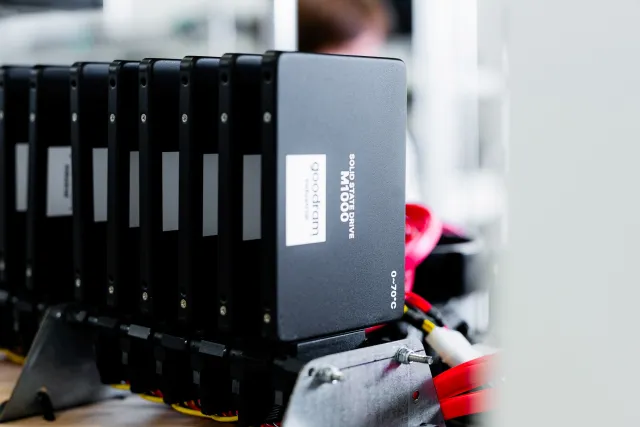
The storage line is deliberately built so validation does not consume Total Bytes Written (TBW) it cannot give back. After controller initialisation and firmware integrity verification, each drive runs two complete write-and-read cycles covering the entire Logical Block Addressing (LBA) space — for a 1 TB drive, approximately 2 TB of data written during validation.
Test stations operate a customized Linux environment that continuously monitors Self-Monitoring, Analysis and Reporting Technology (SMART) parameters and the accumulation of Developed Bad Blocks (DBB). Combined, full-address-space verification and real-time diagnostic detection pick up data transfer errors, communication protocol anomalies and potential stability issues on PCIe and SATA interfaces, while limiting unnecessary NAND flash wear during production testing.

The Two Recipes Side by Side
| Screening dimension | DRAM modules | SSDs |
|---|---|---|
| Stress applied | Full-load thermal burn-in at 80°C, measured on component surfaces | Two complete write-and-read cycles across the whole LBA space |
| Time or data budget | between 30 and 180 minutes by procedure | 1 TB drive ≈ approximately 2 TB written |
| Test infrastructure | more than 400 computer platforms on Intel and AMD architectures | Customized Linux stations tracking SMART and Developed Bad Blocks |
| Defect class targeted | Charge leakage, data retention anomalies, marginal timing | Transfer errors, protocol anomalies, PCIe/SATA stability |
| Engineering output | Logical-to-physical mapping identifies the failing DRAM die | Marginal drives flagged without excessive NAND cell wear |
Environmental Qualification: The Spec Line Most Buyers Skip
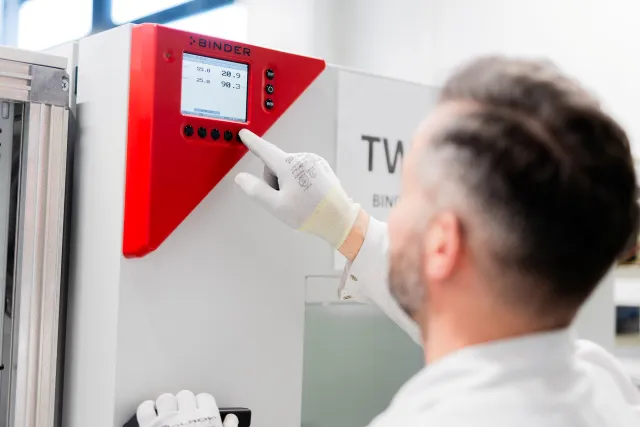
Production screening shows that a unit works; environmental validation shows that the assembly survives. That second job is done with a Binder MKTF 240 climatic chamber offering a range from −70°C to +180°C with humidity control, assessing the resistance of solder joints, printed circuit boards (PCBs) and electronic components to temperature cycling and humidity exposure. Procedures reference established standards, including the IEC 60068 series — such as IEC 60068-2-14 and IEC 60068-2-30 — and MIL-STD-810.
For embedded system manufacturers, the capability that tends to matter most operationally is validation performed directly on customer-supplied hardware platforms. Compatibility and stability are then judged under conditions that more closely reflect the intended application rather than a generic test carrier.
BOM Freeze and Firmware Tuning: Designing for Batch-to-Batch Identity
For industrial system designers, long-term component consistency ranks alongside operational reliability. Goodram Industrial Solutions addresses the requirement with a fixed Bill of Materials (BOM freeze), holding component consistency across production batches.
Application-specific firmware optimisation is the second lever. SSD firmware parameters can be adjusted so that lower write latency takes priority over maximum sequential throughput when the target system rewards responsiveness rather than bulk transfer rate.
What Vertical Integration Inside the European Union Delivers in 2026
With electronica 2026 approaching in Munich, supply chain resilience and European technological sovereignty have moved up the agenda for industrial electronics manufacturers, and the 2026 edition is where that shift will be visible.
Goodram houses R&D, testing laboratories and manufacturing operations within a single facility in Łaziska Górne, Poland — the arrangement that makes it possible to adapt memory and storage parameters to specific OEM application requirements. The same integration lets engineering, quality assurance and production teams communicate directly, accelerating technical issue resolution and supporting consistent manufacturing processes.
For European OEMs and industrial system integrators, access to local engineering expertise, controlled component configurations and production capability inside the European Union reduces the complexity and risk that geographically dispersed supply chains carry. Combining in-house engineering, production-level testing, environmental qualification and long-term component consistency is also a demonstration of what European memory manufacturing contributes to more predictable industrial computing.
Action Recommendations for Specifiers, Buyers and Reliability Leads
- Audit suppliers on screening method, not only on screening result: confirm which test maps to which failure mechanism, and that DRAM and SSD are handled separately.
- Ask for burn-in evidence in numbers — full-load temperature, where temperature is measured, and dwell time — rather than a generic reliability claim.
- For flash, verify that validation limits endurance spending: full-address-space coverage with SMART and DBB monitoring instead of repeated write soak.
- Require environmental data tied to recognised references: the IEC 60068 series, including IEC 60068-2-14 and IEC 60068-2-30, plus MIL-STD-810.
- Qualify the memory on your own hardware platform before production release, not only on vendor test boards.
- Write BOM stability into the purchase agreement for long-lifecycle designs, and state the firmware priority you need — latency or sequential throughput.
- Put manufacturing location and engineering access into the TCO model alongside unit price.
Company Snapshot
Goodram S.A., a Polish company, owns the Goodram brand and is the only manufacturer of DRAM memory modules and SSDs in the European Union. Based in Łaziska Górne since its founding in 1991, it designs and manufactures memory and storage solutions for over 40 markets worldwide, maintaining its own production facilities, R&D capabilities and advanced testing laboratories — making it a vital link in the European semiconductor value chain and a contributor to technological sovereignty and supply chain resilience. The Goodram Industrial and Goodram Enterprise portfolios serve industrial, embedded, server, data center and AI applications.
The company takes part in the European technology ecosystem and supports cooperation between industry, research institutions and technology partners as a member of the Polish Technology Platform for Photonics (PPTF) and the Polish Chamber of Commerce for Electronics and Telecommunications (KIGEiT).
FAQ: Reading the Validation Program as a Buyer
- Why not simply test every product longer? Because blanket extension of test time is economically inefficient, and for flash it consumes NAND cell life before shipment — hence separate DRAM and SSD methodologies.
- What does 80°C actually reveal in DRAM? It accelerates charge leakage in memory cells, exposing data retention anomalies and marginal timing characteristics that room-temperature checks miss.
- How much wear does SSD validation add? Two complete write-and-read cycles across the entire LBA space — on a 1 TB drive, approximately 2 TB written.
- Which standards back the environmental work? The IEC 60068 series, including IEC 60068-2-14 and IEC 60068-2-30, together with MIL-STD-810, executed in a Binder MKTF 240 chamber covering −70°C to +180°C.
- What keeps a design intact over several production years? A fixed BOM from Goodram Industrial Solutions, batch-to-batch component consistency, and the option to validate on the integrator's own hardware.
Closing Note: The 2026 Munich Checkpoint
On this model, reliability is not a certificate collected at the end of the process; it is the sum of the physics a manufacturer chooses to stress and the changes it agrees not to make. Goodram Industrial will be present at electronica 2026 in Munich — a practical opportunity for integrators to bring their own boards and their own workload questions to a facility already built around answering them.