
Worst Smartphone Third Quarter Since 2013: Memory Costs and Channel Restraint Redefine Global Shipment Management
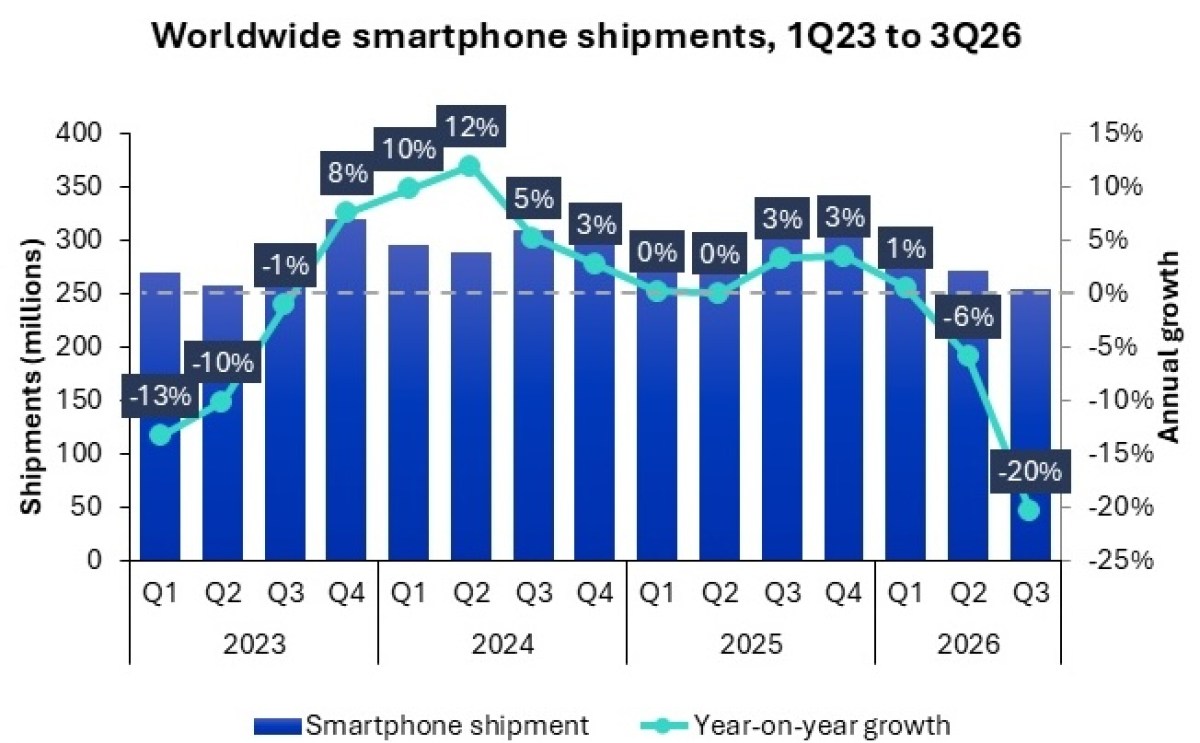
The third quarter has become a structural stress test for the smartphone supply chain. Citing Omdia data published on October 29, 2026, global smartphone shipments were 254.7 million units in the third quarter, down 20% year on year versus the same period last year. That result made the quarter the worst third quarter for the global smartphone market since 2013. The decline was not driven only by softer consumer purchase intent; it also reflected phone makers choosing to tighten shipments as component costs and channel economics moved against them.
Cost pressure moves from bill of materials to channel behavior
The first pressure point is memory. With DRAM and NAND flash prices continuing to rise, phone manufacturers face higher core component costs that cannot easily be engineered out of a smartphone. The impact is concentrated in entry-level and midrange devices, where margins are already thin. Faced with this cost curve, makers have three practical levers: raise retail prices, adjust memory or storage configurations, or ship fewer units to protect profitability.
The second pressure point sits downstream. Higher procurement costs for new phones mean retailers and distributors have more working capital tied up in inventory. That has made many channel partners more cautious than in prior years about building large stocks ahead of the year-end shopping season. As a result, sell-in volumes to channel have been pulled down further, reinforcing the shipment decline in the third quarter.
Case lens: what vendor performance reveals
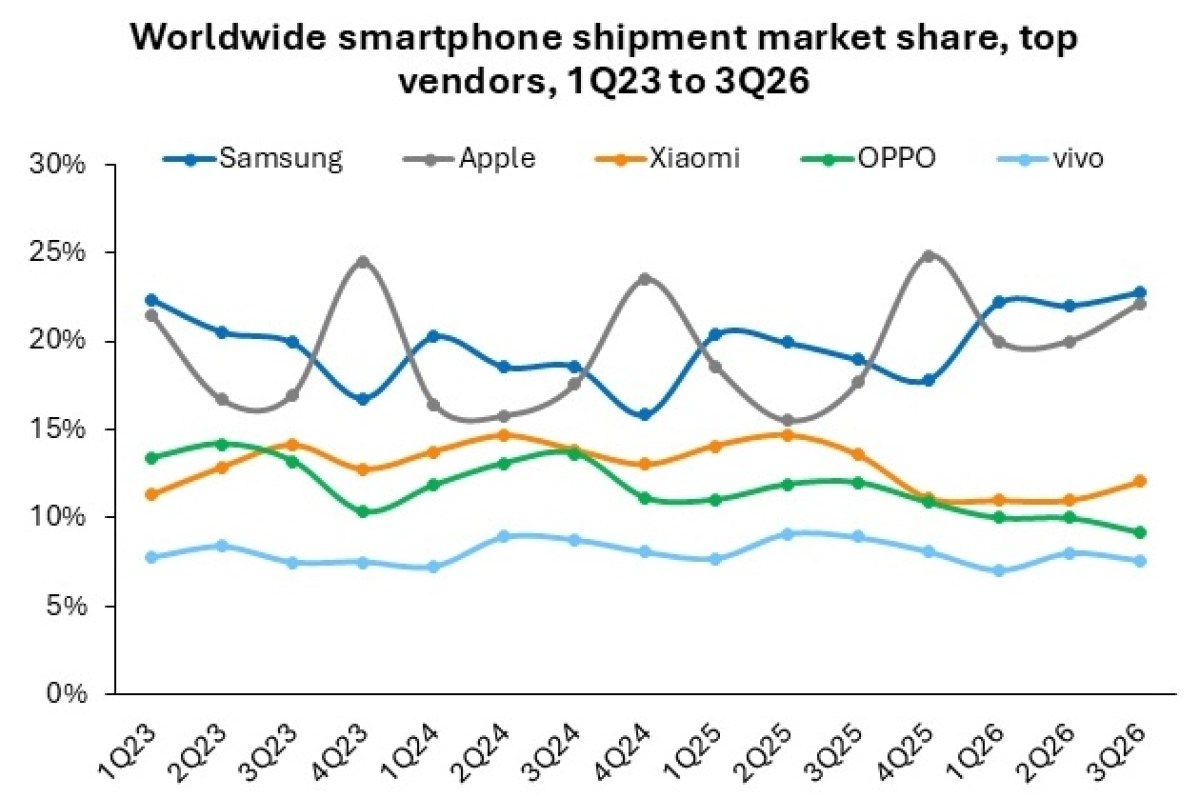
Samsung remained the global No. 1 in the third quarter with shipments of 57.8 million units, down 5% year on year, and a market share that reached 23%. Its relative steadiness rested on Galaxy A series strength in entry-level and midrange demand, plus a broad global supply chain and sales channel network. The Galaxy Z8 series, launched in August, also helped defend Samsung's premium position, supported by promotions such as trade-in and device-upgrade offers.
Apple was No. 2 with 56.5 million units shipped, roughly flat versus the same period last year, with market share reaching 22%. Against an overall decline of 20% for the global smartphone market, Apple was among the few major vendors able to keep shipment scale stable. The company benefited from relatively steady demand in China and North America and continued sales momentum for the iPhone 17 series. In September, Apple introduced iPhone 18 Pro, iPhone 18 Pro Max and its first foldable model, iPhone Duo, while delaying the standard iPhone 18 to 2027. That timing has extended the iPhone 17 sales cycle and concentrated new-product marketing on higher-end devices.
Xiaomi stayed in third place, but shipments fell to 30.7 million units, a sharp year-on-year decline of 29%. Within that result, China shipments dropped 20% and India shipments dropped 28%. With memory and storage chip costs rising, Xiaomi adjusted pricing across markets and gave greater weight to profit margin rather than shipment scale alone. Redmi A7 Pro and Redmi 17 provided some support, but they did not fully offset weak overall demand. In price-sensitive markets, higher handset prices directly reduced consumers' ability to buy.
OPPO Group came fourth, shipping 23.4 million units and falling 39% year on year; its statistical scope includes realme and OnePlus. vivo took fifth place with 19.3 million units, down 33% year on year. OPPO and vivo raised prices on some products in major markets as memory costs climbed. The cost squeeze was especially visible for vendors with significant mid-to-low-end volume: buyers in those segments are more price-sensitive, and the products themselves carry less margin cushion.
Regional divergence: Africa absorbs the strongest shock
Emerging markets experienced the sharpest contraction. Africa smartphone shipments in the third quarter fell 39% year on year, making the region one of the worst performers globally. Outside Greater China, Asia-Pacific markets, the Middle East and Latin America also recorded shipment declines exceeding 20%.
The local constraints were macro as well as commercial. Currency depreciation, inflation and higher living costs reduced purchasing power. More users chose to keep existing phones longer or move to refurbished devices. In some lower-income markets, consumers stopped buying smartphones altogether and switched back to lower-priced traditional feature phones.
North America looked more resilient. The market has a higher mix of premium phone purchases, and carrier installment plans, trade-in offers and device-upgrade programs softened the immediate impact of higher prices on end users.
Common misconceptions
- The decline is only a demand problem. The data shows a dual squeeze: weaker buying willingness and more conservative shipment behavior by manufacturers and channel partners.
- Memory price increases stay inside the phone bill of materials. High-bandwidth memory demand is taking capacity from memory makers, affecting traditional DRAM and pushing phone makers into a more competitive component market.
- Higher prices are enough to restore margins. In entry-level and price-sensitive markets, price increases can further weaken purchasing power, which is why model reduction, configuration changes, mix shift and operating discipline also matter.
Outlook: 2026 contraction, a slower 2027 decline, and a new competitive test
Omdia expects global smartphone shipments for full year 2026 to decline 12% year on year. The fourth quarter remains under pressure because storage chip prices are still rising and promotional discount space during the year-end shopping season is constrained. For 2027, the global smartphone market is expected to shrink further, although the decline may slow compared with 2026.
The 2027 view is closely tied to memory capacity allocation. Demand for HBM continues to absorb manufacturing capacity at memory makers, which also affects traditional DRAM supply. As memory suppliers prioritize AI data center and server demand, smartphone manufacturers are unlikely to regain a comfortable cost buffer in the short term.
Strategically, the market is moving from volume-first execution to resilience-first execution. Omdia's assessment suggests future competition will not be decided simply by shipment scale. Companies with stronger balance sheets, lean inventory and efficient operations are better placed to absorb rising component costs. Vendors may also look to software services, after-sales services and other value-added businesses for additional revenue.
The competitive shape of the industry is also changing. Samsung and Apple, supported by premium product positioning, supply-chain scale and a relatively stable user base, now hold a combined market share that has reached 45%. Xiaomi, OPPO and vivo, which rely more heavily on mass-market sales, are facing both higher component costs and weaker consumer purchasing power.
Action recommendations
- For manufacturers: continue reducing low-margin models where volume does not create profit contribution; recalibrate memory and storage configurations; keep selective products competitive by absorbing some cost pressure where needed; shift the portfolio toward midrange and premium devices so a higher average selling price can offset lower volume.
- For smaller brands: treat supply-chain bargaining power and inventory discipline as survival variables. The analysis indicates that limited capital and compressed margins make the mid-to-premium transition especially difficult.
- For channel and retail teams: watch inventory financing closely. When unit procurement costs rise and year-end discounts are limited, cautious stocking may reduce channel pushback but also caps shipment recovery.
- For sourcing and planning teams: build explicit scenarios around DRAM and NAND price trajectories, and track how HBM demand competes with traditional DRAM supply. The smartphone cost curve is being shaped by demand well beyond consumer handsets.
FAQ
- Why was the third quarter the weakest since 2013?
- Because 254.7 million units was the third-quarter shipment volume, down 20% year on year, with higher memory costs, cautious channels and manufacturer shipment control all weighing on the result.
- Which vendors held up best?
- Samsung stayed the global No. 1 with 57.8 million units, down 5% year on year and 23% market share; Apple was No. 2 with 56.5 million units, roughly flat versus the same period last year and 22% market share.
- Which markets fell hardest?
- Africa declined 39% year on year; Asia-Pacific excluding Greater China, the Middle East and Latin America saw declines exceeding 20%. North America stayed comparatively stable.
- What comes next?
- Omdia projects a 12% decline for global smartphone shipments in 2026, continued pressure in Q4, and a 2027 contraction that may be slower than 2026.
For consumers, smartphone price increases, configuration adjustments in entry-level products and longer replacement cycles may become a new normal. For the broader industry, the contest for memory capacity driven by AI infrastructure is being transmitted through the supply chain, with effects far beyond data centers.