
Industrial Readout: Why the Apollo Evo Titanium Exhaust Signals a Practical Low-Volume AM Path
For plant managers and product engineers, additive manufacturing becomes compelling when it can carry a difficult geometry through a small production series without collapsing into an endless prototype loop. The Apollo Evo exhaust package from Farsoon Europe GmbH and Apollo Automobil GmbH is useful for that reason. The titanium exhaust pipes and exhaust tips were manufactured with an FS811M-6 platform and built for 10 Apollo Evo vehicles. The material used was TA15, also described as Ti-6.5Al-2Zr-Mo-V. Those anchors frame the program as a bounded, evidence-based low-volume production case, not a generic technology showcase.
Case Overview: Hypercar Engineering Meets Production AM
The program split responsibility in a familiar industrial pattern. Apollo supplied vehicle engineering and design knowledge, while Farsoon brought additive manufacturing, Design for Additive Manufacturing (DfAM), and industrial production capability. That split allowed both teams to treat manufacturability as part of the initial component concept.
The design process did not wait until after the exhaust geometry was frozen. DfAM was applied from the beginning to bring together function, manufacturability, and component design. This enabled the teams to consolidate multiple parts into one integrated titanium component. The benefit was operational: fewer assembly steps and fewer downstream manufacturing operations.
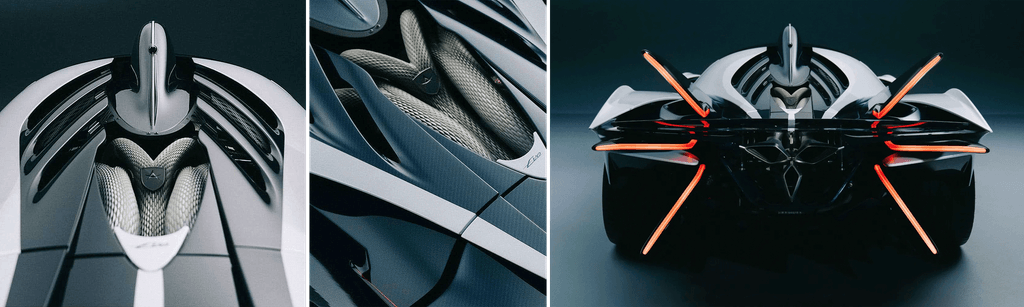
Public Validation: Caribbean Dragon at Goodwood
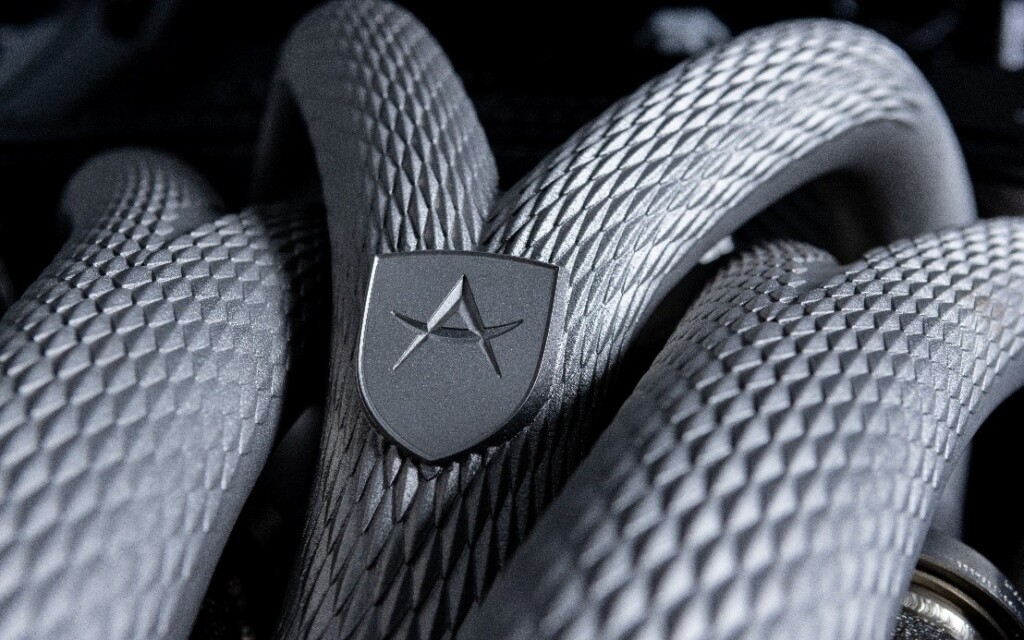
At the 2026 Goodwood Festival of Speed, the first customer vehicle was revealed. The Apollo Evo “Caribbean Dragon” features exhaust pipes with a Dragon Skin surface texture developed by Apollo and Farsoon for additive manufacturing. The texture is generated inside the build process instead of being added as a separate finishing operation. Apollo reports that this surface also assists heat distribution.
The exhaust tips received a different finish route. Application-specific Farsoon process parameters were used during the build, and machined details were later added to obtain a chrome-like surface.
Data Anchors That Keep the Story Auditable
For readers who need to separate verified project details from broad AM marketing, the most useful facts are the ones that can be tracked to a platform, alloy, quantity, technique, and public event.
- FS811M-6 identifies the laser powder bed fusion system used for the titanium exhaust pipes and exhaust tips.
- TA15 identifies the titanium alloy selected for the program; its chemical designation is Ti-6.5Al-2Zr-Mo-V.
- 10 identifies the number of Apollo Evo vehicles equipped with the exhaust system.
- Beam Shaping identifies the process approach used for the enclosed exhaust geometry.
- Goodwood Festival of Speed and 2026 identify the public context in which the Caribbean Dragon was shown.
This structure is important for industrial evaluation: it ties a physical part family to a specific machine, material, process technique, build count, and reveal milestone.
Process Logic: Why the Build Method Changed the Part Definition
The exhaust components were produced on an FS811M-6 using TA15 titanium alloy, with an increased layer thickness to support production of the parts. For the closed exhaust shape, Beam Shaping was employed so the pipes could be formed as single components. Internal support structures were avoided, and post-processing workload was reduced. The program also removed the need to weld together multiple separately manufactured sections.
For manufacturing teams, that is more than a printing story. It shows how a controlled process change can convert a part family from an assembly problem into a consolidated build problem. In this case, the consolidation began in design, then was validated through staged prototyping and machining trials.
Staged Risk Management Instead of a Big-Bang Production Push
The technical development path was divided into multiple stages. That staging let the program manage risk while comparing design options. The teams could also evaluate support-free concepts in parallel and create samples for milling tests and surface treatments. Those trials informed the development process before the final low-volume package was produced.
The project was not handled as a simple equipment purchase. Farsoon supplied application engineering and manufacturing expertise throughout product development, while Apollo supplied vehicle development requirements. The two contributions were combined to create a production-oriented exhaust package.
Common Misconceptions About Low-Volume AM
| Misconception | What the Apollo Evo case suggests |
|---|---|
| Additive manufacturing is only for one-off prototypes. | The same process produced exhaust parts for 10 Apollo Evo vehicles, demonstrating a repeatable low-volume production path. |
| Complex parts always require supports and extensive post-processing. | Beam Shaping helped create single enclosed components without internal support structures, reducing post-processing. |
| A decorative surface must be added after printing in a separate finishing step. | Dragon Skin texture was developed by Apollo and Farsoon for additive manufacturing and created during the build process. |
| Buying a printer is enough. | Farsoon contributed application engineering and manufacturing expertise throughout product development, not only equipment. |
Action Recommendations for Industrial Teams
For organizations considering a limited-run AM program, the Apollo example suggests a sequence that can be applied without adding unsupported claims to an internal business case.
- Put DfAM into the earliest design gate, before the part boundary is frozen, so consolidation targets can be tested while there is still time to change the concept.
- Make the machine, alloy, process technique, and quantity explicit in the project record. In this case, FS811M-6, TA15, Beam Shaping, and 10 vehicles form the auditable spine of the program.
- Stage the development path. Multiple stages allowed support-free designs, milling tests, and surface treatment options to be evaluated before the final low-volume package was produced.
- Look beyond the equipment purchase. The program paired vehicle requirements from Apollo with application engineering and manufacturing expertise from Farsoon.
- Separate build-generated features from machined features. Dragon Skin was produced during the additive process, while the exhaust tips needed machining to achieve a chrome-like finish.
Frequently Asked Questions
What part family was produced for the Apollo Evo?
The part family was the titanium exhaust pipe and exhaust tip package. It was developed and produced through a collaboration between Farsoon Europe GmbH and Apollo Automobil GmbH.
Which platform and material are documented?
The components were produced on an FS811M-6 system using TA15 titanium alloy. The alloy is also identified by its designation Ti-6.5Al-2Zr-Mo-V.
How many vehicles received the exhaust system?
The source description states that 10 Apollo Evo vehicles received the system. That count places the program in a low-volume production category rather than mass production.
What was shown at Goodwood?
At the 2026 Goodwood Festival of Speed, the first customer vehicle was revealed as the Apollo Evo Caribbean Dragon. Its exhaust pipes included the Dragon Skin surface texture developed for additive manufacturing.
Why did Beam Shaping matter?
Beam Shaping was used for the enclosed exhaust geometry. The result was that pipes could be made as single components without internal support structures, reducing post-processing and avoiding welded joints between separately manufactured sections.