
Rocket Propulsion Development and the Industrial Additive Manufacturing Turn: What the EOS–BIZU Space Effort Teaches Operations Teams
Industrial space hardware rarely moves forward because one machine or supplier is introduced into a program. Progress tends to appear when engineering competence, design discipline, and physical verification are linked. That linkage is visible in the cooperation involving EOS and BIZU Space, where additive manufacturing expertise is being connected to propulsion work intended for future space systems.
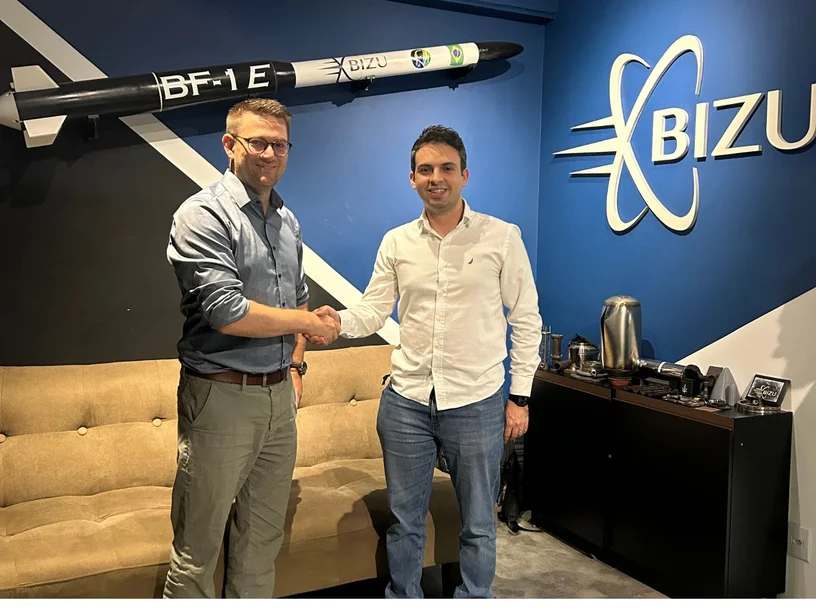 The accompanying image shows Michael Wohlfart (team manager business development & academy, EOS) and Raphael Galate (co-founder of BIZU Space) from left to right as they mark the partnership.
Case in Focus: A Brazilian Startup, a Propulsion Program, and Additive Manufacturing Readiness
BIZU Space operates inside Brazil’s commercial space environment. The company is associated with the country’s first privately developed, fully Brazilian orbital launch vehicle program, a program aimed at independent access to space for small satellite missions. That setting creates a specific engineering problem: propulsion systems must be produced with enough repeatability, performance confidence, and schedule discipline to support a national launch capability.
Within that broader work, the startup is considering industrial metal 3D printing for difficult engine hardware. The named examples are combustion chambers and closed-cycle turbopump systems. Both categories represent high-value components where geometry, material behavior, and verification can shape manufacturing cost and development time.
The cooperation adds training and expert engagement. BIZU Space engineers are to receive Design for Additive Manufacturing (DfAM) instruction through Additive Minds Academy, while engineering support comes from EOS Additive Minds specialists. A related public image records the BIZU Space propulsion system during a hot-fire test in October 2026. For readers in production, engineering, or program management, those details are useful because they bind learning, part selection, and testing into one visible path.
Data Citation: The Facts That Ground the Story
| Fact item | What is stated in the available description | Industrial relevance |
|---|---|---|
| Participating organizations | EOS and BIZU Space | Links additive manufacturing capability with space propulsion development. |
| Company context | BIZU Space is a Brazilian aerospace startup | Shows an emerging national space program relying on advanced production techniques. |
| Named representatives | Michael Wohlfart (team manager business development & academy, EOS) and Raphael Galate (co-founder of BIZU Space) | Connects the partnership to both academy-side expertise and startup-side engineering ownership. |
| Capability route | DfAM training through Additive Minds Academy and support from EOS Additive Minds experts | Emphasizes that education and engineering consultation are part of implementation. |
| Hardware focus | Combustion chambers and closed-cycle turbopump systems | Targets components where production complexity can be decisive. |
| Verification milestone | Propulsion system shown during a hot-fire test in October 2026 | Signals that development is moving beyond design and toward physical demonstration. |
| Program objective | Support independent access to space for small satellite missions through Brazil’s first privately developed, fully Brazilian orbital launch vehicle program | Places manufacturing choices inside a larger strategic industrial context. |
No quantitative performance numbers are included in the short program description used here. That is worth stating because industrial readers should separate named technology direction from validated results.
Why Training and Engineering Support Carry Weight
Additive manufacturing becomes consequential when a team can redesign parts around layer-by-layer production rather than trying to force traditional designs into a new process. The DfAM training described in the collaboration targets that shift. It supports engineers in anticipating how geometry, support structures, orientation, material usage, and post-processing interact with component requirements.
Engineering support from EOS Additive Minds experts adds another layer. A startup propulsion team may know mission needs and fluid dynamics, but a metal process partner can help translate component intent into manufacturable build strategies. The combination of academy training and specialist support is less about a single purchase and more about building repeatable decision-making.
For manufacturing leaders, the practical signal is clear: capability building should be planned as a program element. If engineers learn additive design methods only after parts have been released, rework can consume schedule and budget. If training and consultation are integrated early, part selection and qualification planning can become more coherent.
Implementation Path Suggested by the Program Logic
- Start with the hardware that matters. Combustion chambers and closed-cycle turbopump systems are not decorative prototypes; they are demanding propulsion parts. A sensible additive program begins by identifying which components carry manufacturing complexity, reliability risk, or integration burden.
- Equip the team before scaling the workflow. The Additive Minds Academy training indicates that people capability is treated as part of the technical path. For internal teams, that means embedding DfAM into concept review, drawing release, and procurement criteria.
- Use expert consultation to avoid premature lock-in. EOS Additive Minds support can help examine process selection, build direction, material suitability, and quality gates before a design becomes too fixed.
- Plan verification early. The October 2026 hot-fire test milestone, as presented in the image description, suggests that demonstration events are part of the public record. In industrial programs, test planning should be aligned with component criticality, not left to the end of a development cycle.
- Document lessons as reusable assets. Training, consultation, and testing create knowledge that can be converted into design rules, inspection criteria, and supplier communication templates. This is where one project can support multiple future space systems.
Common Misconceptions to Avoid
- Misconception: Access to industrial metal 3D printing automatically makes rocket engines easier to build. Reality: The described partnership highlights DfAM training and specialist support, which means the challenge is design method, engineering judgment, and verification, not simply ownership of a machine.
- Misconception: A hot-fire test image proves full program maturity. Reality: It records one visible milestone in October 2026. Industrial readers still need qualification data, production repeatability, and integration evidence before making procurement or program conclusions.
- Misconception: The collaboration is only about one company’s equipment. Reality: The stated focus includes Additive Minds Academy instruction and EOS Additive Minds expertise, pointing to a knowledge-transfer relationship rather than a narrow vendor transaction.
- Misconception: National space ambition is unrelated to factory floor practice. Reality: Brazil’s first privately developed, fully Brazilian orbital launch vehicle program depends on parts and processes, so production readiness directly affects access to space for small satellite missions.
- Misconception: Complex components such as combustion chambers and closed-cycle turbopump systems should be treated the same in additive work. Reality: Their geometry, thermal environment, fluid path, and quality requirements may demand different design rules and validation depth.
Action Recommendations for Industrial Decision Makers
Managers evaluating additive manufacturing for high-performance hardware should treat the EOS and BIZU Space story as a template for readiness, not just as a news item. The following checklist can help apply the logic to other engineering programs.
- Map critical components by function, failure consequence, and manufacturing complexity before choosing an additive process.
- Require DfAM literacy in product development teams, not only in the rapid prototyping department.
- Build education and consulting into the project schedule as deliverables, with named owners and review points.
- Define verification gates early, including hot-fire style testing where relevant, so that demonstration results support design decisions.
- Track how training and expert support are converted into internal standards, reusable design guidelines, and clearer supplier requirements.
- Separate announced technical direction from proven production outcomes until performance, repeatability, and quality data are available.
FAQ
What is the EOS and BIZU Space collaboration about?
The collaboration centers on additive manufacturing development for future space applications. The available description says BIZU Space engineers will receive DfAM training through Additive Minds Academy and engineering support from EOS Additive Minds experts, with propulsion hardware such as combustion chambers and closed-cycle turbopump systems in view.
Why is BIZU Space’s program relevant outside Brazil?
It is relevant because it illustrates a common industrial pattern: a space startup is using advanced production methods to pursue launch capability, independent access to space, and small satellite mission support. The manufacturing lessons around training, expert support, and verification apply to many high-complexity sectors.
What role does Additive Minds Academy play?
Additive Minds Academy is presented as the training route through which BIZU Space engineers access Design for Additive Manufacturing (DfAM) instruction. In practical terms, it points to capability development for engineers designing metal parts intended for additive production.
What does the October 2026 hot-fire test indicate?
The image caption states that the BIZU Space propulsion system is shown during a hot-fire test in October 2026. It indicates a demonstration milestone in propulsion development, though it does not provide detailed performance metrics.
What should procurement and engineering managers not assume?
They should not assume that additive manufacturing removes the need for rigorous design review, qualification, or supplier capability assessment. The partnership’s emphasis on DfAM training and expert support suggests the opposite: these activities remain central.
Final Reading
The EOS and BIZU Space cooperation is most useful to industrial readers as a readiness story. It connects Brazilian propulsion development, metal additive manufacturing, academy-based training, specialist support, and a public test milestone within one program narrative. The practical conclusion is not simply that rocket engine parts can be printed; it is that high-stakes hardware programs move faster when the design method, engineering education, and verification discipline are managed together.